This checklist is for drivers who want to handle a few routine car-care tasks at home and choose tools with a clear purpose. Start with the work you expect to do, then check that each tool fits your vehicle, your workspace, and your comfort level. Vehicle compatibility matters as much as the tool itself.

Get business pricing on garage and car supplies
- Business-only prices and quantity discounts
- Tax-exempt purchasing
- Multiple users, one account, clear invoices
The sections follow common maintenance jobs: removing an oil filter, reading diagnostic information, lifting a vehicle, supporting it safely, inflating tires, and charging a battery. Each slot explains what to consider before buying and names a pick where one was provided. Jack stands are covered as advice only, with no product pick.
Use the checklist before you shop: confirm your vehicle’s requirements in its manual, compare them with the tool’s stated capabilities, and gather any accessories the job calls for. If a task feels unfamiliar, pause and get qualified guidance before proceeding. Fit and safe setup should guide every choice.
Oil Filter Wrench
An oil filter wrench can make filter removal more manageable, but the right fit depends on the filter on your vehicle. Before choosing a kit, identify the filter style and dimensions in your owner’s manual or service information. A wrench that does not engage securely may slip or damage the filter, so avoid assuming that one size will work across every vehicle. Match the filter first, then confirm the wrench’s fit.
A common buying mistake is focusing on the number of pieces without checking what those pieces cover. Look for a clear size range, a compatible drive connection, and enough room to turn the tool in the engine bay. A stand may help keep pieces organized, but it does not solve access or clearance issues. Consider whether the kit suits your usual maintenance tasks and whether you already own the ratchet or handle it needs. Check access and drive fit before committing.
The listed pick is the CTA Tools 4326 6-Piece Oil Filter Wrench Kit with Stand. Compare its stated sizes with your specific filter and check the product details for the included components. If you maintain more than one vehicle, verify fit for each rather than treating a multi-piece set as universal. Confirm each vehicle separately.
What to look for:
- A size range that matches your oil filter
- A drive connection compatible with your handle
- Clear descriptions of included wrench pieces
- Enough clearance for the tool in your engine bay
- Fit information for each vehicle you maintain
CTA Tools 4326 6-Piece Oil Filter Wrench Kit with Stand

This six-piece oil filter wrench kit includes heavy-duty swivel-type wrenches covering sizes from 57 to 146 mm. Its stand has a magnetic base for secure placement on metal surfaces around the shop.
Pros:
- Six wrench sizes cover a broad range of oil filters
- Magnetic stand helps keep the set secure on metal surfaces
- Heavy-duty swivel-type wrench design
Cons:
- Designed for metric sizes, which may not fit all filters
Best for: DIYers whose filters match the kit’s stated sizes
Not ideal for: Drivers who have not checked filter fit or access
Bottom line: Choose the CTA Tools kit only after confirming its wrench sizes and drive connection suit your vehicle.
OBD2 Scanner
A diagnostic scanner helps you access vehicle information through its diagnostic connection, but scanner compatibility varies by vehicle and system. Before buying, check the vehicle’s year, make, model, and the functions you want to use against the product’s stated coverage. Do not assume that a scanner described as full-system will support every function on every vehicle. Verify coverage by vehicle and by the task you have in mind.
The listed pick is the ANCEL MT700 Motorcycle Diagnostic Scanner, Multi-Brand Full-System Too. Its name identifies it as a motorcycle scanner, so confirm that your intended vehicle is a motorcycle and that the product supports its make and model. A common mistake is choosing a diagnostic tool based on a broad description while overlooking vehicle type, supported systems, or required features. Check the product details for those specifics before purchase. Vehicle type is essential.
Think about how you will use the information the scanner provides. If you want to investigate a particular warning or system, confirm that the scanner covers that system for your vehicle. Also check connection requirements and any stated setup steps. A scanner can report diagnostic information, but compatibility and interpretation shape how useful that information is. Match features to your task rather than relying on a general label.
What to look for:
- Support for your vehicle’s year, make, and model
- Compatibility with the vehicle type you intend to scan
- Coverage for the systems and functions you need
- Clear connection and setup requirements
- Product details that explain any feature limitations
ANCEL MT700 Motorcycle Diagnostic Scanner, Multi-Brand Full-System Tool

The ANCEL MT700 is a comprehensive motorcycle diagnostic scanner compatible with over 16 brands, offering full-system diagnostics, live data monitoring, and advanced service functions. It helps riders and mechanics quickly identify issues, reset systems, and perform maintenance without dealer visits.
Pros:
- Supports multiple motorcycle brands with full-system diagnostics
- Includes advanced service functions like oil reset and ECU reset
- Easy to use with step-by-step instructions suitable for beginners
- Real-time live data monitoring for better performance analysis
Cons:
- Reset functions may vary depending on the motorcycle model
- Requires some familiarity with diagnostic tools for optimal use
Best for: Motorcycle owners who confirm model compatibility
Not ideal for: Car owners seeking a scanner without verified car support
Bottom line: Check the ANCEL MT700’s stated motorcycle and system coverage against your exact vehicle before buying.
Hydraulic Floor Jack
A floor jack lifts a vehicle for a job, so its fit with your vehicle and workspace deserves careful attention. The listed pick is the Big RED 4 Ton Low Profile Hydraulic Service Floor Jack with Dual Pisto. Check the jack’s stated lifting range against the vehicle’s ground clearance and the height you need for the planned task. The vehicle manual identifies the approved lifting points; use those rather than choosing a lift point by guesswork. Check lift range and lift points.
A common buying mistake is treating capacity as the only deciding factor. Capacity, minimum height, maximum lift, and the space available to position and operate the jack all matter. Confirm the product specifications and compare them with your vehicle and garage layout. A low-profile design may be relevant when clearance is limited, but verify the listed minimum height rather than inferring fit from the name. Read the specifications closely.
A jack lifts; jack stands support. Never work beneath a vehicle supported only by a jack. Choose stands with suitable capacity and height, place them at the vehicle’s approved support points, and follow their instructions. If you are unsure about placement or the surface, stop and consult vehicle-specific guidance. Use stands for support, and keep the work area stable and clear.
What to look for:
- Capacity suited to your vehicle and planned task
- A minimum height that clears your vehicle
- A maximum lift height that meets your needs
- Dimensions that fit your workspace
- Clear instructions and lifting-point guidance for the vehicle
Big RED 4 Ton Low Profile Hydraulic Service Floor Jack with Dual Piston Fast Lif

This heavy-duty floor jack features a 4-ton (8,800 lbs) capacity and a 4-20 inch lifting range, suitable for most vehicles. It is designed for professional and DIY use, offering safe, efficient lifting with a quick dual-pump system and durable steel construction.
Pros:
- High load capacity suitable for most vehicles
- Fast lifting with dual-piston system
- Durable heavy-gauge steel construction
- Easy to maneuver and store
Cons:
- Limited to vehicles within the 4-20 inch lifting range
- Requires assembly and space for storage
- Heavy weight may be difficult to lift manually
Best for: Owners whose clearance and lift needs match its specifications
Not ideal for: Anyone unable to verify lift points or stable placement
Bottom line: Confirm the Big RED jack’s capacity and lifting range fit your vehicle, and use properly placed jack stands for support.
Jack Stands
Jack stands support a raised vehicle while you work, making them a separate and essential part of a lifting setup. No product pick is listed for this section, so focus on choosing stands whose stated capacity and height suit your vehicle and task. Check the vehicle manual for approved support points, and follow both the vehicle and stand instructions. Choose for capacity and height.
A common mistake is relying on a floor jack alone or placing stands wherever they seem convenient. A jack is for lifting; stands are for supporting. Set the vehicle on a firm, level surface, use the designated support points, and make sure each stand is positioned and locked as instructed before beginning work. If the stand’s rating, setup, or placement is unclear, do not proceed. Follow the stated setup.
Check the stands as a pair for the job you intend to do, including their individual capacity markings and usable height range. Consider whether they can be positioned at the vehicle’s approved support points without interference. Keep the jack available as directed by the vehicle and stand instructions, but never treat it as a substitute for stands. Verify fit before lifting, and get experienced help if you have not used stands before.
What to look for:
- Capacity markings appropriate for the vehicle and task
- A height range that reaches the approved support points
- Clear instructions for locking and positioning
- Dimensions that fit the vehicle’s support locations
- A firm, level surface for setup
Digital Tire Inflator
A portable tire inflator is useful when its power source, connection, and operating instructions fit your needs. The listed pick is the DEWALT Tire Inflator Portable Air Compressor 20V MAX, Car Air Pump wit. Before buying, check what is included and what you may need separately, such as a compatible battery or charging equipment. The product name alone does not establish what comes in the package. Check included components.
For tire inflation, use the pressure recommended for your vehicle, found on the vehicle’s tire information label or in its manual. Do not use the maximum pressure printed on a tire as the target for routine inflation. A common mistake is relying on a gauge without checking its reading against the recommended setting or the inflator’s instructions. Confirm how the unit displays pressure, how its connection fits your tire valve, and whether its stated operation suits your use. Follow the vehicle’s pressure guidance.
Think about where you will store and use the inflator, how it is powered, and whether its hose and controls are practical for your tires. Check the product details for operating steps and any limits. Do not assume that portability means it is ready to use without the right power source or accessories. Confirm power and connection before relying on it for routine checks.
What to look for:
- Compatibility with the power source you plan to use
- Clear details about included battery and accessories
- A connection that fits your tire valves
- A readable pressure display and operating instructions
- A practical hose and control layout for your vehicle
DEWALT Tire Inflator Portable Air Compressor 20V MAX, Car Air Pump with Automati
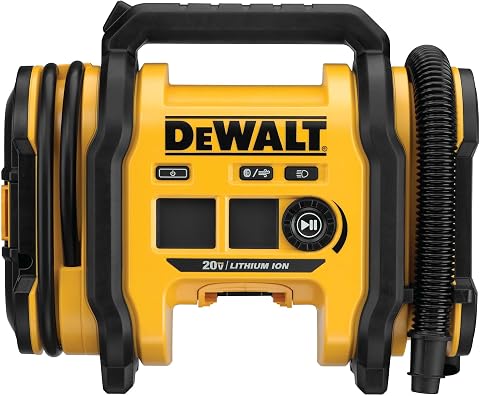
This DEWALT portable air compressor offers high-pressure and high-volume inflation modes, suitable for tires, mattresses, and inflatables. It features automatic shutoff, LED illumination, and versatile power options including battery, 12V DC, and 110V AC.
Pros:
- Multiple power options for versatile use
- Automatic shutoff prevents over-inflation
- LED light improves visibility in low light
Cons:
- Tool only, battery not included
- Heavy-duty rubber feet may not fully prevent movement
- Limited to DEWALT batteries
Best for: Drivers with a compatible power setup and matching needs
Not ideal for: Buyers who have not checked included power components
Bottom line: Confirm the DEWALT inflator’s included components and follow your vehicle’s recommended tire pressure.
Battery Charger
A battery charger needs to match the battery and electrical system you intend to service. The listed pick is the NOCO GENIUSPRO50 50A 6/12/24V Battery Charger & Maintainer. Check your vehicle and battery documentation for voltage, battery type, and charging requirements, then compare those details with the product’s stated compatibility. Do not infer support for a battery type from the charger’s name. Match charger to battery.
A common buying mistake is treating voltage as the only compatibility check. Battery chemistry, charging instructions, and the intended use—charging or maintaining—also matter. Review the product details for supported battery types and operating guidance, and confirm that the charger suits the battery in your vehicle. Check the setup requirements and connection instructions before use. Check battery type and procedure.
Consider where you will use the charger and how its cables and controls will reach the battery safely. Follow both the charger and battery instructions, and do not improvise connections or charging settings. If the battery label or documentation does not make compatibility clear, identify the battery before choosing a charger. Use stated charging guidance for the specific battery rather than relying on a general assumption.
What to look for:
- Compatibility with the battery’s stated voltage
- Support for the battery type you own
- Clear charging and maintenance instructions
- Cable reach and connection requirements for your setup
- Product details that identify supported applications
NOCO GENIUSPRO50 50A 6/12/24V Battery Charger & Maintainer

The NOCO GENIUSPRO50 is a professional-grade, multi-voltage battery charger capable of charging 6V, 12V, and 24V lead-acid and lithium batteries. It features advanced restoration modes, thermal regulation, and durable construction, making it suitable for a wide range of vehicles and applications.
Pros:
- Multi-voltage capability for various battery types
- Durable, flexible cables rated for extreme temperatures
- Advanced features like thermal regulation and deep-cycle repair modes
- Includes comprehensive accessories and a 3-year warranty
Cons:
- Complex setup may be overwhelming for casual users
- Higher price point suited for professionals
Best for: Owners whose battery type and voltage match its stated support
Not ideal for: Anyone unable to identify their battery’s charging requirements
Bottom line: Verify the NOCO charger’s battery-type and voltage compatibility before connecting it.
Build your checklist around the jobs you actually plan to do, then prioritize the safety and fit requirements for each one. Confirm vehicle-specific details first; choose the right supports for lifting work; then fill in task tools such as a filter wrench, scanner, inflator, or charger. Buy for verified fit and the work you expect to perform.
You do not need to tackle every maintenance task at once. Start with the tools that match your vehicle and experience, read the relevant instructions, and pause when a job falls outside your comfort level. A careful check before buying and before use can make home maintenance feel more straightforward. Take it one task at a time.
Halloween Picks
halloween
As an affiliate, we earn on qualifying purchases.