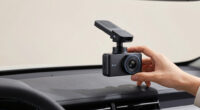
Windshield curvature affects how you should place your dash cam to avoid distortion and blind spots. You’ll want to position it level and centered, preferably behind the rearview mirror, to reduce glare and reflections. Angling the camera downward slightly compensates for the curved surface, ensuring your footage stays clear. Understanding your windshield’s shape is essential for ideal placement. Keep exploring to discover more tips on perfecting your dash cam setup for the best view.

Get business pricing on garage and car supplies
- Business-only prices and quantity discounts
- Tax-exempt purchasing
- Multiple users, one account, clear invoices
Key Takeaways
- Curved windshields cause distortion, requiring precise positioning to ensure clear footage.
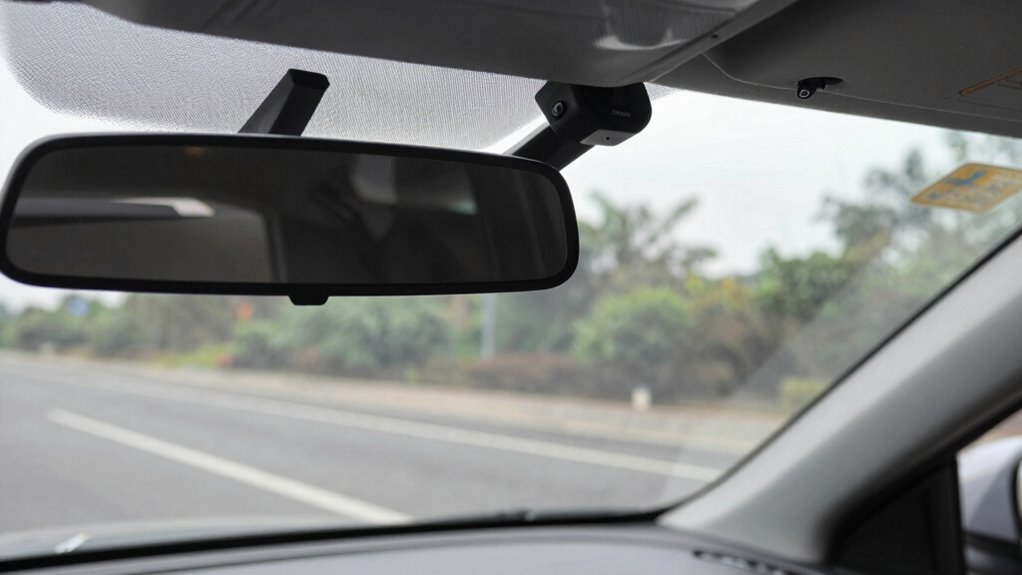
- Mounting the dash cam behind the rearview mirror minimizes glare and maintains a centered view.
- Adjusting the camera angle downward and inward compensates for curvature-induced distortion.
- Placement at the top center balances visibility and reduces reflections from sunlight or headlights.
- Understanding windshield shape helps prevent blind spots and improves overall coverage.
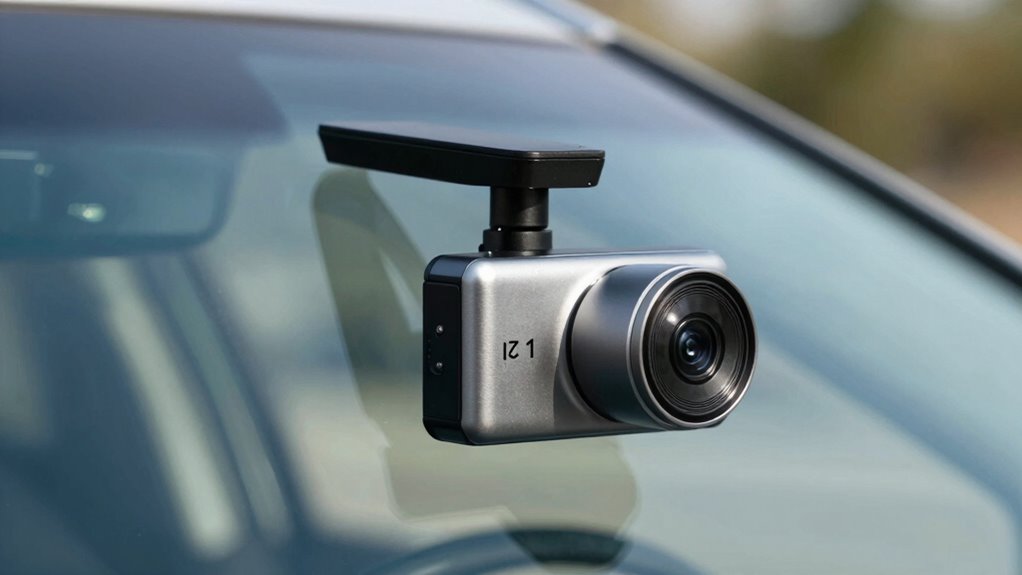
The curvature of your windshield plays a crucial role in how you should position your dash cam for maximum footage. Unlike flat windshields, curved ones can distort the camera’s view, making it essential to take into account how the glass’s shape influences placement. Your goal is to achieve proper sensor alignment, ensuring the dash cam captures a clear, undistorted image of the road ahead. When installing, you want the camera lens to be as level as possible, facing directly forward to avoid skewed footage caused by the windshield’s bend. This positioning helps the sensor align correctly with the road scene, minimizing distortions and ensuring your footage remains accurate in case of an incident. Additionally, understanding how the windshield’s shape affects the camera’s view allows for better adjustments to prevent blind spots and ensure comprehensive coverage.
Position your dash cam level and centered to minimize distortion caused by curved windshields.
Another critical factor influenced by windshield curvature is glare reduction. Curved windshields tend to reflect sunlight and headlights more than flat ones, which can create bright spots or glare that obscure your view. To combat this, you should angle your dash cam slightly downward and toward the center of your windshield, reducing exposure to direct reflections. Adjusting the angle helps prevent glare from washing out the camera’s sensor, maintaining clarity in your recordings. Using a dash cam with a good anti-glare or polarizing filter can further improve footage quality by blocking reflected light, especially during sunrise or sunset. Being aware of reflection issues can help you fine-tune your setup to achieve the best possible footage.
In terms of placement, you’ll find that the top center of the windshield often provides the best compromise between visibility and glare reduction. Position the camera behind the rearview mirror, where it’s less likely to be affected by direct sunlight or reflections from the glass. Keep in mind that the curvature might require you to slightly adjust the angle of the camera lens downward or inward to compensate for the distortion of the view. This ensures the sensor is aligned properly, and the camera captures a wide, unobstructed view of the road ahead without unnecessary glare. Proper installation techniques can help you optimize your dash cam’s performance even with challenging windshield shapes. Additionally, considering the size and shape of your dash cam can make a significant difference in achieving optimal placement and angle, especially on curved surfaces.
As an affiliate, we earn on qualifying purchases.
Frequently Asked Questions
How Does Windshield Curvature Vary Between Vehicle Makes and Models?
You’ll notice that windshield curvature varies considerably between vehicle makes and models due to differences in windshield design and vehicle aesthetics. Some cars have steeply curved windshields, making dash cam placement tricky, while others feature flatter designs for easier installation. These variations influence how you position your dash cam to get the best view without glare or obstruction, ensuring ideal footage regardless of your vehicle’s unique windshield shape and aesthetic style.
Can Curvature Affect the Dash Cam’s Ability to Record in Low Light?
Imagine your dash cam’s lens is like a flashlight beam; if the windshield’s curvature causes lens distortion, it can scatter light and reduce night vision quality. This distortion makes it harder for your dash cam to capture clear images in low light, similar to trying to see through rippled water. So, the more the curvature, the more it might affect your dash cam’s ability to record effectively in dark conditions.
Are There Specific Mounting Accessories for Curved Windshields?
Yes, there are specific mounting accessories designed for curved windshields. These accessories often feature flexible or adjustable brackets that guarantee adhesive compatibility with various curvature types. By using these specialized mounts, you improve mounting stability, preventing your dash cam from shifting or falling. Make certain to select accessories compatible with your windshield’s curve to achieve a secure fit and ideal recording angle, regardless of the windshield’s curvature.
How Does Windshield Curvature Impact Glare and Reflection Issues?
Think of your windshield as a mirror of your journey, where sun glare acts like a spotlight, dazzling and distracting you. The curvature can amplify reflection distortion, making it harder to see clearly. To combat this, position your dash cam carefully, avoiding direct sunlight and reflective surfaces. Use anti-glare films or tinted screens to reduce glare and reflection issues, ensuring your view remains sharp and your footage crystal clear.
Does Windshield Curvature Influence the Field of View for Wide-Angle Cameras?
Yes, windshield curvature influences the field of view for wide-angle cameras by affecting camera alignment and causing visibility distortion. You need to carefully position your dash cam to account for the curvature, ensuring it captures the broad scene without warping the image. Proper alignment helps you avoid blind spots and minimizes distortion, so you get a clear, wide-angle view. Adjusting the camera’s angle based on the windshield’s shape is key for ideal footage.
wide-angle dash camera for curved windshields
As an affiliate, we earn on qualifying purchases.
As an affiliate, we earn on qualifying purchases.
Conclusion
As you position your dash cam, picture the gentle arc of your windshield guiding your eye. The curvature naturally funnels your view, like a river flowing toward the horizon. When placed just right, your camera captures the road ahead with clarity, nestled within that smooth bend. Feel the seamless blend of glass and technology, a silent guardian framing your journey—your dash cam becomes part of the landscape, watching over every mile with unwavering focus.
dash cam mount behind rearview mirror
As an affiliate, we earn on qualifying purchases.
As an affiliate, we earn on qualifying purchases.
As an affiliate, we earn on qualifying purchases.
Fall Picks
fall essentials
As an affiliate, we earn on qualifying purchases.