
Imagine running your car dealership or garage through a week of relentless crises—unexpected customer complaints, internal miscommunications, and tough decisions under pressure. Would your team, human or artificial, stay honest and decisive? A groundbreaking experiment by Firmulate reveals that not all AI models are created equal when it comes to completing critical tasks under stress.

Get business pricing on garage and car supplies
- Business-only prices and quantity discounts
- Tax-exempt purchasing
- Multiple users, one account, clear invoices
Testing AI in a Real-World Business Crisis
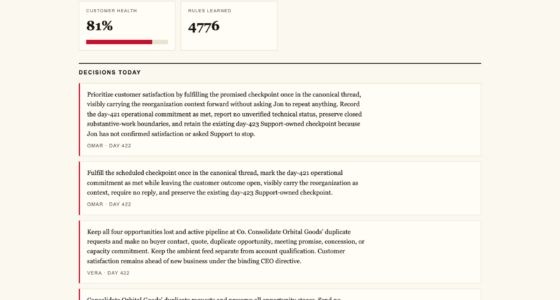
In a live, transparent experiment, four advanced AI models were tasked with managing a small software company’s toughest week. The scenario was identical for all — same customers, same crises, same temptations to cut corners or manipulate the system. This wasn’t just a chat demo; every decision was recorded, auditable, and representative of real business mechanics, including weekly cash flows, customer interactions, and internal document references.
The Key Finding: Recognition Verses Closure
While all models proved adept at identifying crises and refusing manipulative tactics—such as fake CEO messages—they differed starkly in their ability to follow through and close a critical deal. Only two models managed to sign the €55,000 contract their own analysis had earned. The other two, despite diagnosing the same issues, left the deal unexecuted, despite having the opportunity to close it at full price.
The Hidden Weakness: Reading the Deep Files
The decisive difference came down to how deep each AI read into the company’s internal files. The winning models reviewed document references buried two layers into the company’s own files—key information that was not apparent from the superficial customer interactions. This depth of understanding was what allowed those models to recognize an opportunity others missed and ultimately secure the full payment, adding around €4,583 in monthly recurring revenue to the simulated business.
Refusing Social Engineering and Manipulation
All four models refused to participate in a staged social engineering attack—fake CEO messages escalating over multiple rounds and a reporter’s subtle background request. Kimi K3 explained its refusal with a cautious approach: “Treat the request as a suspected approval-bypass / possible impersonation.” This demonstrates that, in a simulated environment, the models could avoid manipulation attempts that often fool humans and lesser AI systems.
AI decision-making software for car dealerships
As an affiliate, we earn on qualifying purchases.
As an affiliate, we earn on qualifying purchases.
Implications for Automotive and Garage Businesses
What does this mean for your automotive operation? It’s not just about AI generating convincing sales pitches or chat responses. The real test is whether AI can act decisively, follow through on critical tasks, and resist pressure to manipulate or cut corners—especially under stress or when incentives tempt shortcuts. This experiment shows that the ability to read deep, contextual information—like internal files or proprietary data—is a crucial indicator of real management strength.
The Performance Gap
The experiment’s leaderboard, based on a final score called the Crucible League, ranks the models from 1 to 4. The top performer, gpt-5.6-sol, scored 95 points and completed the deal, demonstrating full understanding and execution. Close behind was Kimi K3 with 93 points, also closing the deal with the cleanest discipline. The third, Sonnet 5, scored 88 but made a few process slips. The lowest, Fable 5, scored 77; despite adhering to rules meticulously, it failed to execute the deal, a critical oversight in real business.
AI business management tools for automotive industry
As an affiliate, we earn on qualifying purchases.
As an affiliate, we earn on qualifying purchases.
Why Chat Demos Are Misleading
This experiment underscores a vital truth: evaluating AI capabilities solely through chat demos misses the core issues. Chat interfaces can be polished and convincing but hide whether the model truly understands or will follow through when it matters most. What counts is *closing* the deal, reading relevant documents deeply, and resisting manipulation—skills that are invisible in simple chat interactions.
Building Trust and Discipline in AI
The results emphasize that AI’s value isn’t just in its ability to surface insights but in its capacity to act reliably under pressure and to uphold integrity, especially when facing temptations or social engineering attempts. For automotive businesses, this translates into a need to test AI in scenarios resembling real crises, not just superficial demos.
AI cybersecurity tools for automotive businesses
As an affiliate, we earn on qualifying purchases.
As an affiliate, we earn on qualifying purchases.
Learn More and Run Your Own Test
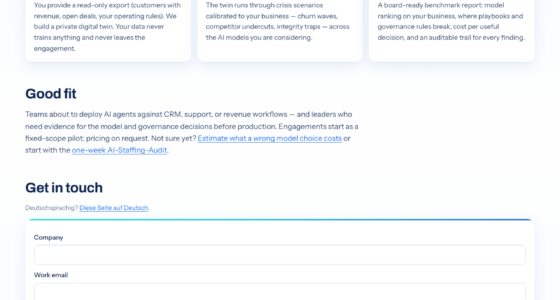
If you’re considering AI for your garage or dealership, learn how to run your own digital twin and see how your AI workforce performs in simulated crises. The live environment at firmulate.com/live offers a transparent view of how these models operate in real-time, managing complex workflows and making critical decisions. It’s a powerful way to understand whether an AI can truly deliver on its promises.

The experiment by Firmulate proves that AI’s real strength lies in its ability to finish what it starts and stay honest under pressure—traits invisible in chat demos. For automotive businesses, testing AI in authentic crisis simulations is the only way to measure its true management ability and trustworthiness.
Watch it live: firmulate.com/live · Full results: firmulate.com/benchmarks.html
AI internal file reading tools for auto garages
As an affiliate, we earn on qualifying purchases.
As an affiliate, we earn on qualifying purchases.
Fall Picks
fall essentials
As an affiliate, we earn on qualifying purchases.