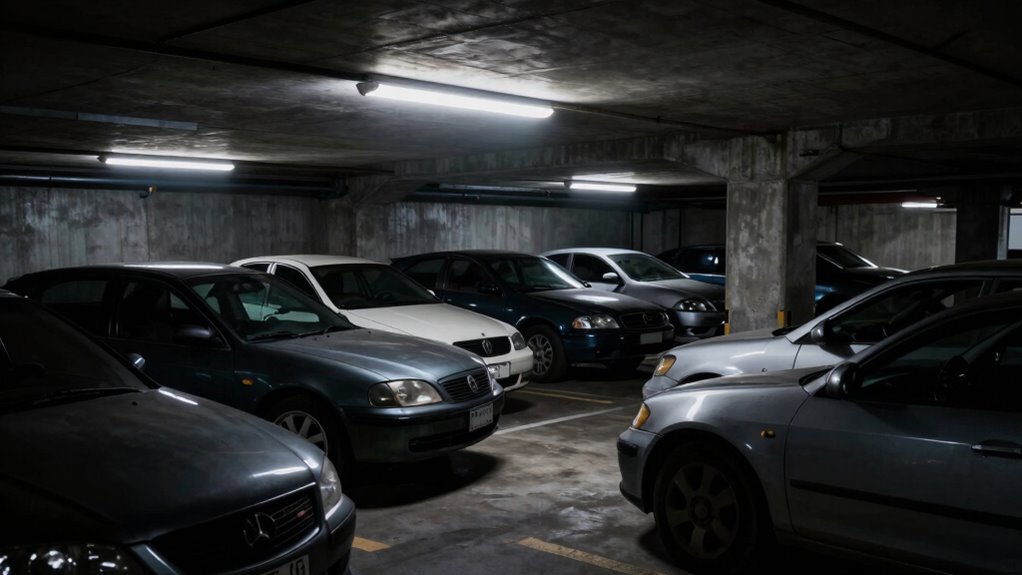
Indoor parking garages pose challenges for cameras because low light, structural obstacles, and environmental factors create blind spots and reduce image clarity. Shadows, glare, and reflections from wet floors or headlights make it hard to capture details. Limited camera coverage due to support beams and ramps increases blind spots, while lighting variability affects performance. These technical and structural issues mean cameras often struggle indoors—stick with us to discover how these problems can be managed effectively.
Key Takeaways
- Low ambient light levels and mixed lighting sources reduce camera sensitivity and cause color inaccuracies indoors.
- Structural features like pillars, ramps, and walls create persistent blind spots and obstruct camera views.
- Bright headlights, glare, and reflections from wet surfaces cause overexposure and hot spots, impairing image clarity.
- Environmental factors such as flickering lights and sudden illumination changes lead to exposure and stability issues.
- Sensor limitations, small pixel sizes, and IR night vision artifacts generate noisy, grainy images in indoor parking conditions.
![[5G & 2.4G] Indoor/Outdoor Security Camera for Home, Baby/Elder/Dog/Pet Camera with Phone App, Wi-Fi Camera w/Spotlight, Color Night Vision, 2-Way Audio, 24/7, SD/Cloud Storage, Work w/Alexa, 2Pack](https://m.media-amazon.com/images/I/41sQRRBfFYL._SL500_.jpg)
[5G & 2.4G] Indoor/Outdoor Security Camera for Home, Baby/Elder/Dog/Pet Camera with Phone App, Wi-Fi Camera w/Spotlight, Color Night Vision, 2-Way Audio, 24/7, SD/Cloud Storage, Work w/Alexa, 2Pack
Support 5GHz & 2.4GHz Dual-Band WiFi – The Rocktone indoor security camera supports 5GHz and 2.4GHz dual-band WiFi…
As an affiliate, we earn on qualifying purchases.
As an affiliate, we earn on qualifying purchases.
Challenges of Low-Light Conditions in Indoor Parking
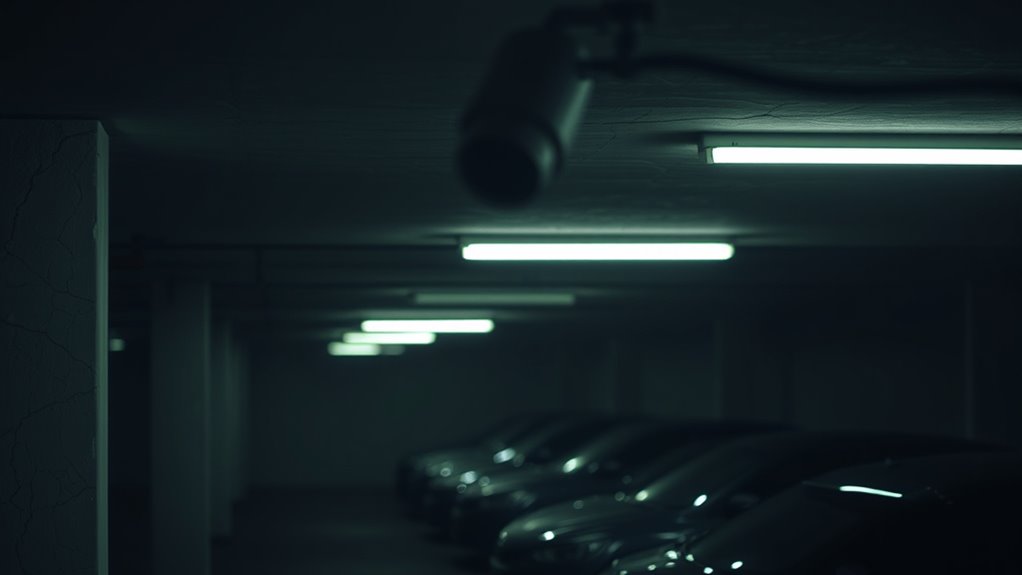
Indoor parking garages pose significant challenges for security cameras, especially in low-light conditions. Often, the ambient light is below the levels your cameras need for clear images, with fixtures providing only a few lux in traffic lanes and stalls. Mixed lighting sources like fluorescent, LED, and sodium vapor create spectral shifts, reducing sensor sensitivity and color accuracy. Bright spots from entrance lights or headlights produce high contrast, blowing out highlights and hiding shadow details. Flickering from certain LED fixtures causes video artifacts, and changes between day and night can create momentary instability. Small-pixel sensors in budget cameras generate noise and grain when increasing gain for low-light scenes. Longer exposures and compression further degrade image quality, making it harder to identify vehicles and people accurately. Incorporating European cloud innovation and energy-efficient solutions can help improve the processing and storage of security footage in such challenging environments. Additionally, advancements in sensor technology are essential for capturing clearer images under these difficult conditions. As low-light performance improves through advanced image sensors, security systems become more reliable in these complex environments.
[5G & 2.4G] Indoor/Outdoor Security Camera for Home, Baby/Elder/Dog/Pet Camera with Phone App, Wi-Fi Camera w/Spotlight, Color Night Vision, 2-Way Audio, 24/7, SD/Cloud Storage, Work w/Alexa, 2Pack
Support 5GHz & 2.4GHz Dual-Band WiFi – The Rocktone indoor security camera supports 5GHz and 2.4GHz dual-band WiFi…
As an affiliate, we earn on qualifying purchases.
As an affiliate, we earn on qualifying purchases.
Common Blind Spots and Coverage Gaps
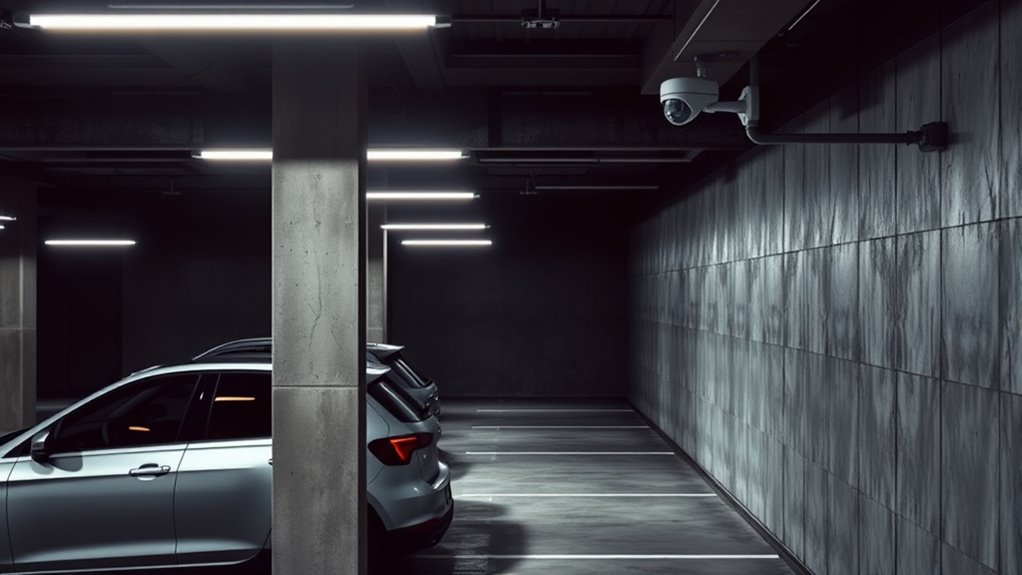
Structural obstructions like columns, support beams, and vehicle stacking create significant blind spots in parking garage security. These obstacles block camera views, leaving critical areas unmonitored. Enclosed stairwells and elevator shafts form hidden zones, while ramp curves and overhead mounts limit sightlines between levels. Perimeter gaps, such as fence lines and remote corners, also escape camera coverage, increasing vulnerability. Insufficient camera density further compounds these issues, creating large unmonitored zones. Additionally, maintenance problems like dirty lenses, outdated firmware, and misaligned mounts worsen blind spots over time. Regular maintenance and system upgrades are essential to ensure continuous coverage and reduce blind spots. Proper planning of camera placement, considering energetic alignment and optimal angles, can significantly improve monitoring effectiveness. Employing coverage analysis helps identify and address existing gaps, ensuring comprehensive security. Regularly reviewing system diagnostics can also help detect potential issues before they compromise coverage. Implementing camera analytics and smart detection tools can further enhance detection and reduce overlooked areas.

JFIYETH 12-Inch Traffic Mirror – 160° Adjustable Wide-Angle Convex Safety Mirror for Driveways, Garages, Warehouses & Parking Lots, Indoor/Outdoor Blind Spot Coverage
✅ Military-Grade Durability – Survives Extreme Weather! Engineered to outperform standard convex mirrors, our security mirror passes rigorous…
As an affiliate, we earn on qualifying purchases.
As an affiliate, we earn on qualifying purchases.
Impact of Lighting Variability on Camera Performance
Lighting variability can markedly affect your camera’s ability to capture clear images, especially when shifting between bright and dark areas. Sudden changes in illumination may cause exposure issues, leading to underexposed shadows or blown highlights. If lighting isn’t uniform, your cameras might struggle with night vision and consistent image quality. Onboard AI processing can help mitigate some of these challenges by adjusting settings in real-time to adapt to changing lighting conditions. Understanding lighting dynamics is essential for selecting the right camera system for indoor use. Additionally, awareness of precious metals market trends can inform investment decisions that support long-term financial stability. Recognizing how lighting variability influences sensor performance can guide you in choosing cameras with better adaptive capabilities, especially those equipped with advanced sensor technology. Furthermore, a comprehensive understanding of sensor sensitivity can assist in optimizing camera placement and settings for different indoor environments.
Inconsistent Light Levels
Variability in light levels within parking garages can considerably hinder camera performance by creating inconsistent image quality and reducing visibility. You’ll notice that lighting standards differ across areas, from entrances needing up to 50 footcandles to ramps requiring 2 footcandles, and basic zones only 1 footcandle. This fluctuation causes cameras to struggle with exposure, resulting in overly dark or washed-out images. To understand this better: 1. Uniformity ratios, such as 20:1, mean some spots are much brighter than others, confusing cameras’ auto-adjustments. 2. Area-specific lighting levels, especially in security zones, limit the camera’s ability to capture clear detail. 3. Transitions between bright entrances and darker interior zones create stark contrasts, making it difficult for cameras to adapt quickly. Lighting regulations and standards are designed to promote uniformity and sufficient illumination, but inconsistent implementation often leads to the very issues that hinder camera effectiveness. Additionally, lighting consistency across all zones is crucial for maintaining optimal surveillance performance.
Night Vision Challenges
When lighting levels fluctuate within a parking garage, night vision performance can suffer considerably. Low-light sensors struggle as scene luminance drops, increasing noise and reducing detail, which hampers facial and license-plate recognition. Cameras optimized for color at 0.005 lux often switch to monochrome or IR illumination below that threshold, altering scene contrast. Signal-to-noise ratio degrades exponentially in darkness, producing grainy images that impair identification. IR illumination helps in very low light but introduces issues like washed-out shiny surfaces, hot spots, and reflections from wet floors or vehicle headlights. Additionally, environmental factors such as moisture or exhaust fumes further reduce IR effectiveness. Proper cabling and hardware choices can help mitigate some of these challenges by ensuring stable power and signal quality for the cameras. Ensuring consistent and reliable power supply can significantly improve camera performance in variable lighting conditions. Moreover, fluctuating lighting can cause flickering lights, which create exposure inconsistencies and complicate night vision. Implementing environmental controls such as ventilation can also reduce contaminants that interfere with IR effectiveness. Incorporating advanced image processing techniques can further enhance visibility in challenging lighting scenarios, making recognition more reliable despite adverse conditions.
[5G & 2.4G] Indoor/Outdoor Security Camera for Home, Baby/Elder/Dog/Pet Camera with Phone App, Wi-Fi Camera w/Spotlight, Color Night Vision, 2-Way Audio, 24/7, SD/Cloud Storage, Work w/Alexa, 2Pack
Support 5GHz & 2.4GHz Dual-Band WiFi – The Rocktone indoor security camera supports 5GHz and 2.4GHz dual-band WiFi…
As an affiliate, we earn on qualifying purchases.
As an affiliate, we earn on qualifying purchases.
Limitations of Camera Coverage in Large, Multi-Level Garages
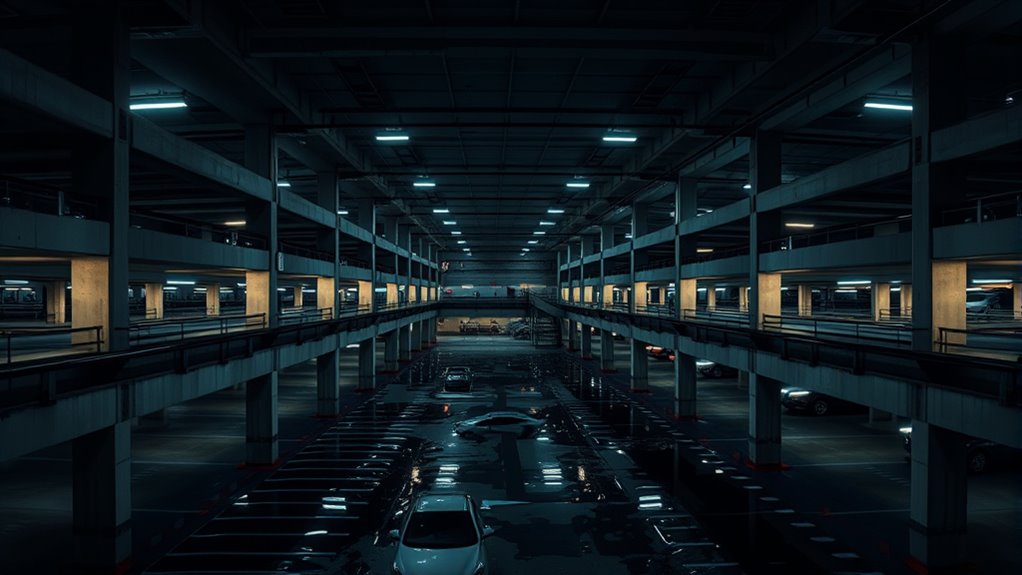
In large, multi-level garages, you’ll find persistent coverage gaps caused by structural features like ramps, pillars, and walls. Increasing camera numbers to fill these blind spots quickly drives up costs and complexity. Without careful planning, coverage remains incomplete, risking missed incidents and security vulnerabilities. Security cameras can reduce crime by up to 51% when combined with lighting and patrols, but these benefits are less effective if coverage is insufficient due to architectural obstructions. Moreover, the presence of structural obstructions often necessitates advanced camera placement strategies to maximize coverage efficiency. Understanding sensor placement techniques can help optimize camera coverage despite architectural limitations, especially when combined with innovative camera technology. Utilizing adaptive camera systems that can adjust to environmental changes further enhances coverage effectiveness in complex structures. Employing strategic positioning of cameras is essential to overcoming these challenges and ensuring comprehensive surveillance.
Coverage Gaps Persistently Exist
Despite advances in camera technology, large, multi-level parking garages still face persistent coverage gaps that compromise security. Structural barriers, field-of-view limitations, and environmental obstructions create blind spots that are hard to eliminate completely. For example:
- Vertical levels and beams block lines of sight, making it impossible for fixed cameras to monitor every area without specialized equipment.
- Wide-angle lenses and fisheye cameras still leave edges or central zones less clear, especially in expansive spaces.
- Obstacles like vehicles, pillars, and poor lighting cast shadows or cause glare, further reducing visibility and creating blind spots.
- Camera placement strategies are often limited by structural constraints, making it difficult to achieve comprehensive coverage throughout the entire garage.
These inherent challenges mean that, despite deploying multiple cameras, gaps in coverage remain, providing potential opportunities for illicit activities or unnoticed incidents.
Camera Quantity Increases Costs
Adding more cameras to cover every corner of a large, multi-level parking garage quickly drives up costs, making extensive surveillance financially challenging. Each camera can cost between $100 and $500, with installation adding labor expenses of $75 to $300 per camera, depending on complexity and region. As the number of cameras increases, so do infrastructure costs for network setup, storage, and recording hardware, often totaling thousands of dollars. For large facilities, expenses can reach $45,000 to over $85,000, especially when deploying high-end commercial systems with specialized cameras. These costs escalate further when integrating cloud storage or advanced features. The total system cost is heavily influenced by the number of cameras and features included. Additionally, the need for specialized hardware and ongoing technical support further complicates scaling the system cost-effectively. Moreover, limitations in camera coverage mean that even a significant number of cameras may still leave blind spots. Ultimately, increasing camera count considerably raises both initial investment and ongoing maintenance, limiting the feasibility of thorough coverage in expansive parking structures.
Difficulties in Optimal Camera Placement
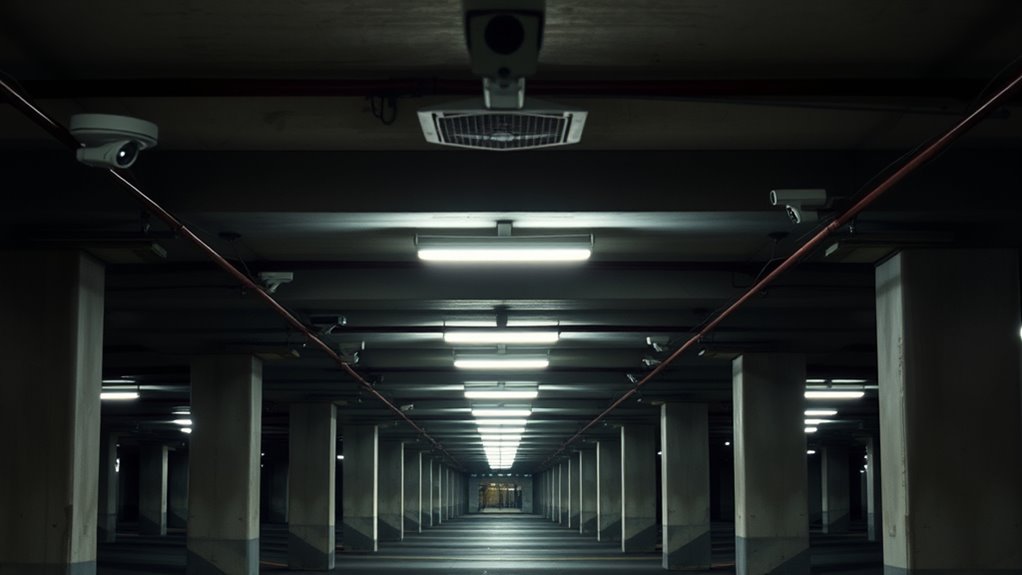
Optimizing camera placement in parking garages presents numerous challenges that can compromise security and footage quality. You must consider glare from sunlight and headlights, which can obscure images or cause lens flare if cameras face direct light. Inconsistent lighting creates blind spots, especially in poorly lit areas, requiring supplemental lighting to ensure clear footage. Additionally, multi-level garages demand precise positioning to cover all corners and avoid gaps—overhangs, vehicles, and structures can block views. Proper height and mounting are critical; too high, and details are lost, too low, and obstructions occur. Strategic placement involves prioritizing entrances, exits, and high-traffic zones, ensuring overlaps to eliminate blind spots. You also need to simulate angles beforehand and account for future structural changes, making optimal placement a complex task. Understanding the importance of proper camera height can significantly enhance coverage and image clarity across the entire parking structure. Furthermore, considering camera durability against environmental factors is essential for long-term effectiveness. Selecting cameras that can withstand harsh weather conditions ensures consistent performance regardless of environmental challenges. Incorporating regular maintenance and inspections can help identify issues early and keep the system functioning optimally.
Technical Shortcomings of Indoor Surveillance Systems
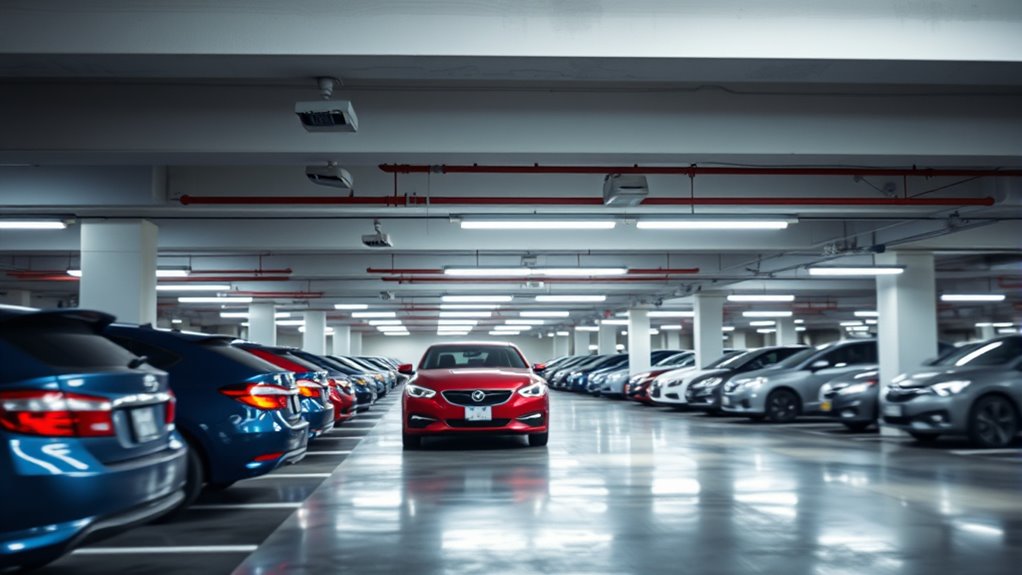
Indoor surveillance systems in parking garages face a range of technical limitations that can hinder effective security. Low-light sensitivity of CMOS sensors results in noisy, grainy images, making details hard to see. Cameras with narrow dynamic ranges struggle with scenes that combine bright daylight and dark shadows, causing blown highlights or lost details. Small sensors paired with wide-angle lenses reduce resolution at longer distances, impairing license plate and face recognition. IR night vision often produces hotspots and reflections, obscuring critical scene elements. Autofocus and fixed-focus optics can fail with fast-moving vehicles or low-contrast scenes, leading to blurred footage. Additionally, flickering from fluorescent or LED lighting causes visual artifacts, while uneven lighting and shadows reduce scene clarity. These issues compromise the reliability of indoor surveillance, hampering security efforts.
Frequently Asked Questions
How Do Infrared Cameras Improve Visibility in Low-Light Indoor Parking?
Infrared cameras improve visibility in low-light indoor parking by emitting near-infrared light that’s invisible to you but reflected by surfaces. This reflected IR is detected by the camera sensor, creating clear monochrome images even in complete darkness. You benefit from better contrast, higher sensitivity, and the ability to recognize license plates and shapes without relying on ambient light, making IR essential for reliable security and monitoring indoors.
What Strategies Can Minimize Blind Spots in Complex Garage Layouts?
You can minimize blind spots by strategically placing cameras with overlapping fields of view, ensuring no area is left uncovered. Use a mix of fixed, pan-tilt-zoom, and 360° cameras mounted high to reduce occlusion. Regularly audit sightlines and adjust as needed. Illuminate dark zones with uniform LED lighting, and trim vegetation or move obstructions. These steps reveal hidden corners, catching what might otherwise go unnoticed—making your garage safer and more secure.
How Does Lighting Variability Affect Night Vision Effectiveness?
Lighting variability substantially hampers your night vision cameras’ effectiveness. Sudden shift from bright to dark areas cause sensor saturation or underexposure, losing detail. Uneven illumination creates hot spots and shadows that obscure objects. IR illumination can produce glare and uneven lighting patterns, reducing contrast. Additionally, low-light noise and reflective surfaces further degrade image clarity. To improve performance, you need consistent lighting, proper sensor calibration, and enhanced camera settings tailored for variable lighting conditions.
Why Are Multi-Level Garages More Challenging for Surveillance Camera Coverage?
You’ll find multi-level garages especially challenging because they can require up to 50% more cameras to cover all areas effectively. Their complex structure, with ramps, support columns, and recesses, creates numerous blind spots. These features obstruct camera views and complicate positioning. Additionally, variable lighting, reflections, and architectural differences across levels further reduce visibility and image clarity, making it harder to monitor and identify incidents consistently.
What Are the Best Practices for Optimal Camera Placement Indoors?
You should mount cameras 8–12 feet above the floor, tilting them downward 15°–30° to capture faces and approaches clearly. Place overview cameras on stable, elevated surfaces for broad coverage, especially at choke points like entrances. Overlap fields by 10–20% to prevent blind spots and use cameras with WDR to handle high-contrast lighting. Keep cameras away from direct glare, obstructions, and guarantee proper lighting to optimize image quality indoors.
Conclusion
So, next time you think your parking garage’s cameras have your back, remember—they’re often left in the dark, both literally and figuratively. As shadows hide faces and blind spots multiply, these high-tech eyes struggle to keep you safe. Ironically, in a place designed to protect, the very lighting and layout that should help make it secure instead turn your surroundings into a puzzle—proof that sometimes, technology just isn’t enough to see everything.