For most home garages, I’d choose the California Air Tools 8010A as the best overall pick: its 8-gallon aluminum tank and quiet, oil-free design suit varied workshop tasks without the footprint of a stationary unit. The CRAFTSMAN 6-Gallon Pancake is a practical value option for occasional inflation and finish work, while the Campbell Hausfeld 60-Gallon Two-Stage is the high-capacity choice for demanding, sustained air use. The main tradeoff is between portability and recovery capacity, with noise, electrical requirements, and available floor space shaping the decision too. A larger tank alone does not guarantee that a compressor can keep up with an air-hungry tool. Read on for the full breakdown and guidance by garage setup.

Get business pricing on garage and car supplies
- Business-only prices and quantity discounts
- Tax-exempt purchasing
- Multiple users, one account, clear invoices
Complete the kit


Key Takeaways
- The California Air Tools 8010A stands out for a quieter, mid-size setup: its 8-gallon aluminum tank and oil-free design offer a different balance from the small pancake models and large stationary compressors.
- Tank size separates occasional-use picks from sustained-work options: the 2- and 6-gallon models favor portability, while the 60-gallon two-stage Campbell Hausfeld and DEWALT are aimed at a dedicated shop.
- Quiet operation appears in more than one size class: the California Air Tools 8010A and RyanTek 15-gallon model address noise concerns, but buyers should still compare their airflow needs and footprint.
- Included hoses and accessory kits matter most for basic garage tasks: several CRAFTSMAN models arrive with accessories, but bundles do not replace checking whether a tool’s required airflow matches the compressor.
- Power and placement can rule out a model before capacity does: the 230V Campbell Hausfeld requires a different electrical setup from the 120V portable and mid-size choices.


| garage air compressor | Tank capacity | Maximum pressure | Noise level | Weight |
|---|---|---|---|---|
| ECOMAX 6-Gallon 150 PSI Oil-Fr | 6 gallons | 150 PSI | 75 dB | 34.17 lb |
| CRAFTSMAN Wall-Mount Air Compr | 0.5 gallons | 125 PSI | 65 dB | 20.9 lb / 11.14 kg (conflicting listing figures) |
| Campbell Hausfeld 60-Gallon Tw | 60 gallons | 175 PSI | — | 255 lb |
| California Air Tools 8010A 1.0 | 8 gallons | 120 PSI | 60 dB | 37.25 lb |
| DEWALT 60-Gallon 175 PSI Stati | 60 gallons | 175 PSI | 70 dB | — |
| CRAFTSMAN 2-Gallon Portable Oi | 2 gallons | 125 PSI | 78 dB | 19 lb in description; 11.11 kg in product information |
| VEVOR 13-Gallon Oil-Free Air C | 13 gallons | 125 PSI | 66 dB | — |
| Craftsman 20-Gallon Oil-Free A | 20 gallons | 175 PSI | 80 dB | — |
| Klutch 29-Gallon Oil-Free Air | 29 gallons | 175 PSI | — | — |
| CRAFTSMAN 8-Gallon Oil-Free Ai | 8 gallons | 150 PSI | — | — |
| Klutch 20-Gallon Portable Air | 20 gallons | 175 PSI | 80 dB | 90 lbs |
| RyanTek 15-Gallon Air Compress | 15 gallons | 125 PSI | 66 dB | 68.3 pounds |
| CRAFTSMAN 6-Gallon 150 PSI Oil | 6 gallons | 150 PSI | 82 dB | 30.8 lbs |
| DEWALT DWFP55130 2.5-Gallon Po | 2.5 gallons | 200 PSI | 71.5 dBA | 36 lbs |
More Details on Our Top Picks
ECOMAX 6-Gallon 150 PSI Oil-Free Pancake Air Compressor with Accessories
The ECOMAX suits a garage where the compressor needs to move between tire inflation, occasional nailing, and other light-duty tasks. Its 6-gallon tank, 150 PSI maximum, and included 25-foot hose make it a more flexible starter setup than the wall-mount CRAFTSMAN, whose half-gallon tank favors quick inflation rather than extended work. The oil-free pump keeps routine maintenance simple, while the flip-up handle helps with storage and transport. The tradeoff is airflow: the listing gives a very low figure of 3 cubic inches per minute at 90 PSI, so I would not choose it for sustained use with air-hungry tools. Compared with the California Air Tools 8010A, it brings more listed accessories and higher maximum pressure, but less emphasis on quiet operation.
Pros:- Oil-free pump reduces routine maintenance.
- Flip-up handle and compact pancake format make it easier to move and store.
- Dual gauges and quick couplers help monitor pressure and connect tools.
- Includes a 25-foot hose and assorted inflation and blow-gun accessories.
Cons:- Listed air delivery of 3 cubic inches per minute at 90 PSI is unusually low and limits confidence for tool use.
- Six gallons may require frequent recovery during longer air-tool sessions.
- Corded operation ties use to a suitable electrical outlet.
Best for: Garage owners who want a movable compressor for tire inflation, occasional brad nailing, and other light tasks, with a hose and fittings included.
Not ideal for: DIYers planning sustained sanding, grinding, or painting; its listed airflow and 6-gallon tank are limiting for air-hungry tools.
- Tank capacity:6 gallons
- Maximum pressure:150 PSI
- Motor:1.5 HP
- Air delivery:3 cubic inches per minute at 90 PSI (as listed)
- Pump:Oil-free
- Power:120 V corded electric
- Noise level:75 dB
- Weight:34.17 lb
- Included hose:25 ft
Our verdict“Choose the ECOMAX for portable inflation and occasional light garage jobs, but skip it if your tools need sustained airflow.”
CRAFTSMAN Wall-Mount Air Compressor with 8-Piece Accessory Kit and 30-Foot Retractable Hose
This CRAFTSMAN is built around a different garage problem than the larger tanks in this roundup: keeping a handy air source available without surrendering floor space. Its wall-mountable design and 30-foot hose suit tire checks and small inflation jobs across a single bay, while the stated 20-second recovery time can help with repeated short bursts. At 65 dB, it is also quieter on paper than the ECOMAX pancake compressor. The key limitation is its half-gallon tank. That makes it a poor match for sustained nailing or other air tools, despite the listed 1.8 CFM airflow. I would choose the ECOMAX for more portable, accessory-rich general use, or the California Air Tools 8010A when a larger tank and low noise matter more than wall storage.
Pros:- Wall-mount option frees floor and bench space.
- Thirty-foot adjustable hose reaches around a typical garage bay.
- Oil-free pump avoids oil-change maintenance.
- Includes inflation and blow-gun accessories, with a stated 20-second tank recovery time.
Cons:- Half-gallon tank limits sustained airflow and frequent tool use.
- Listing provides conflicting weight figures: 20.9 lb and 11.14 kg.
- Maximum pressure is 125 PSI, below the 150 PSI ECOMAX and 175 PSI shop compressors.
Best for: Garage owners with limited floor space who mainly inflate tires, sports equipment, and other items using short bursts of air.
Not ideal for: Buyers who need a portable compressor for extended tool use or larger air-demand jobs; the 0.5-gallon tank is very small.
- Tank capacity:0.5 gallons
- Maximum pressure:125 PSI
- Airflow:1.8 CFM
- Maximum power:1.5 HP (as listed)
- Noise level:65 dB
- Power source:Corded electric
- Hose length:30 ft
- Weight:20.9 lb / 11.14 kg (conflicting listing figures)
- Warranty:1-year limited
Our verdict“Pick this CRAFTSMAN for a permanently handy, space-saving inflation station, not as a general-purpose air-tool compressor.”
Campbell Hausfeld 60-Gallon Two-Stage Air Compressor, 175 PSI, 230V
The Campbell Hausfeld is the stationary-workshop choice for buyers who need a substantial reserve and steady airflow rather than a compressor they can roll around. Its 60-gallon vertical ASME tank and 7.6 SCFM at 90 PSI support longer sanding, grinding, painting, and fastening sessions than the portable ECOMAX or California Air Tools 8010A. A two-stage cast-iron pump is designed for demanding service, and the narrow 23-by-23-inch footprint helps manage floor use despite the tall cabinet. The tradeoffs are substantial: it weighs 255 pounds, needs a dedicated 230/240V supply, and its airflow is well below the DEWALT 60-gallon model’s listed 14.6 SCFM at 90 PSI. I would favor Campbell Hausfeld for a fixed shop with moderate tool demand, not the higher-output DEWALT for heavier simultaneous use.
Pros:- Large 60-gallon tank helps reduce interruptions during longer projects.
- Two-stage cast-iron pump is designed for durable workshop service.
- Provides 7.6 SCFM at 90 PSI for a range of pneumatic tasks.
- Vertical tank and 23-by-23-inch footprint conserve floor area.
Cons:- Requires a dedicated 230/240V electrical supply.
- At 255 lb, it is a stationary installation rather than a portable garage compressor.
- Airflow is substantially lower than the DEWALT 60-gallon model’s listed 14.6 SCFM at 90 PSI.
Best for: Owners of a permanent home workshop who need a large tank for longer sanding, grinding, painting, or fastening sessions and have dedicated 230/240V power.
Not ideal for: Renters, small garages without a dedicated 230/240V circuit, or shops whose tools demand more airflow than 7.6 SCFM at 90 PSI.
- Tank capacity:60 gallons
- Tank type:Vertical ASME
- Maximum pressure:175 PSI
- Airflow at 90 PSI:7.6 SCFM
- Airflow at 175 PSI:6.9 SCFM
- Pump:Oil-lubricated, two-stage cast iron
- Motor:3.7 HP induction
- Electrical supply:Dedicated 230/240 V
- Weight:255 lb
Our verdict“Choose the Campbell Hausfeld for a fixed shop needing a durable 60-gallon setup, but compare the DEWALT if your tools require higher airflow.”
California Air Tools 8010A 1.0 HP Ultra Quiet Oil-Free Air Compressor, 8-Gallon Aluminum Tank
For a garage attached to living space, the California Air Tools 8010A prioritizes a less disruptive sound level without giving up a useful portable tank. At a listed 60 dB, it is quieter than the ECOMAX’s 75 dB and the DEWALT stationary unit’s 70 dB, making it a more comfortable choice for inflation and occasional tool work near the house. The 8-gallon aluminum tank and included wheels offer a useful middle ground between the compact CRAFTSMAN wall-mount unit and the heavy 60-gallon shop compressors. Its 2.20 CFM at 90 PSI, however, points to light-duty use rather than sustained sanding or grinding. The oil-free dual-piston pump also avoids oil maintenance, but the 120 PSI maximum is lower than the ECOMAX’s 150 PSI. It is a quiet convenience pick, not a production-shop machine.
Pros:- Listed 60 dB operation is quieter than the ECOMAX and both large stationary compressors.
- Eight-gallon aluminum tank balances capacity with portability.
- Oil-free dual-piston pump does not require oil changes.
- Wheels, gauges, and quick connectors support repositioning and straightforward setup.
Cons:- Airflow of 2.20 CFM at 90 PSI is limited for sustained air-tool work.
- Maximum pressure of 120 PSI is lower than the ECOMAX and 175 PSI shop models.
- Corded electric operation requires an outlet where the compressor is being used.
Best for: Home garage users who value quieter inflation and intermittent light-tool work, especially near occupied rooms, and want wheels for moving the compressor.
Not ideal for: Users running air-hungry tools for long sessions or needing higher pressure; its 2.20 CFM at 90 PSI and 120 PSI maximum are limiting.
- Tank capacity:8 gallons
- Tank material:Aluminum
- Maximum pressure:120 PSI
- Airflow at 40 PSI:3.10 CFM
- Airflow at 90 PSI:2.20 CFM
- Motor:1.0 HP, 1680 RPM
- Noise level:60 dB
- Weight:37.25 lb
- Recovery time:60 seconds from 90 to 120 PSI
Our verdict“Choose the 8010A if quiet operation and wheeled portability matter more than high airflow or extended air-tool runtime.”
DEWALT 60-Gallon 175 PSI Stationary Electric Air Compressor
Among these five, the DEWALT is the strongest fit for a garage built around air tools that need substantial, sustained airflow. Its listed 14.6 SCFM at 90 PSI is nearly twice the Campbell Hausfeld’s 7.6 SCFM at the same pressure, while the 60-gallon tank and 175 PSI ceiling suit extended shop and automotive work. That output makes it a different class of machine from the portable ECOMAX and California Air Tools 8010A, which are easier to move but intended for lighter workloads. Installation is the real barrier: this unit requires a 240V supply and 30A double-pole breaker, and no power cord is included. Its listed 70 dB noise level and fixed vertical format also make it less suited to shared or compact spaces. I would pick it for a permanent, properly wired shop—not a casual garage setup.
Pros:- Listed 14.6 SCFM at 90 PSI exceeds the Campbell Hausfeld 60-gallon model’s 7.6 SCFM.
- Sixty-gallon tank and 175 PSI maximum support extended shop use.
- Five-horsepower motor is suited to demanding garage and automotive air-tool work.
- Includes a large air outlet, on/off switch, and pressure gauge.
Cons:- Requires a 240V supply and 30A double-pole breaker.
- Power cord is not included, adding an installation task.
- Stationary vertical design and 70 dB noise level are less suitable for compact or noise-sensitive garages.
Best for: Automotive DIYers and serious home-shop owners running high-demand pneumatic tools who have room for a permanent 60-gallon unit and the required 240V circuit.
Not ideal for: Casual users, renters, and garages without a 240V supply and 30A double-pole breaker; installation and fixed placement are poor fits.
- Tank capacity:60 gallons
- Maximum pressure:175 PSI
- Airflow at 90 PSI:14.6 SCFM
- Motor power:5 HP
- Motor voltage:208–230 V; 240 V supply required
- Breaker requirement:30 A double-pole
- Maximum current:20 A
- Noise level:70 dB
- Power cord:Not included
Our verdict“Choose the DEWALT for a permanently wired garage shop whose tools need high airflow; skip it if portability or simple installation matters.”
CRAFTSMAN 2-Gallon Portable Oil-Free Air Compressor, 1/3 HP, 125 PSI, with 10-Piece Accessory Kit
The 2-gallon tank and 19-pound listed weight make this CRAFTSMAN the easiest fit here for a shelf, trunk, or quick inflation task. Its oil-free pump keeps routine upkeep simple, while the included hose, tire gauge, blow gun, and fittings let a buyer start with common garage jobs without assembling a kit separately. Compared with the CRAFTSMAN 8-Gallon, this model takes up less room but stores much less air, so it is a weaker match for repeated tool use or longer cleaning sessions. The 125 PSI ceiling handles inflation, but the small tank is the main limit on sustained work. The product information also gives conflicting weights—19 pounds in the description and 11.11 kg elsewhere—so I would not rely on a precise lift estimate.
Pros:- Compact 2-gallon tank and reinforced handle suit tight storage spaces.
- Oil-free pump avoids routine lubrication.
- Included accessory kit covers common tire and blow-cleaning tasks.
- Overload protection and heat-dissipation design are listed.
Cons:- Small tank limits sustained use and increases interruptions for recovery.
- The listed weight conflicts between the description and product information.
- At 125 PSI, it offers less pressure headroom than several larger compressors in this lineup.
Best for: Garage owners who mainly inflate tires, use a blow gun briefly, or need a small compressor that is easy to store.
Not ideal for: Buyers running pneumatic tools for extended periods or anyone needing a larger air reserve; the 2-gallon tank will require frequent recovery.
- Tank capacity:2 gallons
- Motor power:1/3 HP
- Maximum pressure:125 PSI
- Power:120V corded electric
- Pump:Oil-free
- Noise level:78 dB
- Weight:19 lb in description; 11.11 kg in product information
- Included accessories:Air hose, tire pressure gauge, blow gun, air chuck, plugs, coupler, nozzle, thread seal tape, and sleeve
Our verdict“Choose this CRAFTSMAN for compact storage and occasional inflation, not for extended pneumatic-tool work.”
VEVOR 13-Gallon Oil-Free Air Compressor, 2 HP, 125 PSI
The VEVOR stands out for combining a 13-gallon tank with a stated 66 dB noise level, a useful balance for a garage where a small compressor runs out of stored air too quickly but a loud unit would be disruptive. Its 4.6 SCFM at 90 PSI gives it a clearer case for intermittent nailing, woodworking, and spray tasks than the 2-gallon CRAFTSMAN, though it still has a 125 PSI ceiling and is not the highest-pressure choice here. Compared with the CRAFTSMAN 20-Gallon, the VEVOR is smaller and listed as quieter, but offers less tank capacity and lower maximum pressure. At 71 pounds, it can roll on its supplied wheels, yet lifting it into a vehicle or up steps is still a two-person-or-careful-planning job. The 120V corded supply also keeps it tied to an outlet.
Pros:- 66 dB listed noise level is lower than the other products in this batch.
- 13-gallon tank offers more stored air than compact portable models.
- Oil-free pump avoids lubrication maintenance.
- Wheels and foot pads support rolling and stable placement.
Cons:- 125 PSI maximum pressure is lower than the 175 PSI CRAFTSMAN 20-Gallon and Klutch 29-Gallon.
- At 71 pounds, it is cumbersome to lift despite its wheels.
- Requires a 120V corded outlet, limiting placement.
Best for: Home garage users who want a quieter, wheeled compressor for intermittent nailing, inflation, and workshop tasks.
Not ideal for: Buyers who need higher pressure or long tool run times, or who must frequently carry a compressor up stairs.
- Tank capacity:13 gallons
- Motor power:2 HP
- Airflow at pressure:4.6 SCFM at 90 PSI
- Maximum pressure:125 PSI
- Power:120V corded electric
- Pump:Oil-free
- Noise level:66 dB
- Weight and dimensions:71 lb; 17.5 × 16.5 × 33.3 in
Our verdict“Pick the VEVOR if quieter operation and a useful mid-size tank matter more than higher pressure or easy lifting.”
Craftsman 20-Gallon Oil-Free Air Compressor, 1.8 HP, 175 PSI, Red
For a garage that needs more than quick tire top-offs, this CRAFTSMAN offers a practical middle ground: a 20-gallon tank, 175 PSI maximum, and 4 SCFM at 90 PSI. That combination gives a buyer more stored air and pressure headroom than the VEVOR 13-Gallon, while avoiding the larger footprint and 127-pound weight of the Klutch 29-Gallon. Its oil-free pump reduces maintenance, and two quick couplers make switching between connected tools more convenient. The tradeoff is sound: at 80 dB, it is not a quiet-shop pick, especially beside the VEVOR’s listed 66 dB. This remains a corded 120V unit, and its 6-foot cord may constrain placement near a workbench. I see it as a balanced choice for varied garage jobs, not a substitute for a high-output stationary compressor.
Pros:- 20-gallon tank provides a larger air reserve than the VEVOR 13-Gallon.
- 175 PSI maximum pressure offers more headroom than the VEVOR.
- Oil-free pump and two quick couplers simplify upkeep and tool changes.
- Wheels support movement around the garage.
Cons:- 80 dB operation may be disruptive in an attached or shared garage.
- 120V corded power and a 6-foot cord limit placement flexibility.
- At 4 SCFM at 90 PSI, it is not aimed at prolonged use of air-hungry tools.
Best for: Garage owners who use a mix of inflators, blow tools, and intermittent pneumatic tools and want a substantial tank without moving to a 29-gallon unit.
Not ideal for: Noise-sensitive households or buyers needing a quiet compressor, cordless placement, or sustained high-demand air delivery.
- Tank capacity:20 gallons
- Motor power:1.8 HP
- Maximum pressure:175 PSI
- Airflow at pressure:4 SCFM at 90 PSI
- Power:120V corded electric
- Pump:Oil-free
- Noise level:80 dB
- Dimensions and cord:19.1 × 17.3 × 40.9 in; 6-ft cord
- Included connections:Two quick couplers
Our verdict“Choose this CRAFTSMAN for a versatile garage setup that benefits from a 20-gallon reserve without the bulk of the Klutch 29-Gallon.”
Klutch 29-Gallon Oil-Free Air Compressor, 2.5 HP, 120V, 175 PSI
The Klutch makes the most sense when tank capacity and airflow take priority over easy handling. Its 29-gallon tank and 5.1 CFM at 90 PSI exceed the CRAFTSMAN 20-Gallon’s 4 SCFM at the same pressure, giving garage users a stronger supply for tasks such as nailing, stapling, and painting. The 175 PSI ceiling matches that CRAFTSMAN rather than surpassing it, so the key difference is the larger reserve and higher stated airflow—not extra pressure. Flat-free tires and a brass quick-connect help with movement and hose changes, but they do not make this a light portable unit: it weighs 127 pounds and measures over 45 inches tall. Its 81 dB rating also makes it a poor fit for noise-sensitive spaces. I would choose it for a dedicated garage position, not frequent lifting or transport.
Pros:- 29-gallon tank stores more air than the CRAFTSMAN 20-Gallon.
- 5.1 CFM at 90 PSI is higher than the CRAFTSMAN 20-Gallon’s stated 4 SCFM at 90 PSI.
- Oil-free pump avoids routine oil changes.
- Flat-free tires and brass quick-connect support repositioning and hose changes.
Cons:- At 127 pounds, it is difficult to lift and transport.
- 81 dB operation can be disruptive in a home garage.
- Large 45.3-inch height and broad footprint demand dedicated space.
Best for: DIYers with a dedicated garage workspace who use pneumatic tools regularly and want more tank reserve and airflow than the CRAFTSMAN 20-Gallon provides.
Not ideal for: Buyers who need to carry a compressor between locations, have limited storage space, or want quieter operation.
- Tank capacity:29 gallons
- Motor power:2.5 HP
- Airflow at pressure:5.1 CFM at 90 PSI
- Maximum pressure:175 PSI
- Power:120V corded electric
- Maximum current:14.5 A
- Pump:Oil-free
- Noise and weight:81 dB; 127 lb
- Dimensions:23.2 × 21.1 × 45.3 in
Our verdict“Pick the Klutch when you want the biggest air reserve and higher stated airflow in this batch and can leave the heavy unit in one garage area.”
CRAFTSMAN 8-Gallon Oil-Free Air Compressor, 1.8 HP, 150 PSI, with 10-Piece Accessory Set
This CRAFTSMAN fills the gap between a small inflation compressor and the larger garage tanks: its 8-gallon tank stores more air than the 2-gallon CRAFTSMAN, while the horizontal design, handle, and rubber wheels help it move around a workshop. The stated 45-second recovery time is useful for buyers who want less waiting between short bursts of work, and the included accessory set covers tire inflation, blow cleaning, and compatible pneumatic tasks. Its 150 PSI maximum is above the VEVOR 13-Gallon’s 125 PSI, though the VEVOR has a larger tank and a quieter listed operating level. At 24 pounds, this unit is lighter than the 71-pound VEVOR, but still not effortless to lift. The 120V cord keeps it near an outlet, and the 8-gallon capacity remains a limit for sustained air-tool use.
Pros:- 8-gallon tank offers more reserve than the 2-gallon CRAFTSMAN while remaining more compact than larger models.
- 45-second tank recovery time is specified.
- Handle and rubber wheels support movement around the garage.
- Included accessories cover inflation and blow-cleaning tasks.
Cons:- An 8-gallon tank is still limited for sustained pneumatic-tool use compared with the 20- and 29-gallon models.
- At 24 pounds, it may be awkward to lift despite its portable design.
- Requires a 120V corded outlet.
Best for: Home garage users who want a wheeled, manageable compressor for tire care, cleanup, air brushing, and occasional pneumatic-tool use.
Not ideal for: Buyers running air-hungry tools for long stretches or seeking a low-noise compressor; the tank is modest and no noise figure is provided.
- Tank capacity:8 gallons
- Motor power:1.8 HP
- Maximum pressure:150 PSI
- Airflow capacity:4 CFM
- Power:120V corded electric
- Pump:Oil-free
- Tank recovery time:45 seconds
- Weight and dimensions:24 lb; 25.8 × 11 × 24.1 in
- Included accessories:Air hose, air chuck, tire pressure gauge, blow gun, nozzle, plugs, coupler, thread seal tape, and sleeve
Our verdict“Choose this CRAFTSMAN if you want more capacity than a compact inflator without the footprint and weight of a large-tank garage compressor.”
Klutch 20-Gallon Portable Air Compressor, 2 HP, 120V
The 20-gallon tank gives this Klutch more stored air than the RyanTek’s 15-gallon tank, which can mean fewer interruptions during jobs such as nailing or intermittent spraying. Its 4.2 SCFM at 90 PSI is a useful fit for common garage tools, while the oil-free pump avoids routine oil changes. Rubber wheels, an ergonomic handle, and vibration-reducing feet make it easier to position around a workshop than a stationary compressor, though at 90 pounds it is not a casual lift. Compared with the smaller, quieter RyanTek, this model favors tank capacity over indoor comfort: its 80 dB noise level may be intrusive in an enclosed garage. It also needs a nearby outlet, so portability is limited to places with power.
Pros:- 20-gallon tank provides more stored air than the RyanTek’s 15-gallon tank.
- Oil-free pump reduces routine maintenance.
- Wheels and ergonomic handle help reposition it around a garage.
- Thermal overload protection and vibration-reducing foot stabilizers support workshop use.
Cons:- At 80 dB, it may be loud in an enclosed workspace.
- The 90-pound weight makes lifting and transport difficult.
- Corded operation requires access to an outlet.
Best for: Garage DIYers who want a wheeled compressor with more reserve air for intermittent nailing, spraying, and inflation.
Not ideal for: People working in noise-sensitive indoor spaces or needing to carry a compressor up stairs; it is 80 dB and weighs 90 pounds.
- Tank capacity:20 gallons
- Motor power:2 HP
- Airflow at 90 PSI:4.2 SCFM
- Maximum pressure:175 PSI
- Voltage:120 V
- Pump type:Oil-free
- Noise level:80 dB
- Weight:90 lbs
Our verdict“Choose the Klutch if you want a wheeled, 20-gallon garage compressor for intermittent tool use and can accommodate its noise and weight.”
RyanTek 15-Gallon Air Compressor, 2 HP, Quiet 66 dB, 4.5 CFM @ 90 PSI
The RyanTek’s defining advantage is its 66 dB operating noise, a meaningful difference for indoor garage projects where a louder compressor can dominate the workspace. It also supplies 4.5 CFM at 90 PSI, slightly more airflow than the Klutch 20-Gallon, despite having a smaller 15-gallon tank. That makes it a better fit when noise and tool airflow matter more than stored-air capacity. The oil-free twin-cylinder pump and wheeled design suit jobs such as nailing, inflation, and occasional spray work, but the stated 125 PSI maximum is lower than the Klutch’s 175 PSI. At 68.3 pounds, it rolls more readily than it lifts; buyers should plan to move it on its wheels rather than carry it frequently.
Pros:- 66 dB noise level is lower than the Klutch’s 80 dB rating.
- 4.5 CFM at 90 PSI supports a range of common pneumatic tools.
- Oil-free twin-cylinder pump avoids routine lubrication.
- Wheels and side handle make it easier to roll around a garage.
Cons:- 15-gallon tank holds less air than the Klutch’s 20-gallon tank.
- 125 PSI maximum is below the Klutch’s 175 PSI maximum.
- Its 68.3-pound weight can make lifting difficult.
Best for: DIYers using pneumatic tools indoors who want stronger airflow with less compressor noise than typical garage models.
Not ideal for: Users who need a higher maximum pressure or a light compressor to carry between floors; it tops out at 125 PSI and weighs over 68 pounds.
- Tank capacity:15 gallons
- Motor power:2 HP
- Airflow at 90 PSI:4.5 CFM
- Maximum pressure:125 PSI
- Voltage:110 V
- Noise level:66 dB
- Pump type:Oil-free twin-cylinder
- Weight:68.3 pounds
Our verdict“Pick the RyanTek for quieter indoor garage work and solid airflow, but choose the Klutch if you need more tank capacity or higher maximum pressure.”
CRAFTSMAN 6-Gallon 150 PSI Oil-Free Pancake Air Compressor with 25-ft Hose
This CRAFTSMAN is the practical choice for a garage where the compressor needs to move easily between a bench, driveway, and storage shelf. At 30.8 pounds, it is far easier to carry than the 90-pound Klutch, and the included 25-foot hose adds reach without requiring the tank to follow every task. Its 2.6 SCFM at 90 PSI and dual universal couplers suit intermittent work with nailers, inflation tools, or two compatible low-demand tools. The tradeoff is the 6-gallon tank: compared with the RyanTek’s 15 gallons, it has less stored air for longer or more demanding work, so the motor may cycle more often. Its 82 dB noise rating is also a poor match for buyers seeking a quiet indoor compressor.
Pros:- 30.8-pound weight makes it much easier to carry than the Klutch 20-Gallon.
- Included 25-foot hose provides useful reach around a garage.
- Dual universal quick couplers allow two compatible tools to connect.
- Oil-free pump reduces routine maintenance.
Cons:- Six-gallon capacity can lead to more frequent cycling during sustained work.
- 2.6 SCFM at 90 PSI is lower than the RyanTek’s 4.5 CFM rating.
- 82 dB noise level may be disruptive during extended indoor use.
Best for: Home-garage DIYers who need a compressor they can carry easily for tire inflation, woodworking, and intermittent nailer use.
Not ideal for: People running air-hungry tools for extended periods or working in noise-sensitive spaces; the tank is small and the unit is rated at 82 dB.
- Tank capacity:6 gallons
- Motor power:1.0 HP
- Airflow at 90 PSI:2.6 SCFM
- Maximum pressure:150 PSI
- Voltage:120 V
- Pump type:Oil-free
- Noise level:82 dB
- Hose length:25 feet
- Weight:30.8 lbs
Our verdict“Choose this CRAFTSMAN for portable, intermittent garage jobs and the included hose, not for sustained high-airflow work.”
DEWALT DWFP55130 2.5-Gallon Portable Air Compressor, 200 PSI
The DEWALT is the space-saving option here: its 2.5-gallon tank and ability to store vertically or horizontally suit a crowded garage where a larger tank would be awkward. Its 200 PSI maximum is the highest listed among these four models, while 3.0 SCFM at 90 PSI and quick recovery support intermittent pneumatic-tool use. That airflow exceeds the CRAFTSMAN pancake compressor’s 2.6 SCFM, but the DEWALT’s much smaller tank provides less reserve for repeated bursts. Dual couplers can serve two nailers, and the roll cage adds protection during workshop handling. At 36 pounds, it is portable but heavier than the CRAFTSMAN 6-gallon model. The compact footprint comes with a clear limit: it is not the right pick for long, air-hungry tasks.
Pros:- Compact tank stores vertically or horizontally to fit tight garage spaces.
- 200 PSI maximum pressure is higher than the other three models in this group.
- 3.0 SCFM at 90 PSI exceeds the CRAFTSMAN pancake model’s airflow rating.
- Dual couplers and a protective roll cage suit workshop use.
Cons:- The 2.5-gallon tank provides limited stored air for sustained tasks.
- At 36 pounds, it is heavier than the CRAFTSMAN 6-gallon pancake compressor.
- Corded operation requires an available outlet.
Best for: Garage users with limited storage who need a compact compressor for nailers, quick tool jobs, and occasional inflation.
Not ideal for: People who need a large air reserve for continuous or demanding tool use; its 2.5-gallon tank runs smaller than the CRAFTSMAN’s 6-gallon tank.
- Tank capacity:2.5 gallons
- Maximum pressure:200 PSI
- Airflow at 90 PSI:3.0 SCFM
- Voltage:120 V
- Current:12 A
- Pump type:Oil-free
- Noise level:71.5 dBA
- Weight:36 lbs
Our verdict“Pick the DEWALT when compact storage and high maximum pressure matter more than tank capacity for extended garage work.”
How We Picked
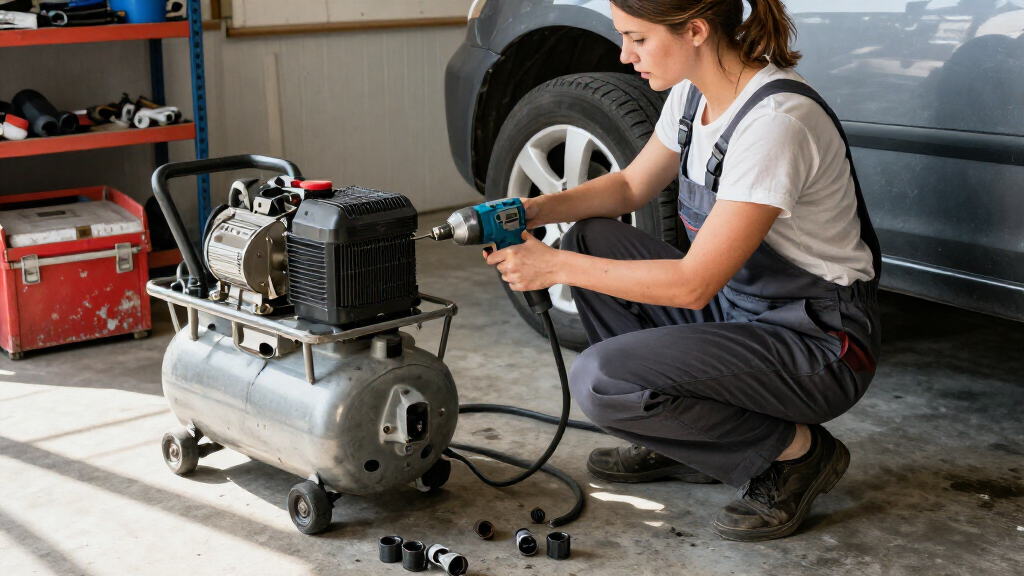
I compared the 14 compressors by the jobs a garage owner is likely to do: tire inflation, nailers, blowing off equipment, and longer-running pneumatic tools. The ranking weighs tank capacity and stated pressure alongside portability, noise, oil-free or oil-lubricated design, included accessories, and the practical demands of installation and power. I treated airflow at working pressure as a key buying check wherever it was provided, since tank volume and maximum PSI alone do not show how well a unit can keep a tool running.
The order favors models with a useful balance for common garage work, then places specialized choices according to the buyer who can benefit from them. Compact pancake compressors rank well for easy storage and occasional tasks but not for sustained high-demand use; larger stationary units can support more demanding work but call for more space and suitable electrical service. Where specifications are not supplied in the product name, I avoid assuming performance beyond the stated details, and buyers should verify the manufacturer’s airflow and duty-cycle information against their tools before choosing.
| garage air compressor | Pump |
|---|---|
| ECOMAX 6-Gallon 150 PSI Oil-Fr | Oil-free |
| CRAFTSMAN Wall-Mount Air Compr | — |
| Campbell Hausfeld 60-Gallon Tw | Oil-lubricated, two-stage cast iron |
| California Air Tools 8010A 1.0 | — |
| DEWALT 60-Gallon 175 PSI Stati | — |
| CRAFTSMAN 2-Gallon Portable Oi | Oil-free |
| VEVOR 13-Gallon Oil-Free Air C | Oil-free |
| Craftsman 20-Gallon Oil-Free A | Oil-free |
| Klutch 29-Gallon Oil-Free Air | Oil-free |
| CRAFTSMAN 8-Gallon Oil-Free Ai | Oil-free |
| Klutch 20-Gallon Portable Air | — |
| RyanTek 15-Gallon Air Compress | — |
| CRAFTSMAN 6-Gallon 150 PSI Oil | — |
| DEWALT DWFP55130 2.5-Gallon Po | — |
Factors to Consider When Choosing Garage Air Compressors
I’d choose a garage compressor by matching the air supply to the tools and the way the garage is used, not by picking the biggest tank or highest pressure figure. These broader checks can help prevent a mismatch that product features alone may not make obvious.
Match Airflow to the Tool, Not Just the Tank
Start with the tool’s stated air consumption at its working pressure, then compare that with the compressor’s delivered airflow at the same pressure. A tank stores a reserve; it does not make a low-output pump sustain a demanding tool indefinitely. Intermittent tools such as nailers can often work with a smaller compressor because the pump gets breaks between bursts. Sanders, grinders, and other continuous-use tools typically need stronger ongoing delivery. A common mistake is comparing compressors by maximum PSI alone, even though that figure does not tell you how quickly the tank refills. If a tool’s requirements are close to the compressor’s output, allow for practical headroom rather than expecting constant operation at the limit.
Choose Tank Capacity Around Your Work Rhythm
Tank capacity affects how much air is available before the pump must run, which can reduce interruptions during short bursts of work. It is not a substitute for pump output: a large tank paired with inadequate delivery will still run down during sustained use. For occasional inflation or brad-nailer work, a compact tank can save room and make storage easier. For several users or longer sessions, a larger tank may smooth out demand, provided the compressor can replenish it at a suitable rate. Think about whether you prefer a portable unit you can store after use or a fixed installation that stays ready in one place. Avoid buying extra capacity that your tools and available space will rarely use.
Account for Noise and Where the Compressor Will Sit
Compressor noise matters when the garage shares a wall with living space, sits beneath a bedroom, or is used for long work sessions. A quieter model can make conversation and nearby tasks less tiring, but sound ratings may be measured under conditions that differ from your room. Placement also affects noise: hard walls and corners can reflect sound, while a clear, ventilated location may reduce the sense of echo. Do not box a compressor into a tight cabinet simply to muffle it, since pumps need suitable airflow and service access. If noise is a priority, compare stated sound levels and the manufacturer’s placement guidance rather than relying on the word “quiet” alone. Consider how far the unit will be from the work area and whether a longer hose is appropriate for your tools.
Check Electrical Service Before Buying a Large Unit
Some garage compressors can run from a standard household circuit, while larger stationary models may call for a dedicated circuit or a different voltage. Confirm the voltage, amperage, plug type, and circuit requirements in the manufacturer’s documentation before delivery. A 230V unit can be a strong fit for a workshop already wired for it, but it may add installation work if the garage is not prepared. Do not assume that an adapter or extension cord makes an electrical mismatch safe. Starting current can also matter, particularly when other equipment shares the circuit. For a fixed installation, include electrical setup and access to a suitable outlet in the space plan.
Plan for Maintenance, Moisture, and Air Quality
Oil-free designs reduce routine oil checks, while oil-lubricated compressors require more attention but may suit buyers who value that style of pump. Either type needs basic care, including draining tank moisture according to the manual and checking fittings for leaks. Moisture can collect in the tank and travel into air lines, which may affect tools or paint work. If you plan to spray finishes, budget attention for filtration, water separation, and a dry-air setup; the compressor alone does not guarantee suitable paint air. Leave room to reach the drain, intake filter, and service points instead of placing the tank flush against a wall. Maintenance habits and air treatment can matter as much as the compressor choice for keeping tools working well.
Pay for Capacity You Can Use, Not Specs You May Never Need
Spending more makes sense when a larger compressor solves a real constraint: frequent tool use, multiple users, or a need for sustained airflow. A stationary tank also brings costs in space, wiring, noise control, and installation that a portable model may avoid. For occasional garage jobs, a smaller unit with a useful accessory bundle can be a more sensible fit if its output matches the tools. Do not let included accessories distract from checking airflow, hose compatibility, or the fittings your tools require. Think through the largest job you genuinely expect to do, then check whether that job is intermittent or continuous. This approach helps prevent both underbuying for demanding work and overbuying a compressor that dominates a small garage.
Frequently Asked Questions
Can a 6-gallon pancake compressor run a garage air tool?
It can run some tools, particularly those used in short bursts, but the tool’s air consumption and working pressure decide whether the match is practical. Nailers and inflation tasks often place less continuous demand on a compressor than sanding or grinding. Check the tool’s required airflow against the compressor’s delivered airflow at the relevant pressure, not just its maximum PSI. If the compressor falls short, the pump may run frequently and the tool may pause while the tank refills. For occasional jobs, that tradeoff may be acceptable; for long sessions, consider a higher-output model.
Is a larger tank always better for a home garage?
No. A larger tank stores more compressed air, which can help with short bursts and reduce how often the pump cycles, but it does not increase the pump’s ability to keep up with continuous demand. Larger compressors also take more floor space and may need more demanding electrical service. A compact model may be easier to move and store if your work is limited to inflation or intermittent tool use. Compare the pump’s delivered airflow with your tools before treating tank capacity as the deciding specification. Choose a larger tank when your work pattern benefits from the reserve and your garage can accommodate the unit.
Is an oil-free compressor the right choice if I want less maintenance?
Oil-free models can reduce routine oil-related upkeep, which may appeal to buyers who want a simpler garage setup. They still need care: tank moisture must be drained, air leaks addressed, and filters or other service items checked as the manual directs. Oil-free construction alone does not tell you how quiet or durable a model will be, so compare those factors separately. If you use tools for long sessions, check the compressor’s duty-cycle guidance and airflow rather than choosing by pump type alone. The right choice depends on your maintenance preferences and the demands of the work.
Do I need a 230V compressor for a home workshop?
Not necessarily. Several portable and mid-size garage compressors are designed around 120V power, which may better suit a typical household setup. A 230V model can make sense for demanding work or a dedicated workshop that already has compatible electrical service. Before choosing one, check the unit’s voltage and circuit requirements against your garage wiring and ask a qualified electrician if anything is unclear. Do not rely on an extension cord or an improvised connection to overcome a mismatch. The electrical setup should be part of the purchase decision, not a detail left until installation.
What should I check before using a compressor for spray painting?
Check the spray gun’s airflow and pressure requirements, then confirm the compressor can deliver enough air continuously for the intended work. Paint finishing also places a higher demand on clean, dry air than many inflation or nailing tasks. You may need filtration and moisture separation, and the placement of those components in the air line can affect results. A larger tank does not by itself remove water or oil contamination from the air. Review the compressor and spray-gun instructions together, and test the air-treatment setup before starting a finish you cannot easily redo.
Conclusion
For the broadest mix of garage use, I’d start with the California Air Tools 8010A as my best overall pick, especially when lower noise and a mid-size footprint matter. For best value and occasional tasks, compare the CRAFTSMAN 6-Gallon Pancake options and select based on the included hose and accessories you will actually use. Beginners who want a compact, approachable setup can look at the CRAFTSMAN 2-Gallon Portable, while recognizing its smaller reserve is not suited to sustained air demand. For best premium, high-capacity use, the Campbell Hausfeld 60-Gallon Two-Stage is the dedicated-shop choice if its 230V requirement and footprint fit your garage; the DEWALT 60-Gallon is another stationary option. If space and noise are the main constraints, compare the RyanTek 15-Gallon and California Air Tools 8010A; if portability is the priority, favor the smaller CRAFTSMAN or DEWALT portable models. Before deciding, match the chosen compressor’s verified airflow and electrical requirements to your tools and garage.