
The best electric vehicle motor for most DIY builders in this roundup is the Kunray KR5V V2, which pairs a 72V system with a 5000W rating for projects that need a strong middle ground between output and complexity. The KR10E 6500W kit is the higher-output choice for experienced builders, while the PeiXWming MY1020 offers a lower-power 48V route for simpler builds. These options differ not only in power, but also in voltage, drivetrain layout, and how much integration work they may require. Match the motor to your vehicle, battery, controller, gearing, and intended use before choosing by wattage alone. Read on for the full comparison and a guide to the tradeoffs that matter.

Get business pricing on garage and car supplies
- Business-only prices and quantity discounts
- Tax-exempt purchasing
- Multiple users, one account, clear invoices
Complete the kit


Key Takeaways
- The Kunray KR5V V2 leads as the most balanced pick: its 72V, 5000W rating sits between the lower-power options and the more demanding KR10E kit.
- The KR10E is the high-output option, not the default upgrade: its 6500W rating makes controller, battery, wiring, and thermal compatibility especially important.
- Lower voltage does not automatically mean a simpler project: the PeiXWming MY1020 is a 48V, 2000W motor, but the whole system still needs compatible controls and mounting.
- Drivetrain layout changes the build as much as power does: the HBWLKJ01 includes a differential, while the MOTOBERRY is a mid-drive and the geared 1800W motor has a 16-tooth gear.
- These motors are not interchangeable drop-ins: voltage, controller pairing, shaft or gear fit, mounting, and vehicle use determine whether a candidate can work in a specific build.
| Kunray KR5V V2 72V 5000W Brushless DC Motor |  | Best Overall for 72V Mid-Drive Builds | Motor type: Brushless DC mid-drive | Voltage: 72V | Peak power: 10kW | VIEW LATEST PRICE | See Our Full Breakdown |
| KR10E 72V 6500W Brushless Motor Kit with NS18 Controller |  | Best High-Power Complete Kit | Motor model: KR10E | Voltage: 72V | Peak power: 12,500W | VIEW LATEST PRICE | See Our Full Breakdown |
| HBWLKJ01 60V/72V 3000W Brushless DC Motor with Differential |  | Best for Differential-Equipped Builds | Motor type: Permanent-magnet brushless DC | Voltage: 60V/72V | Power: 3,000W | VIEW LATEST PRICE | See Our Full Breakdown |
| 60V 1800W Brushless Geared DC Motor with 16-Tooth Gear |  | Best Compact Geared Option | Motor type: Brushless DC geared motor | Voltage: 60V | No-load speed: 3,200 r/min | VIEW LATEST PRICE | See Our Full Breakdown |
| PeiXWming MY1020 48V 2000W Brushless DC Motor |  | Best for 48V Builds | Motor type: Brushless DC | Voltage: 48V | Power: 2,000W | VIEW LATEST PRICE | See Our Full Breakdown |
| MOTOBERRY 60V 2000W Brushless DC Mid-Drive Motor | 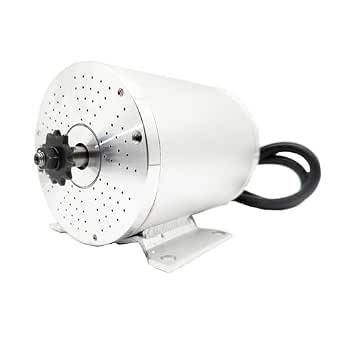 | Best 60V DIY Mid-Drive | Brand: MOTOBERRY | Model: MY1020 | Motor type: Brushless DC mid-drive | VIEW LATEST PRICE | See Our Full Breakdown |
| electric vehicle motor | Voltage | Motor type | Sprocket |
|---|---|---|---|
| Kunray KR5V V2 72V 5000W Brush | 72V | Brushless DC mid-drive | #35, 9 teeth |
| KR10E 72V 6500W Brushless Moto | 72V | — | — |
| HBWLKJ01 60V/72V 3000W Brushle | 60V/72V | Permanent-magnet brushless DC | — |
| 60V 1800W Brushless Geared DC | 60V | Brushless DC geared motor | — |
| PeiXWming MY1020 48V 2000W Bru | 48V | Brushless DC | T8F |
| MOTOBERRY 60V 2000W Brushless | 60V DC | Brushless DC mid-drive | T8F, 11 teeth |
More Details on Our Top Picks
Kunray KR5V V2 72V 5000W Brushless DC Motor
I’d put the Kunray KR5V V2 first for builders who want a substantial 72V mid-drive motor without stepping up to the KR10E kit’s higher peak output. Its 5,000W rated power and 10kW peak suit go-karts, dirt bikes, and scooters built around a compatible controller, while the external Hall sensor and temperature sensor provide useful system feedback. The heatsink and air cooling help manage heat, but this remains a high-current motor: Kunray recommends an 80–100A controller, which adds a real compatibility check before installation. Compared with the KR10E, the KR5V is less powerful but lighter at 12.7 lb and has a specified IP54 rating. Its #35 nine-tooth sprocket also narrows drivetrain choices, so I’d skip it if your build uses a different chain setup or needs a complete motor-controller kit.
Pros:- 5,000W rated output with 10kW peak power for demanding compatible builds.
- Heatsink, air cooling, and a temperature sensor support heat monitoring.
- External Hall sensor is positioned to reduce exposure to heat inside the motor.
- IP54 rating and #35 nine-tooth sprocket are specified.
Cons:- Requires a compatible 72V controller; the recommended 80–100A range makes controller matching important.
- The #35 nine-tooth sprocket limits drivetrain compatibility.
- Motor only; controller and vehicle-specific installation parts are not included.
Best for: Builders of 72V go-karts, dirt bikes, or scooters who need a 5kW mid-drive motor and can match a high-current controller and #35 chain.
Not ideal for: Buyers seeking a ready-to-install motor kit, a lower-voltage setup, or a drivetrain that cannot use a #35 chain and nine-tooth sprocket.
- Motor type:Brushless DC mid-drive
- Voltage:72V
- Peak power:10kW
- Peak torque:35 N·m
- Peak speed:8,000 rpm
- Recommended controller current:80–100A
- Sprocket:#35, 9 teeth
- Water resistance:IP54
Our verdict“Choose the KR5V if you need a capable 72V mid-drive motor with specified cooling and water resistance, and already have a compatible controller and #35 drivetrain.”
KR10E 72V 6500W Brushless Motor Kit with NS18 Controller
The KR10E kit earns its place for buyers who want the motor and controller together, rather than sourcing a separate controller as with the Kunray KR5V V2. Its 12,500W peak power and 42 N·m peak torque give it the strongest stated output among these options, while the programmable NS18 controller lets a builder tailor throttle response and power delivery. That flexibility also brings complexity: tuning beyond factory settings calls for professional guidance, and the encoder motor does not use Hall connectors. The 14.5 lb motor is heavier than the KR5V, and its specified bottom-mount pattern makes frame measurements a prerequisite, not an afterthought. I’d choose it for a serious 72V off-road project with room for the hardware; buyers with a Razor vehicle should rule it out because the listing states it is incompatible.
Pros:- 12,500W peak power and 42 N·m peak torque lead the listed motor options here.
- Includes a programmable Fardriver NS18 controller and keyed voltmeter throttle.
- Temperature sensor, heatsink, copper coil, and air cooling support heat management.
- Pre-installed 420 nine-tooth sprocket and encoder provide drivetrain and motor-control details.
Cons:- Frame dimensions and mounting-hole spacing must be checked before purchase.
- Controller tuning beyond factory settings may require professional guidance.
- Not compatible with Razor vehicles and does not use Hall connectors.
Best for: Experienced builders of 72V go-karts or dirt bikes who want a high-output motor, a programmable controller, and the ability to verify frame fit.
Not ideal for: Razor owners, first-time installers who need plug-and-play wiring, or builders whose frames do not match the specified bottom-mount pattern.
- Motor model:KR10E
- Voltage:72V
- Peak power:12,500W
- Peak torque:42 N·m
- Maximum speed:9,000 RPM
- Controller:Fardriver NS18 programmable sine-wave controller
- Motor weight:14.5 lb
- Mounting:Bottom-mounted; 4 M8 × 1.25 holes, 4.02 × 3.88 in spacing
- Included components:Motor with pre-installed 420 9T sprocket, NS18 controller, keyed voltmeter throttle
Our verdict“Pick the KR10E kit for a high-output 72V off-road build when you can confirm the mounting fit and are prepared to handle programmable-controller setup.”
HBWLKJ01 60V/72V 3000W Brushless DC Motor with Differential
The HBWLKJ01 stands apart because it includes a differential, a useful distinction for vehicle designs that need that component alongside the motor. Its 60V/72V compatibility also gives it more system flexibility than the 48V PeiXWming MY1020, though the listing provides little guidance on mounting, wiring, or vehicle fit. The stated 3,000W output places it below the Kunray KR5V V2’s 5,000W rating, so I’d treat it as a more modest-power option rather than a substitute for that motor in a high-output build. The speed information is unclear: the listing gives both 4,600 rpm and 4,200 rpm at 60V without resolving how the figures relate. I’d only choose it after confirming the RPM, dimensions, and differential compatibility with the seller or vehicle documentation.
Pros:- Differential is included, unlike the standalone motors listed here.
- Supports both 60V and 72V systems according to the product information.
- Permanent-magnet brushless design is specified.
- Listed 3,000W output is between the lower-wattage geared option and higher-output 72V motors.
Cons:- The listing gives conflicting speed figures: 4,600 rpm and 4,200 rpm at 60V.
- Vehicle compatibility and installation dimensions are not specified.
- The listed 50 g item weight is difficult to reconcile with a complete motor-and-differential assembly.
Best for: Custom electric-vehicle builders who specifically need an included differential and can verify voltage, dimensions, and speed details before ordering.
Not ideal for: Buyers who need well-documented installation dimensions, predictable RPM data, or a clearly specified high-output motor for an off-road build.
- Motor type:Permanent-magnet brushless DC
- Voltage:60V/72V
- Power:3,000W
- Listed speed:4,600 rpm; also listed as 4,200 rpm at 60V
- Differential:Included
- Brand:HBWLKJ01
Our verdict“Consider the HBWLKJ01 only if its included differential and dual-voltage listing suit your project and you can independently verify its fit and speed data.”
60V 1800W Brushless Geared DC Motor with 16-Tooth Gear
For a smaller 60V retrofit, this 1,800W geared motor favors manageable packaging and starting or climbing torque over the outright output of the Kunray KR5V V2. Its aluminum shell and copper windings support heat dissipation, while the 16-tooth gear offers a defined starting point for a compatible drivetrain. At 5.5–5.8 kg, it is much lighter than the KR10E motor, which can help when weight and installation space matter. The tradeoff is less protection and less installation certainty: it has no IP rating, and mounting dimensions and connector type need checking before purchase. Its 83% stated efficiency and 30–40A continuous controller recommendation also place it in a different class from the high-current 72V motors. I’d favor it for a modest scooter, bicycle, or tricycle build, not a wet-weather or high-power project.
Pros:- Geared drive is designed to provide stronger starting and climbing torque than a direct-drive setup.
- Aluminum shell and pure copper windings support heat dissipation.
- Lighter than the listed KR5V and KR10E motors, at 5.5–5.8 kg.
- 16-tooth gear and 30–40A continuous controller guidance help define drivetrain planning.
Cons:- No IP rating is specified, so prolonged water exposure should be avoided.
- Mounting dimensions and connector type must be checked for fit.
- Motor surface can become hot during operation.
Best for: Scooter, bicycle, or tricycle builders seeking a relatively light 60V geared motor for a modest-power retrofit with a compatible mounting setup.
Not ideal for: Riders who expect prolonged wet-weather use or builders seeking the high output and heat-monitoring details of the KR5V V2 or KR10E.
- Motor type:Brushless DC geared motor
- Voltage:60V
- No-load speed:3,200 r/min
- Efficiency:83%
- Gear:16-tooth
- Weight:5.5–5.8 kg
- Recommended controller current:30–40A continuous
- Materials:Aluminum shell, pure copper coil
Our verdict“Choose this motor for a compact 60V retrofit where gearing and lower weight matter more than weather protection or high peak output.”
PeiXWming MY1020 48V 2000W Brushless DC Motor
The PeiXWming MY1020 is the lineup’s clearest match for a 48V project: its 2,000W rating avoids the 60V or 72V system requirements of the geared motor and Kunray models. Hall sensors, labeled wiring ports, and an included mounting base give builders useful installation cues, though they do not replace checking the mounting dimensions. At approximately 9.5 lb, it sits between the lighter 60V geared option and the heavier KR10E, while its T8F sprocket means the drivetrain must match that chain format. The listed 5 N·m torque is modest beside the KR5V’s 35 N·m and the KR10E’s 42 N·m, so I would not choose it for a build prioritizing strong torque. Warranty information also conflicts, listing both one year and an extended 24 months for qualifying issues.
Pros:- 48V specification suits builds that do not use the 60V or 72V systems of other motors in this roundup.
- Hall sensors, labeled wiring ports, and a mounting base provide useful installation details.
- Aluminum alloy housing, copper coils, and cooling vents support heat dissipation.
- T8F sprocket and approximately 27.6-inch motor cable are specified.
Cons:- Listed torque is 5 N·m, well below the Kunray KR5V V2 and KR10E figures.
- Mounting dimensions still need to be checked against the vehicle.
- Product information gives conflicting warranty terms of one year and an extended 24 months for qualifying issues.
Best for: Builders of compatible 48V scooters, go-karts, or off-road vehicles who want a 2,000W brushless motor with labeled wiring and a mounting base.
Not ideal for: Buyers building around 60V or 72V systems, needing high stated torque, or requiring settled warranty terms before purchase.
- Motor type:Brushless DC
- Voltage:48V
- Power:2,000W
- Maximum speed:5,100 RPM
- Torque:5 N·m
- Sprocket:T8F
- Weight:Approximately 9.5 lb
- Included components:Electric brushless DC motor
Our verdict“Pick the MY1020 for a compatible 48V build that values installation details over the higher torque and power potential of the 72V options.”
MOTOBERRY 60V 2000W Brushless DC Mid-Drive Motor
The MOTOBERRY MY1020 is a practical fit for DIY builders who want a 60V, 2000W brushless mid-drive without stepping up to the higher-power options in this roundup. Its 4300–4500 RPM no-load speed and 11-tooth T8F sprocket give builders specific drivetrain details to match against their intended setup, while the aluminum-alloy housing and copper coil support heat handling. Compared with the PeiXWming MY1020, this motor calls for a 60V system rather than 48V, so it suits a different battery and controller combination—not a direct swap for every build. It is also far less powerful than the 72V Kunray KR5V and KR10E. The tradeoff is that the listing includes only the motor, and its stated dimensions omit length, leaving fitment checks to the buyer.
Pros:- 60V, 2000W brushless mid-drive suits compatible DIY vehicle projects.
- 4300–4500 RPM no-load speed and 11-tooth T8F sprocket provide useful drivetrain matching details.
- Aluminum-alloy housing and copper coil support heat dissipation.
- Listed for scooters, go-karts, e-bikes, and electric tricycles.
Cons:- Requires a compatible 60V battery and electrical setup.
- Only the motor is listed as included, so other drive-system components must be sourced separately.
- Dimensions give width and height but omit length, limiting fitment information.
Best for: DIY scooter, go-kart, e-bike, or tricycle builders who already have a compatible 60V electrical system and want a 2000W brushless mid-drive.
Not ideal for: Builders seeking a complete motor-and-controller kit, a documented full set of mounting dimensions, or the greater power of the 72V Kunray KR5V or KR10E.
- Brand:MOTOBERRY
- Model:MY1020
- Motor type:Brushless DC mid-drive
- Voltage:60V DC
- No-load speed:4300–4500 RPM
- Sprocket:T8F, 11 teeth
- Housing material:Aluminum alloy
- Item weight:4.6 kg
Our verdict“Choose the MOTOBERRY MY1020 for a 60V DIY build that needs a 2000W mid-drive, but look elsewhere for a complete kit or substantially higher output.”
How We Picked
I ranked these motors around the decisions that shape an electric vehicle build: power and voltage fit, drivetrain arrangement, and the amount of system matching a buyer should expect. I treated a motor’s wattage as one clue rather than a promise of vehicle speed or range, since battery capability, controller limits, gearing, load, and cooling all affect real performance. A kit with a controller or a motor with a defined drivetrain feature can reduce some integration uncertainty, but it does not remove the need to check compatibility.
The Kunray KR5V V2 ranks first as the broadest middle-ground choice in this lineup. The KR10E follows for buyers who can support its higher output; the HBWLKJ01 earns a distinct place for builds that need its differential arrangement. The remaining picks serve more specific priorities: geared output, a lower-voltage system, or a mid-drive layout. I weighed versatility and clear use-case fit alongside output, rather than ranking every motor by its largest wattage figure.
| electric vehicle motor | Motor type | Sprocket |
|---|---|---|
| Kunray KR5V V2 72V 5000W Brush | Brushless DC mid-drive | #35, 9 teeth |
| KR10E 72V 6500W Brushless Moto | — | — |
| HBWLKJ01 60V/72V 3000W Brushle | Permanent-magnet brushless DC | — |
| 60V 1800W Brushless Geared DC | Brushless DC geared motor | — |
| PeiXWming MY1020 48V 2000W Bru | Brushless DC | T8F |
| MOTOBERRY 60V 2000W Brushless | Brushless DC mid-drive | T8F, 11 teeth |
Factors to Consider When Choosing Best Electric Vehicle Motors
Before choosing among these motors, I would map the motor to the whole vehicle system, not shop by wattage in isolation. The following checks can prevent a mismatch that turns a promising motor into an expensive fabrication or electrical project.
Match Voltage Across the Motor, Battery, and Controller
Start by checking the motor’s stated voltage against the battery’s operating range and the controller’s supported input. A 48V, 60V, or 72V label is not a casual preference: a mismatch can cause poor operation or damage components. Battery voltage can vary with charge state, so check the controller and motor specifications for their allowed range rather than relying only on the pack’s name. Also verify connector type, current limits, and whether the battery management system can support the controller’s demand. A higher-voltage setup may reduce current for a given power level, but it requires compatible parts throughout the system. Common mistake: buying the motor first and discovering that the existing battery and controller cannot support it.
Treat Wattage as a System Requirement, Not a Performance Promise
A motor’s wattage rating does not tell you exactly how fast a vehicle will travel or how far it will go. The result depends on controller output, battery capacity, gearing, wheel size, vehicle weight, terrain, and how long the motor must sustain its load. A higher rating can support more demanding use, but it can also call for heavier electrical components and better heat management. For a project with long climbs or sustained high load, check whether the motor’s rating is continuous or peak and ask how cooling is handled. For lighter duty, an oversized motor may add integration demands without improving the part of the ride you care about. Choose around the job and duty cycle, not the biggest number on the label.
Choose the Drivetrain Layout Before Planning Mounts
Motor placement determines how power reaches the wheels and what parts the vehicle needs around it. A mid-drive can work through a mechanical drivetrain, while a differential-based arrangement handles drive distribution differently; a geared motor’s output must match its intended driven component. Check mounting points, shaft dimensions, gear or sprocket fit, chain alignment, and clearance before ordering. A motor that looks close in a listing may still need custom brackets or drivetrain changes. Those changes affect cost, serviceability, and how easily you can replace wear parts later. Decide on the vehicle layout first, then shortlist motors that can physically and mechanically fit it.
Check Controller Pairing and Electrical Headroom
A controller must suit the motor’s voltage and current needs, and its settings should match the motor type. A kit that includes a controller may simplify sourcing, but buyers still need to confirm that the controller supports their battery, throttle, sensors, and intended operating limits. Look for current ratings, protection features, wiring diagrams, and whether the controls supplied match the vehicle. Leave headroom in the battery, wiring, connectors, and fuse selection rather than treating every component’s maximum rating as a normal operating target. Inadequate wiring or connectors can overheat under load even when the motor itself is suitable. If you are replacing only the motor, verify compatibility with the parts already installed before assuming they can be reused.
Plan for Heat, Duty Cycle, and Maintenance
Repeated acceleration, low-speed heavy loads, and long climbs can heat a motor more than short bursts do. Ask how the motor is cooled and whether its rating suits the duration and conditions of your intended use. Make room for airflow, inspect cable routing, and consider how you will reach bearings, gears, and fasteners for service. A compact or enclosed installation may protect components from debris but can limit heat dissipation. Maintenance needs also depend on the rest of the drivetrain, including chain tension, lubrication, and alignment. Buying more power does not solve a cooling or maintenance problem, so plan those needs before settling on a motor.
Account for Legal Use and the Complete Build
A motor’s power and the vehicle it goes into may affect where the finished build can be used legally. Rules vary by location and by vehicle type, so check local requirements before buying, especially if the project may be used on public roads or shared paths. Budget for the complete system: battery, controller, charger, mounting hardware, cables, fuses, and any drivetrain changes. A motor sold on its own may require more compatible parts than a kit, even if its headline specification looks attractive. Check what is included and what support or documentation is available for installation. This broader view can make a lower-rated, better-matched setup a better project choice than a powerful motor that needs extensive supporting upgrades.
Frequently Asked Questions
Can I run a 72V motor from a 60V battery?
Do not assume that a 72V motor will work correctly on a 60V pack. The answer depends on the motor’s permitted voltage range, the controller’s input limits, and how the system is configured. A lower supply voltage can change available performance, while an incompatible controller or operating range can cause faults or damage. Check the manufacturer’s specifications for both components, including the battery’s full-charge voltage rather than only its nominal label. If the documentation does not confirm compatibility, ask the supplier or choose a matched motor, controller, and battery setup.
Is the 6500W KR10E automatically a better choice than the 5000W Kunray?
No. The KR10E’s higher stated output suits a build designed to support more power, but it may call for a capable battery, controller, wiring, and heat-management plan. The Kunray KR5V V2 is the more balanced choice for buyers who want a substantial 72V motor without making maximum output the main priority. Neither rating alone predicts vehicle speed or range; gearing, load, wheel size, and controller setup matter too. Choose the KR10E only if the rest of the system and the vehicle’s structure match its demands.
Can I replace an existing motor without changing the controller?
Possibly, but only if the controller supports the replacement motor’s voltage, current, motor type, and sensor arrangement. Physical fit is not proof of electrical compatibility. Compare connector and wiring layouts, controller limits, throttle requirements, and any hall sensor or other feedback specifications. A replacement with a different power rating may also exceed the limits of the battery or wiring even if it connects. Confirm the complete pairing against manufacturer documentation before powering the system.
Which matters more for a conversion: motor wattage or drivetrain layout?
Both matter, but drivetrain layout should be settled early because it determines how the motor can connect to the vehicle. A high-output motor is not useful if its shaft, gear, mounting position, or power delivery does not fit the build. Once the layout is workable, compare power needs against vehicle weight, terrain, duty cycle, and available battery capacity. The HBWLKJ01’s differential and the MOTOBERRY’s mid-drive represent different integration paths, not just different power choices. Check fit and mechanical compatibility before using wattage to separate otherwise suitable candidates.
What should I verify before buying a motor listed without a complete kit?
Confirm exactly what is included: motor, controller, throttle, wiring, mounting hardware, and any required sensors or drive components. Then check the motor’s voltage and current requirements against your battery, controller, and charger, and verify shaft dimensions and mounting measurements against the vehicle. Ask for clear specifications on continuous versus peak output, cooling, and wiring if the listing leaves them unclear. Plan for compatible fuses, connectors, and cables rather than assuming existing parts will carry the load. A parts list and wiring diagram can reveal extra requirements before they become build delays.
Conclusion
For most DIY builders, I recommend the Kunray KR5V V2 as the best overall because its 72V, 5000W specification occupies a useful middle ground in this lineup. The PeiXWming MY1020 is the best value-minded choice for a project built around a 48V, 2000W motor, while the KR10E is the best premium-style pick for experienced builders with a system designed for its higher output. Beginners should start with a clearly documented, compatible setup and may prefer a lower-power project such as the PeiXWming, after checking what supporting parts are needed. For a differential-based build, shortlist the HBWLKJ01; for a mid-drive layout, look at the MOTOBERRY; and for a geared setup, compare the 60V 1800W motor against your mounting and gear requirements. My final choice would depend on system compatibility first, then power and drivetrain fit.