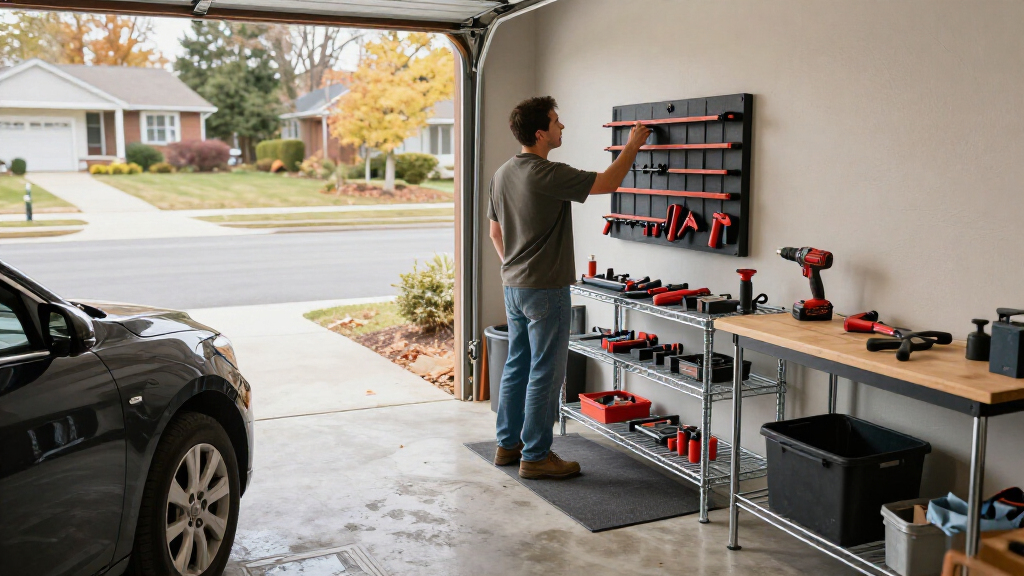
This checklist is for anyone planning a more capable home garage, whether you’re organizing tires, working on vehicles, or adding equipment for maintenance tasks. Each pick fills a different role, so consider the work you expect to do and the space and power available in your garage. Your projects and workspace are the best starting point.

Get business pricing on garage and car supplies
- Business-only prices and quantity discounts
- Tax-exempt purchasing
- Multiple users, one account, clear invoices
The sections move from lifting and storage to shop equipment, a cordless tool, and support gear. Each one explains why the slot matters, what to check before buying, and who the named pick may suit. Use the categories to compare each item with your actual garage setup.
Read the fit and compatibility notes before making a choice. Check the product’s specifications and instructions for vehicle compatibility, installation needs, electrical requirements, and included accessories; the product name alone may not answer those questions. Verify the details that affect safe use and day-to-day convenience.
Portable Car Lift
A portable lift can change how accessible a vehicle is during garage work, so this slot calls for careful attention to fit and setup. The pick is the XK Mobile Car Lift 6200 lb Single Post Manual Unlock 220V. Its name identifies a 6,200-pound capacity, a single-post design, manual unlocking, and 220V power. Those details are a starting point for comparison, not a substitute for checking the manufacturer’s compatibility guidance. Vehicle fit and setup should lead your review.
A common mistake is focusing on capacity while overlooking lift-point placement, vehicle clearance, floor conditions, or the electrical supply. Confirm the vehicle’s weight and approved lifting points against the lift documentation, and check whether the garage floor and ceiling clearance meet the specified requirements. Make sure the required 220V supply is available and that you understand the manual unlocking procedure. Check every requirement before planning installation or use.
Consider how the lift will be positioned, moved, and stored, and whether its operating area leaves room to work around the vehicle. If you expect to use it with more than one vehicle, compare each vehicle’s specifications individually. Keep the operating instructions accessible and follow the maker’s setup and use guidance. Compatibility comes first for this equipment.
What to look for:
- Vehicle weight and approved lift-point compatibility
- Required floor, clearance, and installation conditions
- 220V electrical supply requirements
- How the manual unlock procedure works
- Storage, positioning, and operating-space needs
XK Mobile Car Lift 6200 lb Single Post Manual Unlock 220V

This mobile single post car lift has a maximum capacity of 6200 lbs and is designed for easy movement and maintenance. It features safety locks, extendable support arms, and reinforcement systems suitable for large SUVs and trucks.
Pros:
- High lifting capacity suitable for large vehicles
- Safe and adjustable support arms for various vehicle types
- Easy to move without space limitations
Cons:
- Heavy weight (714 kg) may require assistance to move
- Requires 220V power supply, limiting portability in some locations
- Complex setup may need professional installation
Best for: Garages with compatible vehicles and the specified 220V supply
Not ideal for: Setups that cannot meet the lift’s documented requirements
Bottom line: Confirm vehicle, floor, clearance, and electrical compatibility before choosing this lift.
Wall-Mounted Tire Rack
A dedicated tire rack can give seasonal or spare tires a defined storage place, helping keep the garage floor available for other tasks. The pick, Adjustable Rolling Tire Rack for Garage and Workshop, combines adjustability with a rolling design in its name. Before choosing it, determine whether its mounting approach and mobility suit your layout; the title alone does not explain how it is installed or whether it rolls while loaded. Storage needs and layout guide this decision.
One common buying mistake is assuming that “adjustable” means the rack fits every tire or that “rolling” means it can be moved safely in every configuration. Check the stated tire dimensions and load limits, and confirm the adjustment range accommodates the items you plan to store. Because the product name also says “wall-mounted,” verify what must attach to the wall and whether the rolling feature applies to the whole rack or a particular configuration. Resolve the design details before installation.
Measure the intended location, including access around the rack and the clearance needed to load and remove tires. Check the wall and mounting hardware requirements in the product documentation, and follow the specified installation method. If you need the rack to move, confirm how it is stabilized and what conditions are allowed for movement. Measure first and match the rack’s documented use to your space.
What to look for:
- Tire size range and stated load limits
- Wall attachment and mounting requirements
- What the rolling feature allows in use
- Adjustment range for the tires you store
- Clearance for loading, removal, and movement
Adjustable Rolling Tire Rack for Garage and Workshop
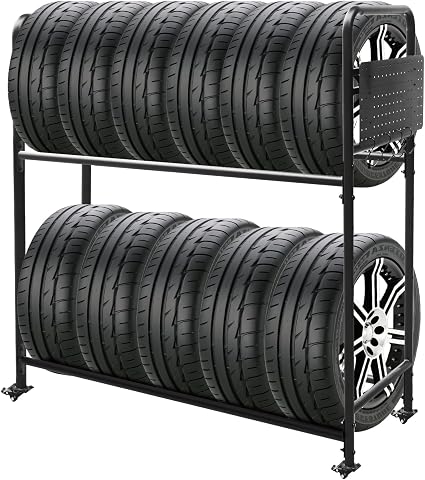
This heavy-duty, foldable tire storage rack features adjustable tiers, a sturdy metal frame supporting up to 620 lbs per tier, and four swivel casters with locking brakes for mobility and stability. It includes a detachable tool shelf, making it ideal for organizing tires, tools, and accessories in garages, workshops, or storage areas.
Pros:
- Heavy-duty construction supports up to 620 lbs per tier
- Adjustable height and tier spacing for various tire sizes
- Mobility with locking casters for flexible placement
- Includes a detachable tool shelf for added organization
Cons:
- Assembly may require time and effort
- Large size may not suit small garages
- Limited color options
Best for: Garages that need adjustable tire storage and can meet mounting requirements
Not ideal for: Spaces without a suitable mounting location or movement clearance
Bottom line: Check tire fit, mounting details, and rolling use before setting aside wall space.
Garage Air Compressor
An air compressor can support garage tasks that call for compressed air, but choosing one starts with the tools and work you actually plan to run. The listed pick is the Campbell Hausfeld 60-Gallon 2-Stage Vertical Air Compressor, 175 PSI. Its name provides tank capacity, configuration, and maximum pressure as comparison points. Tool requirements matter more than a headline specification on its own.
A frequent mistake is treating maximum pressure or tank volume as proof that a compressor will suit every air tool. Check each tool’s required pressure and airflow, then compare those figures with the compressor’s published output at the relevant pressure. Also confirm the electrical supply, installation conditions, and ventilation requirements from the product documentation. A vertical compressor needs a planned location with appropriate access for operation and service. Match the compressor to the tools and the garage infrastructure.
Before purchase, measure the proposed footprint and account for the space needed around the unit as specified by the manufacturer. Check whether the installation calls for a dedicated circuit or other electrical provisions, and review noise and drainage guidance in the documentation. The product name does not establish these details. If you expect to connect multiple tools or use them continuously, check the intended duty and output requirements carefully. Plan the installation alongside the tool list.
What to look for:
- Airflow and pressure needs of intended tools
- Published compressor output at working pressure
- Electrical supply and installation requirements
- Footprint, access, and ventilation guidance
- Operating and maintenance instructions
Campbell Hausfeld 60-Gallon 2-Stage Vertical Air Compressor, 175 PSI, 230V

A heavy-duty stationary air compressor with an oil-lubricated two-stage cast-iron pump rated for up to 10,000 hours of life. It delivers 7.6 SCFM at 90 PSI and a maximum of 175 PSI from a 3.7 HP 230V induction motor, powered through a space-saving 60-gallon vertical ASME tank.
Pros:
- Durable two-stage cast-iron pump with up to 10,000 hours of life
- High airflow and 175 PSI max pressure support demanding air tools
- Vertical design saves floor space in garages and workshops
- Quieter, lower-maintenance operation compared to gas-powered alternatives
Cons:
- Requires a dedicated 230/240V electrical supply
- Oil-lubricated pump requires ongoing oil maintenance
- Stationary design is not portable
Best for: Garages whose tools match the compressor’s documented output
Not ideal for: Setups without suitable space or electrical provisions
Bottom line: Compare tool requirements with published output and confirm installation needs.
Cordless Impact Wrench
A cordless impact wrench can be a convenient addition when your garage work calls for a powered fastening tool. The pick is the DEWALT 20V MAX Cordless Impact Wrench with Hog Ring Anvil, Brushless H. The name identifies a 20V MAX platform, hog ring anvil, and brushless design, while the ending appears truncated. Confirm the complete model details and included contents before comparing it with your needs.
A common mistake is assuming the tool includes a battery, charger, or every socket needed for a job. Check the exact package contents and whether you already have a compatible battery and charger. Review the manufacturer’s stated fastening capabilities and intended applications, then choose sockets rated for impact use and appropriate to the fasteners you expect to encounter. Package and task compatibility shape the practical choice.
Fit matters too: consider the tool’s size, grip, controls, and access in the spaces where you plan to use it. Check whether the hog ring anvil works with your preferred impact sockets and whether the retention approach suits your workflow. For vehicle fasteners, follow the vehicle maker’s specifications and use a suitable torque-checking method when required. Use the right socket and procedure for the task.
What to look for:
- Complete model identifier and package contents
- Battery and charger inclusion and compatibility
- Manufacturer-stated fastening capabilities
- Impact socket fit with the hog ring anvil
- Tool access, handling, and intended applications
DEWALT 20V MAX Cordless Impact Wrench with Hog Ring Anvil, Brushless High Torque

The DEWALT DCF900P1 is a 20V MAX brushless high-torque 1/2-inch impact wrench delivering 1030 ft-lbs of max fastening torque and 1400 ft-lbs of max breakaway torque. It features 4-mode speed settings with a variable speed trigger, Precision Wrench control to prevent overtightening and fastener run-off, and an on-tool LED work light.
Pros:
- Extremely high torque output (1030 ft-lbs fastening, 1400 ft-lbs breakaway) for heavy-duty applications
- Precision Wrench mode helps prevent overtightening and fastener run-off
- 4-mode speed settings with variable speed trigger for user control
- Includes battery, charger, and kit bag with a 3-year limited warranty
Cons:
- Heavy at 11 pounds, which may cause fatigue during extended use
- Battery sold separately in some configurations
Best for: Users with compatible batteries and tasks suited to the tool
Not ideal for: Buyers who need a complete kit without verifying package contents
Bottom line: Confirm the full model, included battery system, and task requirements before buying.
Mechanic Creeper Seat
A creeper seat can make garage work more comfortable when tasks call for sitting or moving at a low height. The pick is the Omega 91452 Black Low Profile Z-Creeper. Its name identifies a low-profile Z-creeper style, but it does not state dimensions, weight capacity, padding, or conversion details. Fit and stated capacity are essential checks before selecting a seat.
A common mistake is choosing based only on the “low profile” description without checking whether the seat height and working position suit the jobs at hand. Review the manufacturer’s dimensions and load limit, and determine whether the product’s configuration matches how you intend to work. Check the wheel design and any stated floor-surface limitations, since movement and stability affect day-to-day usability. Check the specifications rather than relying on the product name.
Measure the clearance under the vehicles or work areas where you expect to use the creeper, and consider how easily you can get on and off the seat. Review assembly instructions, maintenance guidance, and any locking or positioning features listed by the manufacturer. Keep the work area clear of obstacles that could interfere with movement. Match the seat to your workspace and follow the product’s use guidance.
What to look for:
- Seat dimensions and working height
- Documented weight capacity
- Wheel suitability for your floor surface
- Configuration and intended working positions
- Assembly, maintenance, and clearance needs
Omega 91452 Black Low Profile Z-Creeper

The Omega 91452 Z-Creeper features a low profile design for extra workspace, with six swivel casters for mobility and thick padded cushions for comfort. Its foldable body allows for multiple positions, including sitting, making it versatile for various jobs.
Pros:
- Low profile design provides extra workspace
- Foldable for multiple positions including sitting
- Swivel casters enable easy mobility
- Thick padded cushions for extended comfort
Cons:
- No specific material details provided
- Potentially heavy due to capacity and padding
Best for: Tasks where a low creeper seat fits the work area
Not ideal for: Workspaces that need dimensions or capacity the product cannot meet
Bottom line: Verify dimensions, capacity, and floor suitability before choosing the creeper.
Automotive Battery Charger
A dedicated charger can be useful for battery-related garage work, but the right choice depends on the battery and functions you need. The named pick is the Schumacher Electric SC1445 Wheeled 6/12V 250A Battery Charger and Engi. The title identifies wheeled construction, 6/12V operation, and a 250A figure; the final word appears cut off, so confirm the complete product description. Battery compatibility comes first.
A common mistake is assuming that a charger suits every battery because its voltage matches. Check the battery type and capacity against the charger’s documented compatibility and charging instructions. Clarify what the 250A specification describes and whether it applies to a particular starting or charging function. Review the available operating modes and protections in the full product documentation. Understand the specifications before connecting equipment.
Consider where the wheeled unit will be used and stored, including access to the vehicle and a suitable power outlet. Check the charger’s input requirements, cable reach, and operating instructions, and follow the battery and vehicle makers’ guidance during use. If you need charging, starting assistance, or both, verify that the complete model supports the intended task. Confirm the full model and functions before relying on the product title.
What to look for:
- Complete model name and documented functions
- Compatibility with the specific battery type
- Meaning of the 250A specification
- Input power and cable reach
- Storage, movement, and operating instructions
Schumacher Electric SC1445 Wheeled 6/12V 250A Battery Charger and Engine Starter
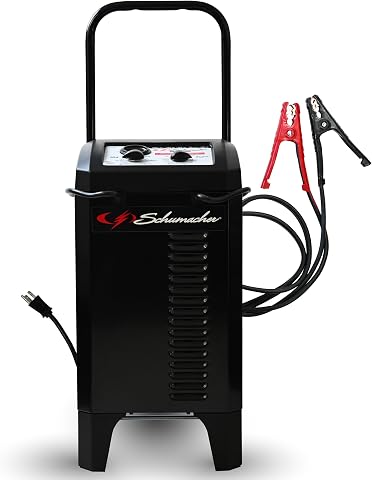
This wheeled manual battery charger and engine starter supports 6V and 12V standard, AGM, gel, and deep-cycle batteries for automotive, marine, and powersport use. It offers a 250A engine start, 25A and 50A boost charging, and a 135-minute timer for manual charging control.
Pros:
- High 250A engine-start capacity
- Supports multiple battery types and vehicle categories
- Offers 25A and 50A boost charging
- Wheeled design for mobility
Cons:
- Manual timer requires users to control the charging process
Best for: Garages needing a wheeled unit compatible with their batteries
Not ideal for: Buyers who have not confirmed the full model and intended function
Bottom line: Verify battery compatibility, the 250A rating, and supported functions in the full specifications.
Build your checklist in a practical order: first identify the work you plan to do, then confirm the space, electrical supply, vehicle fit, and tool compatibility each item requires. Prioritize the equipment that serves your most frequent tasks, and check complete model details and package contents before comparing alternatives. Start with requirements that could rule out a product.
A garage upgrade can happen one well-matched piece at a time. Measure carefully, follow manufacturer instructions, and choose equipment that fits the work you actually expect to do. Thoughtful planning makes it easier to create a setup you can use with confidence.
Fall Picks
fall essentials
As an affiliate, we earn on qualifying purchases.