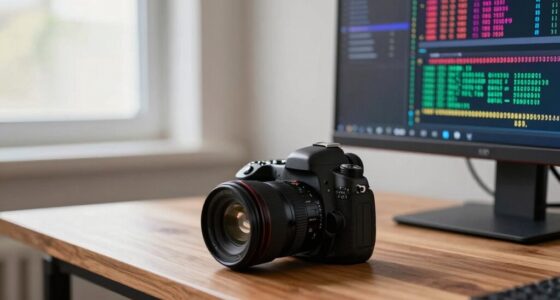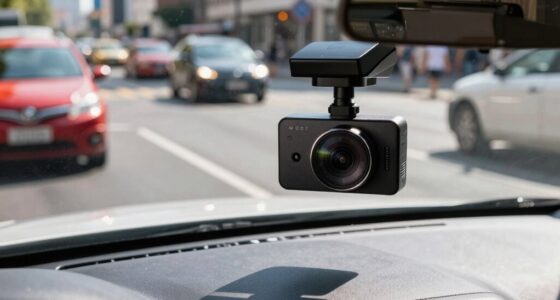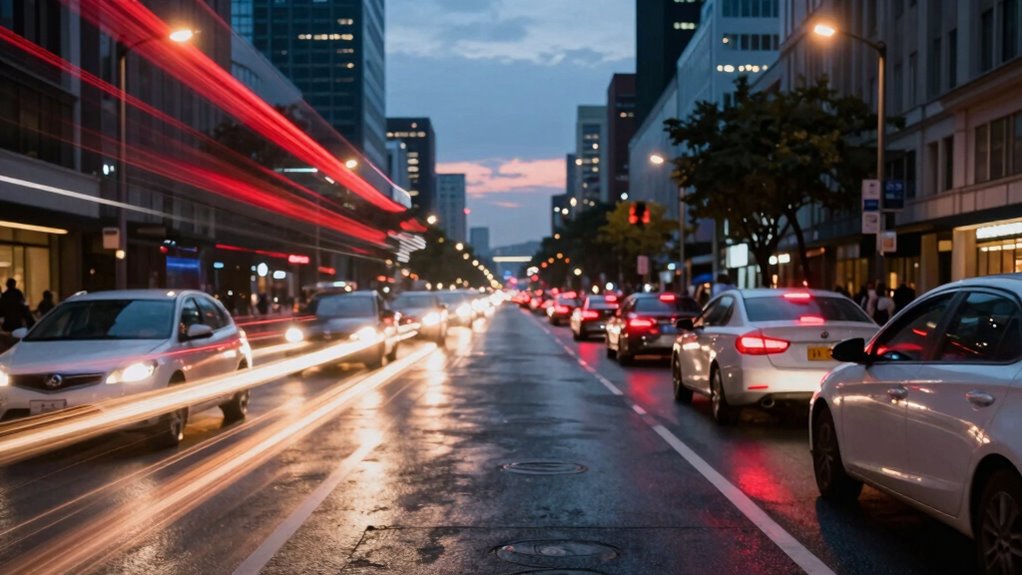

When traffic speed increases, your camera’s ability to capture clear images depends on its resolution and response time. Faster vehicles require high-resolution cameras with quick frame rates to record sharp, detailed shots like license plates and vehicle types. Sudden acceleration can cause missed details if the camera isn’t equipped to adapt to rapid speed changes. Understanding how technology handles these challenges can help you see why modern cameras are essential for effective traffic enforcement. Keep exploring to learn more.

Get business pricing on garage and car supplies
- Business-only prices and quantity discounts
- Tax-exempt purchasing
- Multiple users, one account, clear invoices
Key Takeaways
- Higher vehicle speeds require cameras with higher resolution and faster frame rates for clear, detailed images.
- Rapid acceleration can cause vehicles to appear in fewer frames, risking missed details like license plates.
- Advanced sensors detect speed changes, triggering multiple captures to ensure critical moments are recorded.
- Quick-response cameras are essential to effectively track and capture fast-moving vehicles.
- Technological improvements in sensors and imaging enhance accuracy and reliability in high-speed traffic monitoring.

Traffic speed monitoring and camera capture play an essential role in maintaining road safety and enforcing traffic laws. When vehicles accelerate or decelerate unexpectedly, it directly impacts how effectively cameras can do their job. Higher vehicle acceleration means your camera needs to be quick and precise to capture clear images of moving cars. If a vehicle speeds up suddenly, a camera with high resolution can better freeze that moment, capturing details like license plates or vehicle type. Conversely, if the camera’s resolution isn’t sharp enough, even vehicles traveling at moderate speeds could appear blurry, making it difficult to identify them or gather vital evidence.
Your camera’s resolution is key in determining what it can effectively record at different speeds. When a vehicle accelerates rapidly, the camera’s ability to capture high-resolution images becomes even more critical. A high-resolution camera can record finer details and maintain clarity despite the quick movement. This is especially important when law enforcement needs to identify vehicles involved in traffic violations or accidents. At lower speeds, even cameras with moderate resolution can produce usable images, but as vehicle speeds increase, the need for higher resolution becomes more apparent. The sharper the images, the more reliable the evidence, especially when it comes to issuing tickets or investigating incidents.
High-resolution cameras are essential for clear traffic images, especially at higher vehicle speeds.
Vehicle acceleration also affects the timing and positioning of camera captures. Many traffic cameras are designed with sensors that detect sudden changes in speed, prompting them to take multiple shots or video clips. If a vehicle accelerates just before passing a camera, the system’s ability to keep up depends on both the camera’s frame rate and its resolution. Faster acceleration might mean the vehicle appears in only a fraction of the total frames, emphasizing the importance of high frame rates combined with high resolution for capturing fast-moving objects. This guarantees that even at high speeds, critical details aren’t missed. Additionally, sensor technology continues to advance, providing more accurate detection of sudden speed changes and improving overall capture effectiveness. The integration of advanced sensor systems further enhances the ability of cameras to adapt to changing traffic conditions. Recognizing how vehicle behavior influences capture success underscores the importance of continuous technological improvements. For example, high-speed cameras are now capable of adapting to these rapid changes, ensuring critical moments are never missed.
In the essence, the faster a vehicle accelerates, the more your camera’s technological capabilities matter. High resolution and quick response times go hand in hand to guarantee that images are clear and useful, regardless of how quickly a vehicle is moving. Traffic speed changes challenge camera systems to adapt, and understanding how vehicle acceleration influences what your camera can capture highlights the need for advanced technology in traffic enforcement. When designed properly, these systems can accurately track and document speeding vehicles, helping keep roads safer for everyone. Additionally, advancements in camera technology continue to improve the ability to capture high-quality images at varying speeds, further enhancing traffic monitoring systems.
As an affiliate, we earn on qualifying purchases.
Frequently Asked Questions
How Does Camera Shutter Speed Affect Motion Blur at Different Speeds?
Your camera’s shutter speed directly impacts motion blur by controlling shutter duration. Faster shutter speeds, like 1/1000 sec, freeze fast-moving objects, minimizing blur. Slower shutter speeds, such as 1/30 sec, increase shutter duration, resulting in more pronounced blur effect at higher speeds. When capturing quick movement, a short shutter duration helps you avoid unwanted motion blur, while a longer shutter creates artistic blur effects at slower speeds.
Can Cameras Automatically Adjust for Varying Traffic Speeds?
Oh sure, your camera’s magically tuned to traffic flow—if only! Most cameras don’t automatically adjust for varying traffic speeds without manual calibration. They rely on settings like shutter speed and ISO, which you can tweak to match traffic conditions. Advanced traffic cameras use sensors and calibration algorithms to adapt to changing speeds, but for your everyday camera, you’ll need to manually adjust to keep up with the rush hour chaos.
What Role Does Focal Length Play in Capturing Moving Vehicles?
Focal length plays a vital role in capturing moving vehicles because it affects depth perception and how much of the scene you see. A longer focal length zooms in, isolating the vehicle and creating a compressed background, making motion appear smoother. A shorter focal length offers a wider view, capturing more context but with less depth perception. Adjusting focal length helps you effectively track vehicles at different speeds and distances.
How Do Environmental Conditions Influence Camera Performance at High Speeds?
You might worry weather impact and light conditions will ruin your shots at high speeds, but with the right gear, you can still capture sharp images. Rain, fog, or low light can reduce visibility and camera performance, so use weatherproof equipment and adjust your settings for better light sensitivity. By preparing for these conditions, you guarantee your camera performs well, regardless of environmental challenges.
Are There Specific Camera Settings Recommended for Capturing Fast-Moving Traffic?
To capture fast-moving traffic effectively, you should set your camera to a fast shutter speed to freeze motion, especially in night photography conditions. Use camera stabilization to prevent blurring, and increase ISO if needed to compensate for low light. A wider aperture can also help gather more light. These settings help you get sharp, clear images of quick-moving vehicles, even in challenging lighting conditions.
high frame rate surveillance camera
As an affiliate, we earn on qualifying purchases.
As an affiliate, we earn on qualifying purchases.
Conclusion
As traffic speeds increase, your camera’s ability to freeze motion diminishes, making it harder to capture clear images. Did you know that at 60 mph, a fast-moving car covers roughly 88 feet in just one second? That’s enough distance to blur details and hide vital moments. So, next time you’re snapping photos of speeding traffic, remember: slow down the speed, and you’ll get sharper, more detailed shots that tell a clearer story.
As an affiliate, we earn on qualifying purchases.
high-speed traffic monitoring camera
As an affiliate, we earn on qualifying purchases.
As an affiliate, we earn on qualifying purchases.
Fall Picks
fall essentials
As an affiliate, we earn on qualifying purchases.