
TL;DR

Get business pricing on garage and car supplies
- Business-only prices and quantity discounts
- Tax-exempt purchasing
- Multiple users, one account, clear invoices
Engineer and YouTuber Michael Pick converted a BMW i3 range-extender hatchback into a small pickup by replacing its rear section with a custom cargo bed. The Drive reports that Pick kept the project under $10,000, but details about road testing, payload, and long-term durability were not provided.
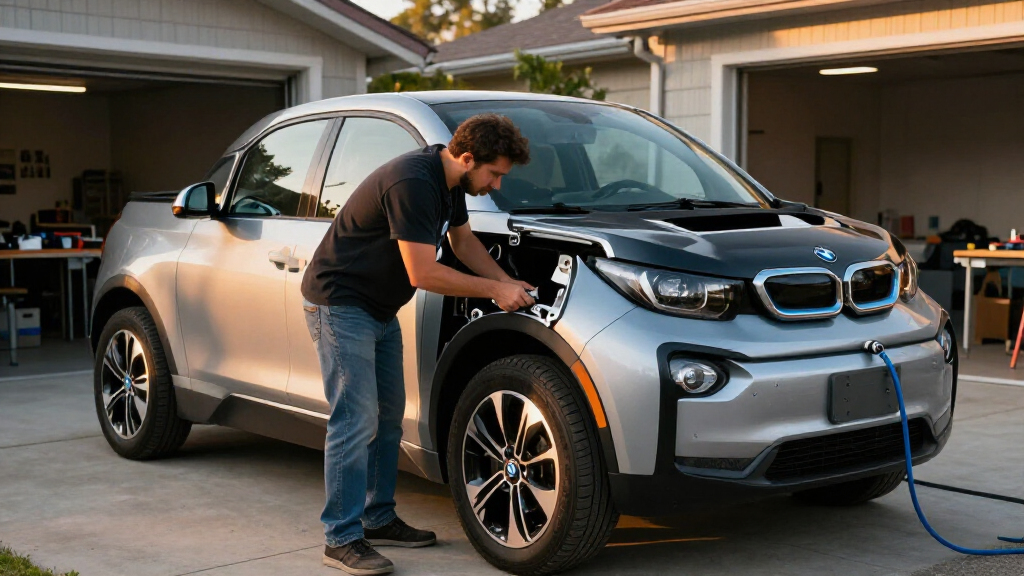
Engineer and YouTuber Michael Pick has converted an auction-bought BMW i3 REx into a small pickup, cutting away the hatchback’s rear and fitting a custom cargo bed. The Drive reports that the project stayed below Pick’s $10,000 budget target, offering a homemade alternative to waiting for the Slate truck’s planned launch, though the report does not establish how the vehicle performs in regular use.
Pick started with a worn i3 bought from an auction without seeing it in person, according to The Drive. The conversion replaces the original rear body section with an open cargo area. A steel frame connects the new bed to the remaining car, while the bed itself is made from plywood sealed with epoxy and finished with bedliner.
The donor is an i3 REx, which has a gasoline range-extender engine beneath the rear-seat area. Since that engine still needs access for servicing, Pick designed the bed to be removable. The report says he applied waterproof sealant to seams and coated exposed cut edges of the carbon-fiber structure with epoxy, because unfinished carbon fiber is vulnerable.
Much of the original i3 remained in place. The Drive says the car’s electronics made preserving existing components easier than modifying the firmware to account for missing parts such as locks, taillights, and data connections. Pick’s reported spending stayed a couple of thousand dollars below his $10,000 cap; expenses included items such as a replacement head unit and windshield, rather than only the custom fabrication.
A DIY Route to an Electric Pickup
The build is a practical example of how an existing electric car can be repurposed rather than replaced, using a used vehicle and custom fabrication to create a compact cargo hauler. Its reported cost makes it an interesting counterpoint to a new electric pickup, but it is not a direct cost comparison: the i3 conversion is a one-off project, and the source does not detail labor costs, future repairs, or the truck’s capabilities.
The project also highlights the complications of modifying a modern electric vehicle. The i3’s carbon-fiber structure and integrated electronics mean that cutting away bodywork involves more than fitting a bed. Pick’s decision to retain much of the original system and make the bed removable addresses some service and compatibility concerns, but does not by itself establish the conversion’s safety or durability.
Products Worth Considering

NOCO GENIUS2X4 6V/12V Four-Bank Battery Charger and Maintainer

Nextbase iQ 4K Smart HD Dash Cam Pro with 64GB microSD Card – Front and Rear View, 1440p, Smart Sense Parking, Emergency SOS, Roadwatch AI

VIOFO A329S 4K+2K+2K Dash Cam Front Cabin and Rear, STARVIS 2 HDR, Wi-Fi 6
As an affiliate, we earn on qualifying purchases.
Why Pick Started With an i3
The BMW i3 was a small electric hatchback introduced in 2014, with a carbon-fiber monocoque that The Drive describes as unusual for a mainstream car. The publication says the model was not a major success in North America, where small vehicles have faced a less receptive market. Pick’s conversion uses that compact platform as the basis for a utility vehicle.
The project was motivated by Pick’s desire for an inexpensive electric truck, according to The Drive’s report. Rather than wait for the Slate vehicle referenced in the headline, he bought the i3 and built his own. The Drive characterizes the resulting pickup as clean-looking but not necessarily refined enough for most buyers; that is an assessment of the project, not evidence of a production-ready vehicle or a market comparison.
““a monocoque made of carbon fiber””
— The Drive, describing the BMW i3’s construction
Testing and Capability Details Missing
The report does not give a full itemized budget, the vehicle’s payload or towing capacity, or results from road and durability testing. It also does not specify how much time the build took, whether the vehicle has been inspected or certified after the structural changes, or how its range compares with an unmodified i3 REx. Those details are needed to judge how useful the pickup is beyond the build itself.
The $10,000 figure is presented as Pick’s project spending against his budget target; the source does not say whether it includes the builder’s labor, future maintenance, or costs associated with making the truck suitable for a particular jurisdiction. The report also does not establish whether the conversion is intended for sale or will remain a personal vehicle.
Further Use Will Test the Build
The next meaningful evidence will come from information about the pickup’s use: whether Pick reports on its reliability, cargo capacity, range, or servicing after the conversion. The Drive’s account describes the fabrication and budget but does not announce a production plan or formal testing schedule.
For now, the vehicle is best understood as a one-off DIY conversion, not a ready-made substitute for a production electric truck. Its real-world usefulness and long-term performance remain unconfirmed in the available report.
Key Questions
Who built the BMW i3 pickup?
Michael Pick, an engineer and YouTuber, built the conversion, according to The Drive.
How much did the project cost?
The Drive reports that Pick aimed to spend less than $10,000 and finished a couple of thousand dollars below that limit. The report does not provide a full itemized account or clarify whether labor was included.
How was the pickup bed made?
The bed is made from plywood sealed with epoxy and coated with bedliner. A steel frame connects it to the remaining vehicle, and the bed can be removed to allow service access to the range-extender engine.
Is the conversion a production alternative to the Slate truck?
No production plan is reported. This is a single custom-built vehicle; the source does not show that it is being sold or that it has the testing, capacity, or support of a production pickup.
How well does the converted i3 perform?
The available report does not provide confirmed figures for range, payload, towing, or long-term reliability. Those capabilities remain unclear.
Source: thedrive.com