
TL;DR

Get business pricing on garage and car supplies
- Business-only prices and quantity discounts
- Tax-exempt purchasing
- Multiple users, one account, clear invoices
Prebuilt AI workstations now often match or beat DIY on price, thanks to component shortages and bulk buying. The decision boils down to your need for customization, support, and speed of deployment.
Building your own AI workstation used to be the obvious way to save money. You’d pick each component, tune the system, and enjoy maximum control. Learn more about building vs buying. But today, the landscape has shifted. The soaring costs of GPUs, RAM, and SSDs have made DIY less of a no-brainer.
Now, prebuilt systems often come bundled with professional thermal tuning, validated cooling, and a warranty — all at a price that can rival or beat a DIY build. This article breaks down the real tradeoffs, so you can decide whether to build from scratch or buy ready-made for your AI projects.
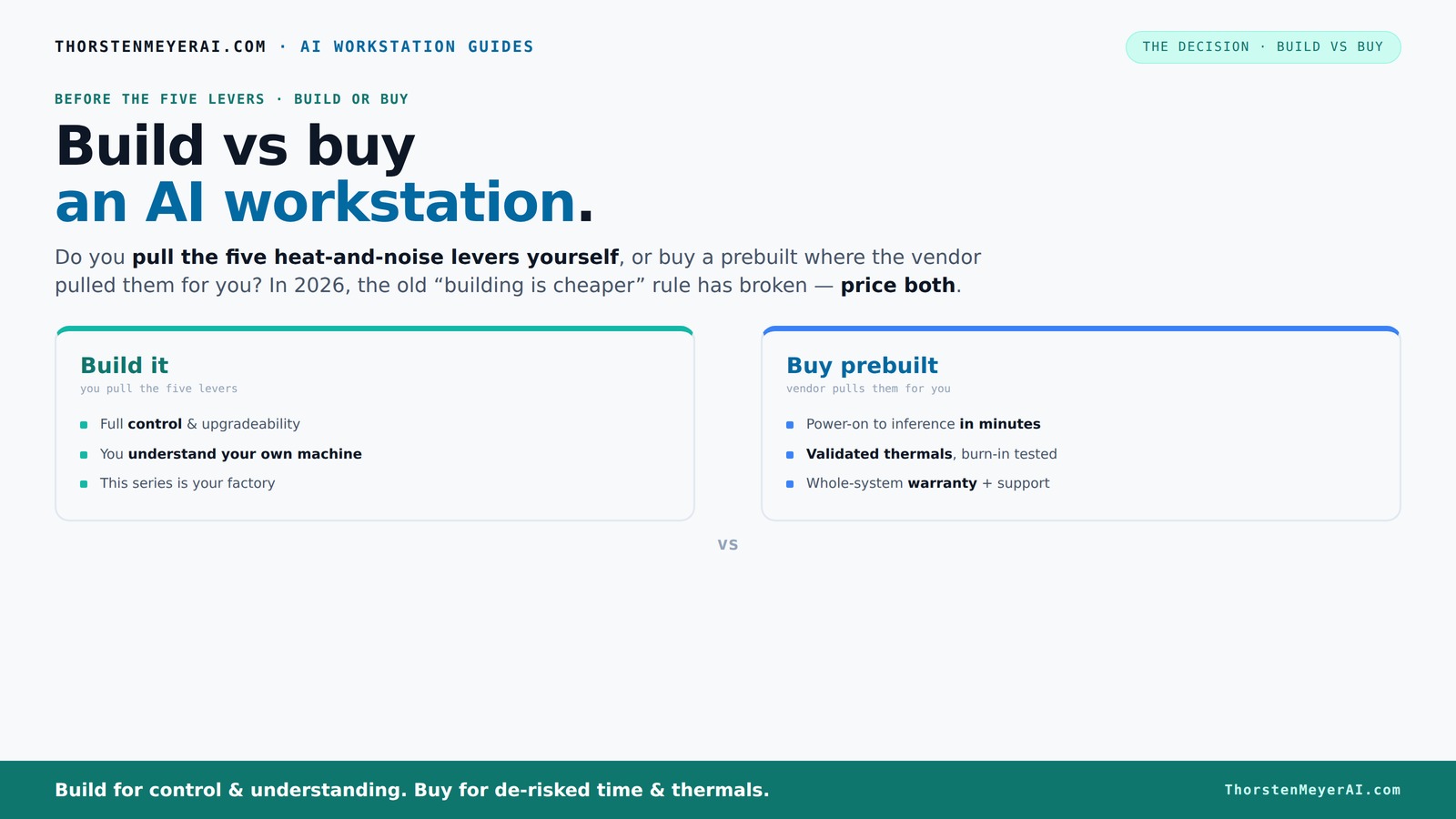
Build vs buy
an AI workstation.
The real question behind this whole series: do you pull the five heat-and-noise levers yourself, or buy a prebuilt where the vendor pulled them for you? And in 2026, the old “building is cheaper” rule has broken. Match your situation in Part 3.
Key Takeaways
- Market shifts mean prebuilts often match or beat DIY on price due to component shortages and bulk discounts.
- Prebuilts save time and reduce troubleshooting, especially for multi-GPU setups and high-end systems.
- Building offers unmatched customization and upgrade flexibility but requires technical skill and patience.
- Thermal management is a key factor — prebuilts handle this at the factory, while DIY lets you fine-tune for your workflow.
- Your choice depends on your workflow, need for support, budget, and how much you enjoy tinkering.
As an affiliate, we earn on qualifying purchases.
Why the old rule 'Build is Cheaper' No Longer Applies in 2026
The game has changed. Component shortages and inflation have driven up prices for key parts like GPUs, DDR5 RAM, and SSDs. Check out oil and component specs. For example, a high-end GPU that cost around $1,000 last year now easily hits $1,250 or more.
Meanwhile, prebuilt vendors have secured bulk discounts, allowing them to offer systems at prices that are tough for DIY builders to match today. See build vs buy comparisons. It’s a shift that turns the traditional wisdom on its head.
This means you can’t just assume building saves money anymore. You need to compare prices for your specific config, including labor, warranty, and support costs.
As an affiliate, we earn on qualifying purchases.
Who Pulls the Levers? Building vs Buying and the Heat Management Game
Imagine your AI workstation as a high-heat furnace. Making it run cool and quiet hinges on five levers: undervolting the GPU, selecting the right cooler, optimizing airflow, tuning fans, and placement.
If you buy prebuilt, the vendor pulls these levers for you. They test, tune, and validate thermal performance — often with water cooling and custom fan curves. This means you get a machine ready to run at peak performance with minimal noise.
On the flip side, building your own rig puts you in control. You select a quiet GPU, pick a cooling solution, and fine-tune every detail for your workflow. Explore thermal testing and cooling options. It’s more effort, but it means the system is tailored exactly to your needs.
As an affiliate, we earn on qualifying purchases.
When Buying Prebuilt Makes Sense — Fast, Risk-Free, and Supportive
If you need your AI system up and running yesterday, a prebuilt is the way to go. It arrives with the OS, drivers, and AI stack pre-installed — just power it on and start training.
Plus, support and warranty are centralized. If something breaks, you call one support line. Vendors like Lambda and Puget test systems under load for 24–48 hours, ensuring reliability and reducing downtime risks.
High-end, multi-GPU setups especially benefit — complicated cooling, power delivery, and validation are handled by experts, saving you hours of troubleshooting.
As an affiliate, we earn on qualifying purchases.
When Building Yourself Is Still the Right Choice
Are you a hobbyist or a researcher with time and a DIY streak? Building your own machine still pays off if you want precise control over every component. Want a quieter GPU? Pick a model with low noise ratings. Need a specific cooling setup? Choose your case and fans.
Plus, if your workflow involves custom hardware or software tweaks, building gives you the flexibility to optimize exactly how you want.
Remember, this path requires patience, technical skill, and a willingness to troubleshoot. But it also means you can tailor your system for long-term upgrades and specific workflows.
Comparison Table: Build vs Buy — The Real Deal
| Feature | Build Your Own | Buy Prebuilt |
|---|---|---|
| Cost | Often cheaper initially, but market conditions can flip this. | Often comparable or cheaper due to bulk discounts and efficiency. |
| Time to Deploy | Longer — sourcing parts, assembly, testing. | Fast — ready to run out of the box. |
| Customization | Maximum control — choose exact parts, cooling, airflow. | Limited — depends on vendor options. |
| Support & Warranty | Multiple vendors, varying support quality. | Single point, often longer warranty, professional support. |
| Thermal Tuning | DIY — tune for your workload. | Vendor-validated, optimized systems. |
| Upgradeability | Flexible — standard parts, easy upgrades. | Depends — proprietary parts may limit upgrades. |
AI-Specific Features: Prebuilt vs Custom
Prebuilt systems increasingly include AI-optimized hardware, like dedicated NPUs, and come with vendor software stacks that cut down on setup time. They’re designed for AI workflows, with power efficiency and software tuning baked in.
Building your own gives you the freedom to pick specific GPUs, CPUs, and cooling tailored for your exact AI task — whether that’s training large models or running inference on edge devices.
Pitfalls to Watch Out For in Both Paths
Building can lead to compatibility issues, poor cooling choices, or undervolted GPUs that throttle performance. Proprietary motherboards or PSUs can complicate future upgrades.
Prebuilts might use lower-quality components, or come with bloatware and limited upgrade paths. Always check reviews and component quality before buying or building.
The key is awareness — knowing where shortcuts or compromises might hurt your AI workflow.
Who Should Pick Which? A Quick Guide
Choose prebuilt if: You need fast deployment, support, and a system you can trust to run reliably under load. Small businesses and researchers often fall into this group.
Build if: You want maximum control, plan to upgrade over time, or have specific hardware needs. Enthusiasts and long-term users benefit from the flexibility.
Think about your workflow, budget, and technical comfort — that’s the real guide.
Frequently Asked Questions
Is a prebuilt AI workstation worth it?
For most professionals, a prebuilt offers faster deployment, validated thermals, and support, making it worth the extra cost for peace of mind and uptime. Hobbyists might prefer building for control and cost savings.Is building cheaper than buying prebuilt?
Not always. Recent market shifts mean prebuilts can match or beat DIY prices, especially when considering support, warranty, and time saved. Always compare your exact configuration prices.What do I lose by buying prebuilt?
You sacrifice some control over component choices, cooling options, and upgrade paths. Prebuilts may also include proprietary parts that complicate future repairs or upgrades.What do I gain by building my own?
Maximum customization, the ability to select exact hardware for your workflow, and the satisfaction of tuning every detail. It’s ideal if you plan long-term upgrades or need specific hardware tweaks.How important is the GPU compared to CPU, RAM, and storage?
For AI workloads, the GPU often dominates performance, especially in training and inference. However, CPU, RAM, and storage also matter — balance your system based on your specific AI tasks.Conclusion
In 2026, the decision to build or buy your AI workstation isn’t just about saving a few dollars. It’s about what matters most — speed, support, control, or cost.
If time and reliability top your list, prebuilts are your best bet. If customization and long-term flexibility matter more, building from scratch still makes sense. Either way, understanding your workload and priorities will help you choose the right path.
Imagine your ideal AI machine — sleek, quiet, perfectly tuned. Now ask: do I want to craft it myself, or trust an expert to do it for me? The answer shapes your AI journey.
Halloween Picks
halloween
As an affiliate, we earn on qualifying purchases.