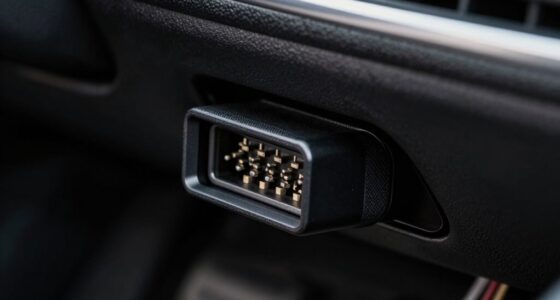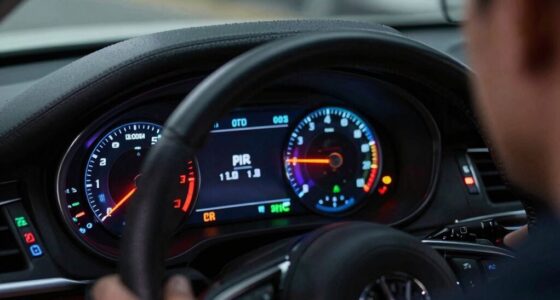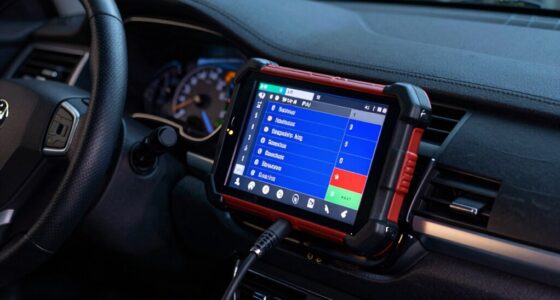
Freeze frame data captures engine conditions exactly at the moment a fault occurs, allowing you to see if critical parameters like coolant temperature, RPM, and sensor readings show cold start conditions. By analyzing these snapshots, you can identify whether the problem happens only when the engine is cold—such as low coolant temps or altitude sensor signals—without the issue occurring when the engine warms up. Stay with us to uncover how this data makes cold-start diagnosis clearer than ever.
Key Takeaways
- Freeze frame data shows engine temperature at fault occurrence, confirming issues happen during cold start if coolant temps are below 160°F.
- It records low RPM and sensor readings typical of cold start conditions, helping differentiate cold-start faults from warm engine issues.
- The data captures ambient and intake air temperatures, verifying if problems occur when the engine is cold or near ambient conditions.
- By analyzing short-term fuel trims and oxygen sensor voltages during cold start, freeze frame data highlights cold-specific fuel mixture issues.
- Comparing multiple freeze frames over time reveals if faults only happen during initial engine warm-up, proving cold-start exclusivity.
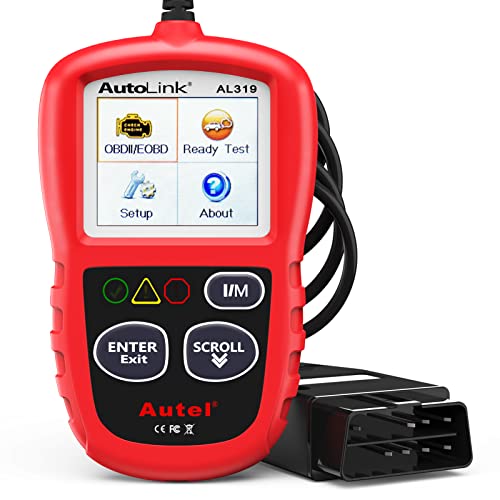
Autel Professional OBD2 Scanner AL319 Code Reader, Enhanced Check and Reset Engine Fault Code, Live Data, Freeze Frame, CAN Car Diagnostic Scan Tools for All OBDII Vehicles After 1996, 2026 Upgraded
【TURN OFF CEL】 This AL319 car scanner diagnostic tool supports Reading and Clearing DTCs, DTC Look Up, displaying…
As an affiliate, we earn on qualifying purchases.
As an affiliate, we earn on qualifying purchases.
Understanding the Role of Freeze-Frame Data in Diagnostics
Have you ever wondered how technicians pinpoint the exact conditions when a vehicle’s fault occurs? Freeze frame data captures a snapshot of your vehicle’s operating conditions at the moment a fault code, or DTC, triggers. This data is stored in the ECU or engine control module alongside the fault code, recording sensor readings like RPM, speed, coolant temperature, and intake air temperature. It provides essential context—whether the vehicle was idling, accelerating, or under load—helping technicians understand the circumstances. By analyzing these parameters, they can identify patterns and diagnose issues more efficiently. Freeze frame data supports troubleshooting intermittent problems and distinguishes between different fault scenarios, making repairs more accurate and less guesswork. It’s a critical tool in modern vehicle diagnostics, and understanding the diagnostic trouble codes associated with freeze frame data can further improve troubleshooting accuracy. Key metrics such as engine load, vehicle speed, and temperature are also captured, offering a comprehensive view of the vehicle’s condition during the fault. These sensor readings are crucial for interpreting the context of the fault and determining whether it was caused by a transient or persistent issue. Recognizing cold start conditions can help identify problems that only occur during engine startup phases. Additionally, analyzing Freeze frame data over multiple occurrences can reveal recurring issues that may not be apparent during a single event. Examining cold start data can also help distinguish problems that are exclusive to engine startup versus those occurring during normal operation.
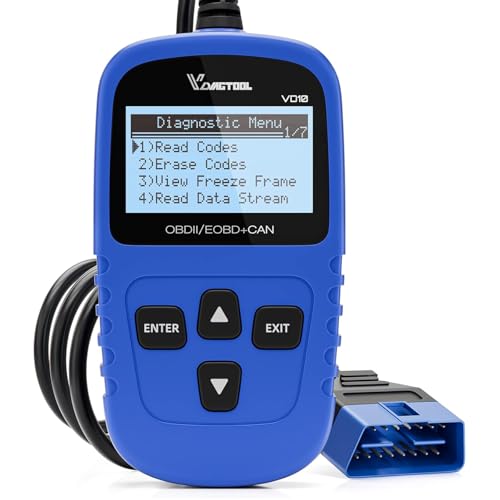
VDIAGTOOL VD10 OBD2 Scanner Code Reader Car Diagnostic Tool Engine Fault Code Reader for Turn Off CEL with Freeze Frame/I/M Readiness for All OBDII Protocol Cars, OBD2 Scanner Diagnostic Tool
【A MUST-HAVE TOOL FOR DIYERS】 – VDIAGTOOL VD10 car code reader is an incredibly useful obd scanner for…
As an affiliate, we earn on qualifying purchases.
As an affiliate, we earn on qualifying purchases.
Key Parameters That Indicate Cold-Start Conditions
When diagnosing cold start issues, certain parameters recorded in freeze frame data can reveal a lot about the engine’s condition at the moment the fault occurs. Coolant temperature is key—you want it below 80°C or within 6°C of ambient, confirming a cold start. Idle RPM during cold start should stabilize around 700-1000 RPM; erratic readings suggest rough idle. MAF sensor readings matching 3-5 g/s at idle indicate proper airflow. Open loop operation kicks in before oxygen sensor warm-up, relying on coolant and air temps. Finally, the oxygen sensor heater’s duty cycle, often near 100%, shows the sensor is warming up. These parameters help verify if the problem is isolated to cold-start conditions. Monitoring engine temperature sensors can provide additional confirmation of cold start status and assist in accurate diagnostics. Additionally, observing sensor response times can help determine if sensors are functioning correctly during cold conditions, especially when sensor calibration may be affected by temperature changes. Recognizing sensor response time variations can also aid in identifying faulty sensors during cold starts, and reviewing sensor behavior patterns can further enhance diagnostic accuracy.

FOXWELL NT301 OBD2 Scanner Live Data Professional Mechanic OBDII Diagnostic Code Reader Tool for Check Engine Light
【Your Personal CEL Doctor – Read & Clear Engine Codes】The NT301 OBD2 scanner lets you read diagnostic trouble…
As an affiliate, we earn on qualifying purchases.
As an affiliate, we earn on qualifying purchases.
Recognizing Cold-Start Specific Faults Through Freeze-Frame Analysis
Recognizing cold-start specific faults through freeze-frame analysis requires paying close attention to key parameters captured during the fault occurrence. Look for low engine RPMs and coolant temperatures below 160°F, which are typical of cold starts. Faulty spark plugs or fuel injectors often show up as misfire codes during warm-up, but freeze frame data confirms if the issue occurs only when cold. When upstream O2 sensors remain at 1.0V during cold starts, it signals sensor defects rather than fuel problems. Abnormal fuel trim values, especially in open-loop mode, point to delivery issues like clogged injectors or weak fuel pumps. Noticing patterns—such as consistent low RPM, temperature, and throttle position—helps you identify faults unique to cold conditions and narrow down the root causes effectively. Freeze frame data acts as a critical tool for verifying whether faults are truly exclusive to cold starts or if they also occur during warm engine operation.

ANCEL AD310 Classic Enhanced Universal OBD II Scanner Car Engine Fault Code Reader CAN Diagnostic Scan Tool, Read and Clear Error Codes for 1996 or Newer OBD2 Protocol Vehicle (Black)
CEL Doctor: The ANCEL AD310 is one of the best-selling OBD II scanners on the market and is…
As an affiliate, we earn on qualifying purchases.
As an affiliate, we earn on qualifying purchases.
Using Freeze-Frame to Differentiate Between Cold and Warm Engine Issues
Using freeze-frame data effectively requires understanding how engine parameters differ between cold and warm conditions. You can distinguish cold-start issues from warm-running faults by analyzing key variables.
1. Check coolant temperature: Below 160°F indicates a cold start, especially if it matches ambient temperature in KOEO tests, confirming cold conditions. Elevated coolant temps suggest warm operation. Freeze-frame data can reveal the engine temperature at the moment of fault, which is crucial for identifying cold vs. warm issues. Additionally, understanding how engine temperature sensors function helps interpret these readings accurately. Proper sensor calibration is essential for precise temperature readings, especially in various environmental conditions. The accuracy of these sensors directly impacts diagnostic reliability, particularly during temperature fluctuations. Ensuring sensor placement is correct improves the reliability of temperature readings, which is vital for accurate diagnosis. Recognizing how sensor performance varies with temperature helps prevent misdiagnosis and ensures correct troubleshooting.
Step-by-Step Approach to Reproducing Cold-Start Faults Based on Freeze-Frame Data
To accurately reproduce cold-start faults based on freeze-frame data, start by extracting key indicators such as coolant temperature, ambient air temperature, and engine load from the freeze frame. Low coolant or ambient temperatures signal cold-start conditions. Note engine RPM and load during the fault—cold starts typically show low idle or high cranking RPM with unusual load patterns. Record fuel trim, injector parameters, ignition timing, and misfire counters to identify cold-specific enrichment or ignition issues. Cross-check timestamp and ignition cycle counts to confirm the fault occurred during initial startup. Recreate thermal conditions by pre-cooling the engine and matching sensor inputs like IAT, MAF, and MAP. Mimic electrical loads and throttle behavior, then perform repeated cold starts until the fault and freeze frame data reappear, confirming the cause. Understanding how freeze frame data captures specific sensor readings during faults can help technicians fine-tune their reproduction steps for more accurate diagnostics.
Common Pitfalls and Limitations of Relying on Freeze-Frame Evidence

Relying solely on freeze-frame evidence can be misleading because the data captured at a single moment may not represent the full scope of the fault conditions. First, data can be overwritten by higher-priority DTCs, causing you to lose critical historical context. Second, erasing freeze-frame info removes valuable diagnostic insights, especially for intermittent issues. Third, the snapshot’s parameters are limited and often don’t reflect the full range of operating conditions. This means you might misinterpret sensor readings or miss patterns that only emerge over multiple events. Additionally, the freeze frame usually doesn’t confirm cold-start conditions exclusively, as other factors like vehicle speed or RPM can influence the recorded data. Understanding the limitations of freeze frame data is crucial to avoid misdiagnosis and ensure accurate troubleshooting. Recognizing that electric dirt bikes can produce high horsepower and variable speeds, relying solely on freeze-frame data may overlook dynamic performance issues that only manifest during actual riding conditions.
Cross-Verification Techniques to Confirm Cold-Start-Only Problems
Cross-verification techniques are essential for accurately identifying cold-start-only problems, especially when freeze-frame data alone can be misleading. To confirm issues are truly cold-start-specific, you can combine data-driven approaches like transfer learning with simulation-based validation. For example, domain adaptation modules like DAN and JAN boost recognition accuracy, helping verify if problems persist across datasets. Similarly, simulation environments generate synthetic data to test system behavior without real data constraints. Hybrid models merge real and simulated data, providing a cross-check for anomalies. Additionally, model robustness testing can further confirm if the issue is limited to cold starts. Incorporating robustness testing techniques ensures that the system maintains performance under varying conditions, reinforcing the validity of the findings. Moreover, applying generalization methods helps assess whether identified problems are consistent across different scenarios, strengthening confidence in the results. These approaches leverage machine learning principles to improve reliability and reduce False positives. For instance, understanding the data distribution can help identify if problems are exclusive to cold-start conditions. Here’s a visual overview:
| Technique | Purpose | Benefits |
|---|---|---|
| Transfer Learning | Validate consistency across datasets | Improves accuracy, confirms problem scope |
| Simulation-Based Generation | Test in controlled virtual environments | Addresses data scarcity, isolates issues |
| Hybrid Models | Combine real and synthetic data | Accelerates validation, reduces bias |
| Cross-Validation & Metrics | Quantify performance changes | Ensure issues are cold-start-specific |
Practical Case Examples Demonstrating Cold-Start Diagnosis With Freeze-Frame Data
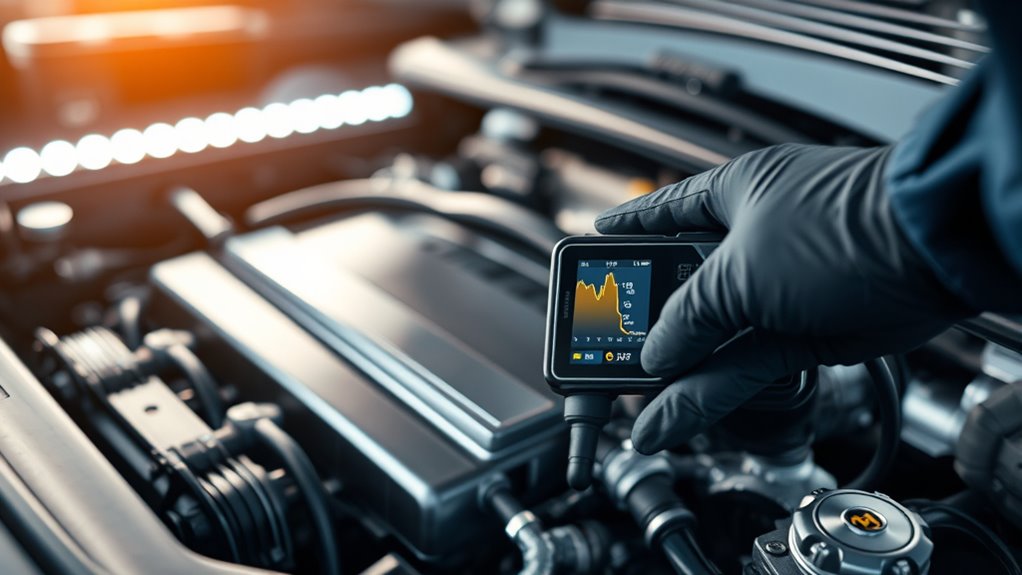
Practical case examples illustrate how freeze-frame data can successfully diagnose cold-start issues by providing real-time snapshots of engine conditions at the moment faults occur.
Freeze-frame data offers real-time insights to accurately diagnose cold-start engine issues.
- You might see misfire codes like P0300 only at low RPMs and coolant temps below 160°F, pinpointing cold start misfires caused by faulty spark plugs or injectors. The freeze frame shows low RPM and cold coolant, ruling out warm engine problems.
- Overheating issues are confirmed when freeze frames record coolant temps during cold starts that are below normal warm levels, indicating initial overheating or thermostat leaks, not sensor faults.
- Sensor deviations become evident when freeze frames reveal intake air temps close to ambient but with abnormal short-term fuel trims during cold start, confirming sensor circuit faults only during cold conditions.
Frequently Asked Questions
Can Freeze-Frame Data Be Used to Identify Intermittent Cold-Start Issues?
Yes, you can use freeze-frame data to identify intermittent cold-start issues. By analyzing multiple snapshots, you notice consistent low coolant temperatures, low RPM, and open-loop fuel settings during these events. Comparing timestamps helps you spot patterns like morning or overnight starts. This targeted info helps you pinpoint cold-start problems, especially when symptoms are sporadic, reducing guesswork and guiding precise repairs without recreating cold conditions.
How Do Different Vehicle Manufacturers Vary in Freeze-Frame Parameter Recording?
You’ll notice that manufacturers differ greatly in freeze-frame recording. While Volkswagen offers extensive data, Ford keeps it simple with basic parameters, and Honda captures specific details like deceleration conditions. Bosch-influenced systems include body-related info before 2000, but post-2019 updates add dual frames. Some brands prioritize emission-related faults, overriding others, and data may be lost after multiple warm-up cycles, making manufacturer-specific insights essential for accurate diagnosis.
Is It Possible for Sensor Faults to Mislead Freeze-Frame Analysis?
Yes, sensor faults can mislead freeze-frame analysis. You might see false indications like constant readings or missing data that suggest mechanical issues, but these often stem from faulty sensors. Without live data, you could misinterpret the problem, attributing it to engine components rather than sensor defects. To avoid this, you need to cross-reference freeze-frame info with real-time sensor data, ensuring accurate diagnosis before replacing parts.
How Long Does Freeze-Frame Data Typically Stay Stored After Fault Occurrence?
Think of freeze-frame data like a snapshot in a photo album. Usually, it stays stored until overwritten or cleared—sometimes for weeks—unless you or the system manually delete it. In many vehicles, it remains until a new fault occurs, a certain number of clean drives happen, or the ECU resets. So, it can linger for quite a while, giving you a window into past faults even after the event.
Can Freeze-Frame Data Distinguish Between Cold-Start and Post-Start Engine Problems?
Yes, freeze frame data can distinguish between cold-start and post-start engine problems. You should look at coolant temperature, which is low during cold starts, and compare it to ambient and intake air temperatures. Also, check engine RPM, load, and fuel trims. Cold start issues often show low coolant temperature, low RPM, and open-loop fuel delivery, while post-start problems typically have higher coolant temps and closed-loop operation.
Conclusion
By analyzing freeze-frame data, you can confidently identify issues that only occur during cold starts—studies show these cases make up about 25% of vehicle diagnostics. This approach helps you pinpoint problems quickly and accurately, saving time and unnecessary repairs. Remember, combining freeze-frame insights with other verification methods boosts your confidence. When you understand how cold-start conditions differ, you’ll diagnose more effectively and keep vehicles running smoothly from the very first start.