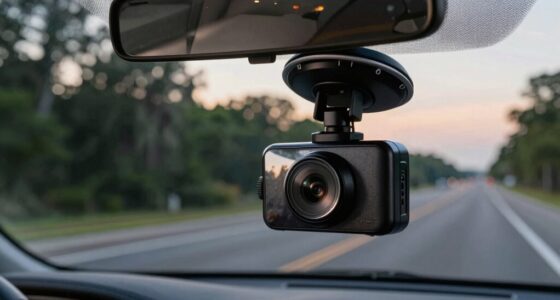
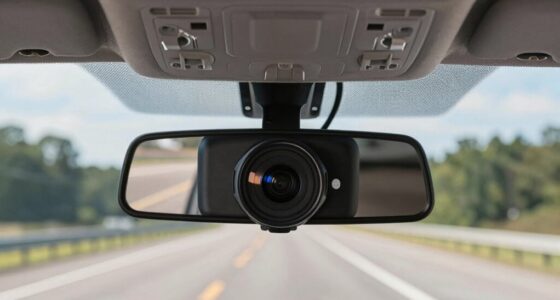
In Minnesota, you must mount your dash cam behind or near the rearview mirror to stay legal and guarantee your view isn’t blocked. The state follows a one-party consent law, so you can record audio if you’re involved, but it’s best to inform passengers and use signage. Keep wiring tidy and secure for safety. To fully comply with laws and protect your footage, understanding the details is essential—learn more to stay informed.
Key Takeaways
- Dash cams must be mounted behind, above, or below the rearview mirror; dashboard mounting is prohibited per Minnesota law.
- Minnesota is a one-party consent state; audio recording is legal if one person involved consents.
- Inform passengers about audio recording with signage or verbal notices and disable microphones if consent is unavailable.
- Proper wiring and stable mounting ensure compliance, safety, and clear footage without obstructing driver visibility.
- Federal property may restrict recording; always follow posted signage and federal regulations when recording on federal sites.
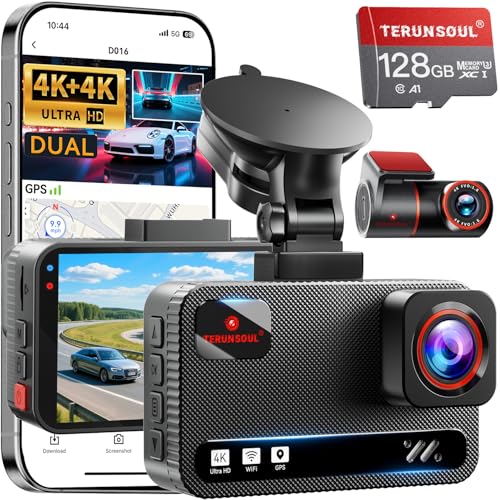
TERUNSOUl 4K+4K Dash Cam Front and Rear, Free 128GB Card Included, 5.8GHz WiFi Dash Camera for Cars, Built-in GPS, G-Sensor, 170°Wide Angle, 3" IPS Screen, 24H Parking Mode, Support 512GB Max
Ultra HD 4K Front + 4K Rear Recording: The Terunsoul dash cam supports dual-channel simultaneous recording, capturing both...
As an affiliate, we earn on qualifying purchases.
Understanding Minnesota’s Dash Cam Mounting Regulations

To make certain your dash cam complies with Minnesota law, understanding the specific mounting regulations is essential. Your dashcam must be mounted directly behind the rearview mirror, ensuring it doesn’t obstruct your view. Mounting slightly above or below the rearview mirror is permitted, but dashboard mounting is prohibited. These rules help keep your vision clear and prevent distractions. Minnesota law, under Statute 169.71, exempts certain objects behind, above, or below the mirror, but generally restricts anything that could block your line of sight. Improper placement can lead to fines or traffic violations, and evidence from obstructed cameras may not hold up in court. Be aware that all vehicles, including commercial ones, must follow these mounting rules to stay compliant and avoid penalties. Additionally, proper installation and secure mounting are crucial to ensure the camera remains functional and legally compliant during your drives. Remember, dash cam regulations are in place to promote safe driving practices and prevent visual obstructions. Ensuring your dash cam is mounted correctly also helps you adhere to vehicle safety standards, avoiding potential legal issues. Moreover, understanding vehicle equipment laws can help you stay informed about updates or changes in dash cam regulations. Properly aligning your dash cam not only complies with the law but also guarantees better footage quality for evidence if needed. Recognizing the importance of mounting position can significantly impact both legality and safety.

REDTIGER 4K Dash Cam Front Rear, STARVIS 2 Sensor, Free Card Included, 5.8GHz WiFi-20MB/s Fast Download, Dash Camera for Cars with GPS, WDR Night Vision, 170°Wide Angle, 24H Parking Mode(F7NP)
[4K+1080P Front & Rear Recording] REDTIGER F7NP dash cam captures every detail with stunning 4K front and 1080P...
As an affiliate, we earn on qualifying purchases.
Optimal Placement for Compliance and Safety

To stay compliant and safe, you should mount your dash cam directly behind or near the rearview mirror, avoiding any obstruction of your view. Make sure wiring is neatly tucked away to prevent interference or hazards, especially near airbags. Proper placement guarantees clear footage and reduces the risk of citations or safety issues while driving. Additionally, ensure that the dash cam does not block or distract from any required view of the windshield or side windows to comply with general prohibitions on obstructions. Proper placement also supports clear footage capture, which can be important for evidence in disputes, and using a stylish design can help the device blend seamlessly with your vehicle’s interior. Paying attention to essential oils for safety can also contribute to a calmer driving environment. Being aware of dash cam laws and regulations helps ensure your device remains compliant and effective. Proper positioning can also help avoid potential privacy concerns related to recording other drivers or pedestrians.
Behind Rearview Mirror
Placing your dashcam behind the rearview mirror guarantees you stay within Minnesota’s legal requirements while maximizing safety. According to Minnesota Statute 169.71, mounting the device immediately behind, slightly above, or slightly below the rearview mirror is permitted. These positions ensure the dashcam doesn’t obstruct your view or cause glare. Mounting on the dashboard or other locations that block your line of sight is illegal and can make court evidence inadmissible. While GPS units near the bottom of the windshield are allowed, they aren’t suitable for dashcams. Proper placement behind the mirror helps you monitor safely without interfering with your forward visibility. Staying within these specific positions is also important to ensure your dashcam does not violate other safety regulations or legal standards. Implementing proper installation techniques is crucial for maintaining compliance and optimal functionality. Sticking to these positions is vital to avoid fines, violations, or evidence being dismissed if obstructing your view. Additionally, understanding dashboard placement guidelines helps ensure compliance and safety standards are met. Properly installing your dashcam according to vehicle safety laws not only protects you legally but also enhances your overall driving safety. Moreover, choosing the right mounting location can prevent accidental damage and improve the device’s longevity. Ensuring your dashcam is securely mounted in the correct position can also prevent distractions while driving, keeping you focused on the road.
Minimize Obstruction Risk
Ensuring your dashcam doesn’t obstruct your view is essential for both legal compliance and safety. To meet Minnesota standards, place the camera immediately behind, slightly above, or below the rearview mirror, avoiding intrusion into the primary windshield unobstructed zones. Use low-profile mounts and compact cameras to reduce visual obstruction and guarantee access to vehicle controls and the instrument cluster isn’t blocked. Position the camera so it doesn’t sit in peripheral zones used for lane changes or pedestrian detection, preserving situational awareness. Choose matte finishes and position the camera to prevent glare or reflections from sunlight or the windshield. Regularly inspect your mount at different times of day to confirm no new glare issues. Proper placement minimizes obstruction risk, helps avoid citations, and maintains safety. Proper placement also plays a key role in preventing legal issues related to obstruction. Dash cams must be installed securely to prevent falling or causing distractions during driving. Additionally, consider camera visibility to ensure it remains unobtrusive and functional. Paying attention to professional installation standards can further improve safety and compliance. Being aware of obstruction zones can help you choose the best mounting location to avoid accidental blocking of critical vision areas. Being mindful of visual obstruction can also prevent unintended distractions for the driver and other road users.
Keep Wiring Tidy
Keeping your dashcam wiring tidy is essential for both compliance and safety. Proper routing prevents wires from dangling into your field of view, reducing distractions while driving. Route wires along the headliner toward the A-pillar, securing them with adhesive clips behind trim panels or tucking excess into door sill grommets. Avoid crossing wires into your line of sight or hanging loose near the mirror. Use zip ties near the mirror mount base for added security. For power, conceal wiring with hardwire kits under the fuse panel or route through firewall grommets for a clean look. Keep the cables away from heat sources and ensure they don’t interfere with airbags or other safety features. Proper wire management is also crucial to comply with vehicle safety standards, which often require unobstructed views and non-distracting wiring. Additionally, choosing the right mounting position can help minimize cable length and simplify routing. Proper wire management keeps your setup legal, unobtrusive, and safe during everyday driving, and selecting a professional installation service can ensure all wiring complies with local regulations. Incorporating thermal behavior principles from high-heat outdoor cooking can help you understand how to avoid heat sources that might damage wiring or components. Being aware of heat dissipation can help prevent overheating of the wiring and connected devices. Understanding electrical load is also important to prevent overloading circuits and ensure longevity of your wiring setup.

TERUNSOUl 4K Dash Cam Front and Rear, Full HD 3 Channel Dashcam, Free 128GB MicroSD Card, Built-in 5.8GHz WiFi Built-in GPS, Collision Sensor, Night Vision, HDR, 3.16" IPS, 24H Parking Mode(Black)
UHD 4K Front + 1080 Rear + 1080P Cabin Recording: Supports simultaneous triple-channel recording, delivering crystal-clear details for...
As an affiliate, we earn on qualifying purchases.
Navigating Audio Recording and Consent Requirements

Managing audio recording and consent requirements in Minnesota is straightforward thanks to the state’s one-party consent rule. You only need to ensure that either you or one participant consents to the recording. This means, during a drive, if you’re involved in a conversation, your consent is enough. To stay compliant, you should:
- Verbally inform passengers about active audio recording.
- Post clear signs indicating that audio is being captured.
- Disable the microphone if you can’t obtain consent.
- Use quick-toggle functions on your dash cam to control audio recording.
- Be aware that privacy laws can vary by jurisdiction and may affect how recordings are stored or shared. Additionally, understanding body piercing regulations can help ensure personal privacy and safety when considering modifications. Also, familiarizing yourself with Glycolic Acid benefits can be useful for personal skincare routines, which is a common concern for many individuals. Staying informed about vetted services like Witbeck Vacuums can also help in maintaining your home environment efficiently. Being aware of wave and wind conditions can be important for ensuring your dash cam functions properly in various weather scenarios.
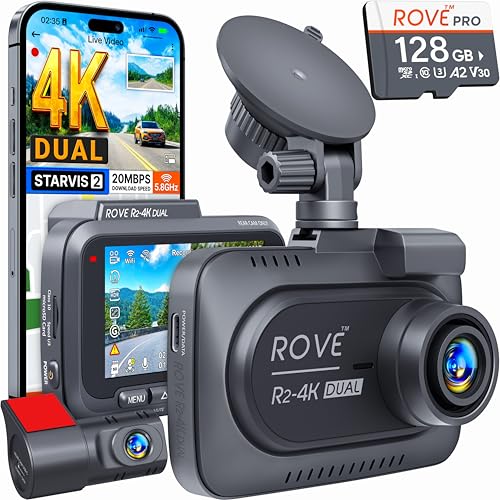
ROVE R2-4K DUAL Dash Cam Front and Rear, STARVIS 2 Sensor, FREE 128GB Card Included, 5G WiFi - up to 20MB/s Fastest Download Speed with App, 4K 2160P/FHD Dash Camera for Cars, 3" IPS, 24H Parking Mode
4K FRONT + 1080P REAR RECORDING – ROVE R2-4K DUAL dash cam offers dual-channel recording capabilities, capturing footage...
As an affiliate, we earn on qualifying purchases.
Privacy Considerations and Data Security Measures
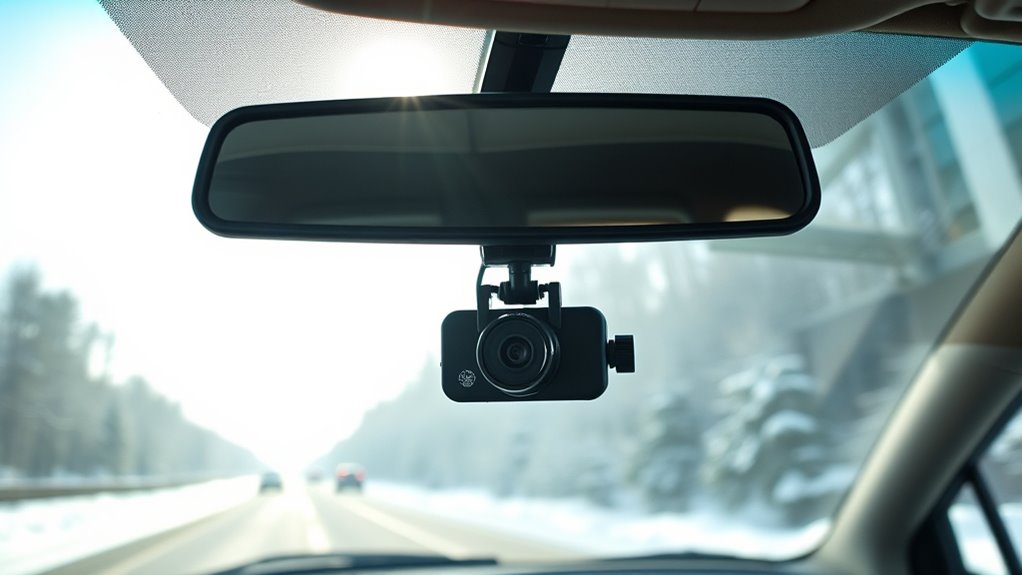
You need to guarantee your dash cam complies with privacy laws by understanding where recording is allowed and how data should be handled. Protect your footage with strong security measures like encryption and password protection to prevent unauthorized access. Additionally, if you’re recording employees or others, make sure you follow proper notification policies to respect their privacy rights. Furthermore, understanding state-specific regulations on audio recording is essential to avoid legal complications.
Privacy Laws Compliance
Ensuring privacy compliance when using dash cams in Minnesota requires careful attention to audio recording laws and mounting practices. You must follow the one-party consent rule, meaning recording is legal if you’re involved or have consent from one participant. Be mindful of recording in private spaces, which could pose legal risks. To stay compliant, consider these steps:
- Mount your dash cam behind or near the rearview mirror to avoid obstructing your view and reduce interior privacy intrusion.
- Use visible signage or notices, especially for commercial or fleet vehicles, to inform passengers and employees about recording.
- Establish clear policies on interior audio recording, disabling it in private areas or during breaks to respect privacy.
- Ensure your recordings are stored securely and used only for intended lawful purposes to prevent civil liabilities. Additionally, regularly review and update your privacy policies to align with evolving laws and best practices.
Data Storage Security
Protecting the privacy of dash cam footage in Minnesota involves implementing robust data security measures to prevent unauthorized access and breaches. You should encrypt data stored in the Samsara cloud at rest, and ensure footage in transit uses SSL or 256-bit AES encryption. High-end dash cams support encryption for stored videos on memory cards, minimizing risks. Access controls are vital—restrict data access to authorized personnel, enforce strong passwords, and enable multi-factor authentication. Only users with explicit permissions should access live streams or audio. Set clear data retention policies, scheduling automatic deletion after specified periods. Use secure storage options like AWS, which meets ISO 27001 and SOC 2 standards, and perform regular firmware updates. Maintaining audit logs and disabling auto-upload features further enhances data security and protects sensitive footage. Ensuring that security practices are regularly reviewed and updated is essential to adapt to emerging threats and maintain effective protection.
Employee Notification Policies
Clear employee notification policies are essential for maintaining transparency and respecting privacy when using dash cams in Minnesota. You must inform employees in writing about the installation and purpose of dash cams, including safety, incident investigation, and training. Make certain you obtain signed acknowledgment forms if dash cam use is part of employment conditions. Your notification should specify:
- Whether in-cab audio is recorded
- If live-viewing is possible
- When recording is triggered (continuous, ignition-on, or event-based)
- Any special state rules for audio recording or privacy restrictions. Implementing clear notification policies helps build trust and ensures legal compliance. Additionally, if vehicles carry passengers or the public, visible signage or verbal notices must inform them of recording. Proper policies help balance security with privacy rights.
Legal Uses and Evidentiary Value of Dash Cam Footage

Dash cam footage can serve as powerful evidence in Minnesota courts when it meets certain criteria. To be admissible, your footage must be relevant, legally obtained, and authentic. This means it should comply with state mounting and recording laws to avoid being dismissed. Proper authentication requires proof of origin, no tampering, and a clear chain of custody. Footage from public areas tends to have higher admissibility if verifiable, especially when timestamps and dates are accurate. In court, dash cam videos help prove fault in accidents, support insurance claims, and verify witness testimony. They can also clarify conflicts or corroborate police reports. When properly handled, dash cam footage can considerably strengthen your case, provided it meets legal standards and is preserved correctly. Ensuring proper storage and documentation is essential to prevent tampering and maintain the footage’s integrity for legal proceedings.
Practical Steps for Proper Dash Cam Installation
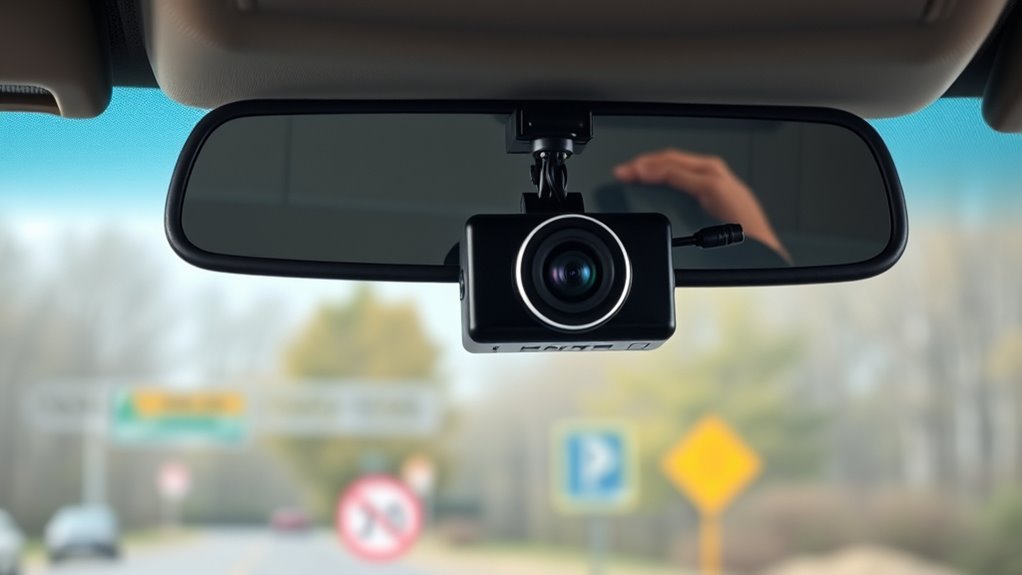
Installing your dash cam correctly begins with choosing the right mounting location and making sure it’s securely attached. First, pick a spot behind, slightly above, or below the rearview mirror, avoiding dashboard mounting to keep your view clear. Next, gather your tools: adhesive pads or suction cups, a power cable, wire tuck tools, and a removal tool for the rearview mirror if needed. Then, thoroughly clean the windshield surface where the camera will attach, and secure it using the pads or cups, adjusting for a clear 60/40 road-sky view. Route the wires neatly along the headliner, tucking them along the A-pillar. Finally, connect the power cable, test the system, and ensure it activates automatically when you start your vehicle.
Special Rules for Federal Property and Cross-Border Recording
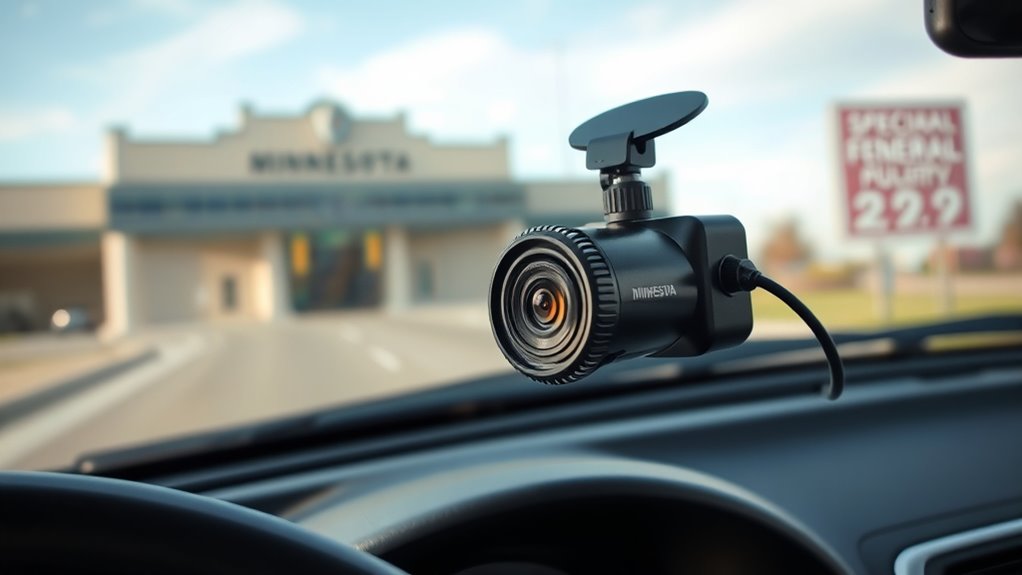
When recording on federal property or crossing into federal jurisdictions, special rules come into play that differ from typical state laws. Federal lands often have restrictions posted at entrances, especially around sensitive sites like courthouses or military installations. Recording audio or video without permission may violate federal security rules, even if state law allows it. Federal restrictions generally take precedence within federal boundaries, regardless of state consent laws.
| Area | Rule | Enforcement |
|---|---|---|
| Federal buildings | Prohibited without authorization | Federal officers may seize recordings |
| Parking lots & checkpoints | Restricted by posted rules | Security personnel enforce restrictions |
| Cross-border recordings | Vary by jurisdiction at borders | Signage and officer instructions clarify |
Disabling audio or seeking explicit permission minimizes legal risks while crossing or on federal property.
Tips for Fleet Operators and Commercial Vehicle Use

Ensuring proper mounting of dash cams is essential for fleet safety and compliance in Minnesota. To do this, follow these tips:
- Mount cameras behind, above, or below the rearview mirror to avoid fines.
- Confirm the camera doesn’t obstruct your windshield view, especially in commercial vehicles.
- Clearly inform employees about dash cam installation, footage use, and storage policies to address privacy concerns.
- Train drivers on audio recording consent, emphasizing Minnesota’s single-party consent law and the legality of in-vehicle audio.
Proper placement prevents traffic citations and makes footage admissible in court. Clear communication and adherence to mounting rules help maintain fleet safety, protect driver privacy, and ensure legal compliance. These steps optimize dash cam benefits while minimizing legal risks.
Frequently Asked Questions
Can I Mount My Dash Cam in the Center of the Windshield?
You can mount your dash cam in the center of the windshield, but you must guarantee it doesn’t obstruct your view. According to Minnesota law, devices behind or near the rearview mirror are preferred, and any placement that blocks your line of sight could lead to a citation. Position the camera carefully, keeping it within the mirror zone, to stay compliant and maintain clear visibility while driving.
Is Audio Recording Legal Without Informing Passengers in Minnesota?
In Minnesota, you can record audio without informing passengers because it’s a one-party consent state. This means only your consent is needed for audio capture, and you’re not required to notify others in the vehicle. However, it’s courteous to inform your passengers about the audio recording to avoid potential privacy concerns. If anyone objects, consider disabling the microphone or switching to video-only mode to stay compliant.
What Are the Penalties for Obstructing the Driver’s View With a Dash Cam?
Think of penalties for obstructing your view as a roadblock—you’ll want to avoid them. If your dash cam blocks your clear view, you can face a ticket costing around $120, plus court fees. You might also be required to reposition or remove the camera immediately. Depending on the situation, you could get points on your driving record or face increased insurance risks, so proper mounting is essential.
Do Federal Restrictions Apply to Dash Cam Use at Border Crossings?
Federal restrictions do apply to dash cam use at border crossings, but enforcement varies. U.S. Customs and Border Protection may ask you to turn off or cover your dash cam due to security concerns, even though no explicit nationwide ban exists. You need to be aware that agency policies and security protocols can limit your camera’s operation, and failure to comply might lead to delays, secondary inspections, or recording seizures.
Can Employers Review Dash Cam Footage Without Employee Consent?
You have the right to review dash cam footage without employee consent in Minnesota, as the law leans toward transparency rather than secrecy. Think of it as shining a light in a dark room—employers are encouraged to inform employees about cameras and footage use. While courts accept plain-view recordings, openly sharing footage fosters trust. Just remember, clear policies and proper notice keep this process fair and within legal boundaries.
Conclusion
By following Minnesota’s dash cam laws, you’re not just recording your drives—you’re safeguarding your rights and ensuring safety. Think of your dash cam as a watchful eye, always ready to serve justice and peace of mind. When you mount, record, and store footage responsibly, you turn your vehicle into a fortified fortress of privacy and legality. Drive confidently, knowing your camera keeps you protected—like a silent guardian on every journey.