Knowing the difference between mini, low-profile, and Micro2 fuses helps guarantee you select the right one before wiring your vehicle. Mini fuses are standard-sized, while low-profile versions are slimmer for tight spaces. Micro2 fuses are smaller still, ideal for compact panels, and Micro3 fuses offer advanced protection with see-through housings. Recognizing their size, shape, and color coding prevents mistakes and keeps your system safe. If you’re curious, you’ll find helpful tips to identify and match these fuses effectively.
Key Takeaways
- Verify fuse dimensions, shape, and terminal type to correctly identify mini, low-profile, or Micro2 fuses before wiring.
- Check color coding and markings to determine amperage ratings and fuse compatibility with your circuit.
- Measure physical size and height to distinguish between standard mini and low-profile fuses for proper fit.
- Examine fuse housings and terminal configurations to ensure proper matching with your vehicle or marine system.
- Consult the fuse manufacturer’s specifications or manuals to accurately identify fuse type before installation.

Liamner 120 Pieces Mini Fuse Kit, Car Fuse Assortment Kit, Mini Blade Fuses Automotive for Car, RV, Truck, Marine, Motorcycle, Auto Accessories(2A/3A/5A/7.5A/10A/15A/20A/25A/30A/35A)
- Comprehensive Mini Fuse Kit: 120 pieces with multiple amperages
- Color-Coded for Easy Identification: Different colors and markings for each fuse type
- High-Quality Zinc Alloy Construction: Corrosion-resistant, durable, high-performance fuses
As an affiliate, we earn on qualifying purchases.
As an affiliate, we earn on qualifying purchases.
Overview of Mini Blade Fuses and Their Features
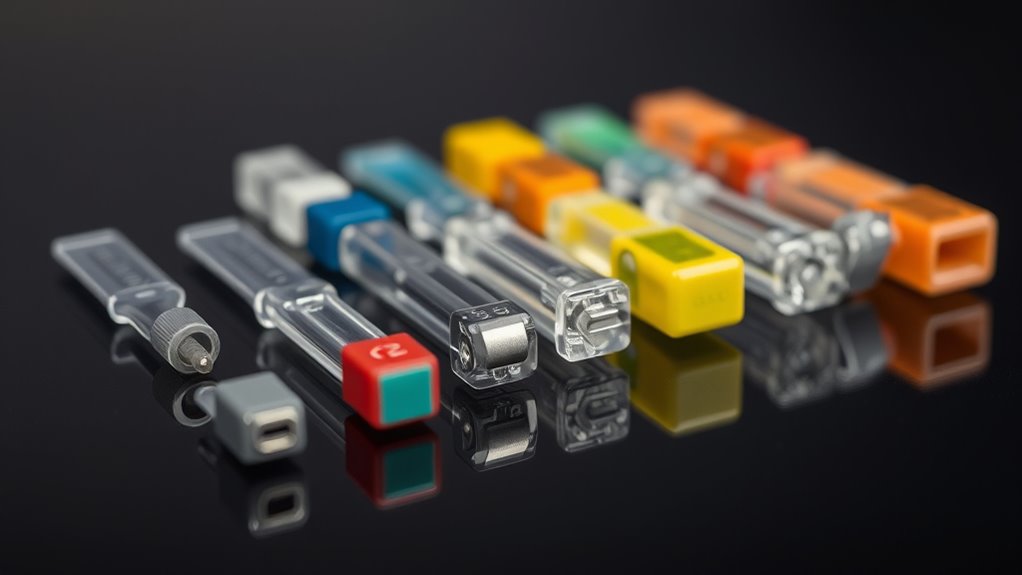
Mini blade fuses are compact, reliable components used to protect automotive and marine electrical circuits. Their small size allows for higher panel density, with a typical width of about 10.9 mm, making them ideal for space-constrained environments. The body height is around 16.3 mm, and the thickness about 3.6 mm, fitting standard automotive specifications. They’re rated at 32 V DC, with an interrupting capacity of 1000 A, ensuring safe operation during short circuits. The terminals are usually silver- or tin-plated zinc alloy, housed in durable PA66 plastic. Color coding helps identify ampere ratings quickly—red for 10 A, yellow for 20 A, green for 30 A. These fuses are widely available individually or in packs, suitable for a range of automotive and marine applications. Application versatility makes them a popular choice among vehicle enthusiasts and technicians alike. Additionally, their standardized size ensures compatibility with various fuse holders and circuits. Understanding the weight of wind turbine blades can help in selecting the appropriate fuse for renewable energy equipment used in larger systems. A clear understanding of fuse ratings is essential for effective circuit protection and safety compliance. Some models also incorporate temperature tolerance features, enhancing their durability and performance under varying operating conditions.

Mehdingna 100 Pcs Low Profile Mini Fuse Kit – Professional Blade Fuses Automotive for Car, Truck, RV, Boat with Fuse Puller (2A 3A 5A 7.5A 10A 15A 20A 25A 30A 35A)
- High-Quality Materials: Corrosion-resistant zinc alloy terminals
- Complete Fuse Kit: 100-piece assortment with storage box
- Includes Fuse Puller: Convenient fuse removal tool included
As an affiliate, we earn on qualifying purchases.
As an affiliate, we earn on qualifying purchases.
Differentiating Low-Profile Mini Fuses From Standard Mini Fuses

To tell low-profile mini fuses apart from standard ones, start by checking their height—low-profile fuses are about 8.73mm tall, much shorter than the 16.3mm standard. Their space-saving design makes them ideal for compact circuits, but both share the same width and pin spacing for compatibility. Look for labels or measure the fuse to verify you’re using the right type before wiring. The difference in height is a key indicator, which helps ensure you select the correct fuse for your application. Additionally, understanding fuse types can aid in selecting the appropriate fuse for specific circuit needs. Recognizing the differences in design can also be beneficial when working with various electrical components. Knowing the power and speed capabilities of electric bikes can also help in choosing the right components for your electrical setup. Being aware of home theater projector specifications can similarly assist in matching components for optimal performance. Properly identifying fuse types also contributes to safety and reliability in electrical systems, especially during seasonal preparations.
Size and Height Difference
Ever wondered how to tell low-profile mini fuses apart from standard ones? The key difference is in their size and height. Low-profile mini fuses measure approximately 10.9 × 3.6 × 16.3 mm, with a reduced overall height of 16.3 mm, making them more compact. They fit tighter spaces and are designed to sit closer to other components. This difference impacts installation, especially in crowded compartments. You can easily identify the low-profile type by measuring its height or checking its compatibility with tuning-fork terminals. Color coding and visual inspection of the housing can also help distinguish them quickly. Additionally, understanding the fuse’s size and dimensions can assist in selecting the correct type for your specific application. Being aware of fuse standards can further guide you in choosing the right fuse for safety and compliance.
Space-Saving Design Benefits
How does a low-profile mini fuse maximize space in modern electrical systems? Its compact height allows more fuses to fit within the same panel space, boosting fuse box density—ideal for space-constrained vehicles like imports, SUVs, and trucks. Its slim profile reduces overall weight and eliminates the need for bulky female box terminals, saving material and simplifying installation. The tuning-fork terminals and silver-plated zinc contacts further cut down on component count while enhancing durability. Its see-through housing provides quick fuse status checks without additional space. Additionally, its cost-effective manufacturing process contributes to lower product prices, making it an economical choice for vehicle owners. The use of specific sound healing frequencies in manufacturing processes can also influence material properties, improving longevity and performance.] Incorporating mini fuse technology helps optimize the layout of modern electrical systems by allowing more efficient use of available space. Furthermore, standardization ensures compatibility across various vehicle models and simplifies maintenance procedures.
Identification and Compatibility
Identifying the difference between low-profile mini fuses and standard mini fuses is straightforward once you know what to look for. Measure the plastic body height: around 8.7–9.1 mm indicates a low-profile mini, while approximately 16.3–16.4 mm points to a standard mini. Both share the same blade width (~10.9 mm) and spacing, so visual inspection of the body height is key. Count the terminals: two terminals usually mean mini or low-profile mini, while three terminals indicate a Micro3 fuse. Check blade spacing; narrower spacing suggests Micro2 or Micro3, whereas standard and low-profile minis have identical spacing. Always cross-check markings and fuse codes to ensure compatibility, and remember that fuse holders are often specific to each type, so don’t rely solely on color coding. Accurate identification is essential to prevent installation errors and ensure proper circuit protection.

JOREST 60Pcs Micro Assorement Fuses Kit -Micro2 Fuse kit, Micro 2 Automotive Replacement Fuses for Car RV Truck Motorcycle(2Amp 3A 5A 7.5A 10A 15A 20A 25A 30A 35A 40A)
- Designed for Micro2 Fuse Applications: Compatible with newer vehicle electronic systems
- Complete Range of Current Sizes: Includes 11 different fuse ratings from 2A to 40A
- Optimal Quantity and Selection: 60 fuses with popular sizes increased for convenience
As an affiliate, we earn on qualifying purchases.
As an affiliate, we earn on qualifying purchases.
Understanding Micro2 Fuses: Size and Functionality
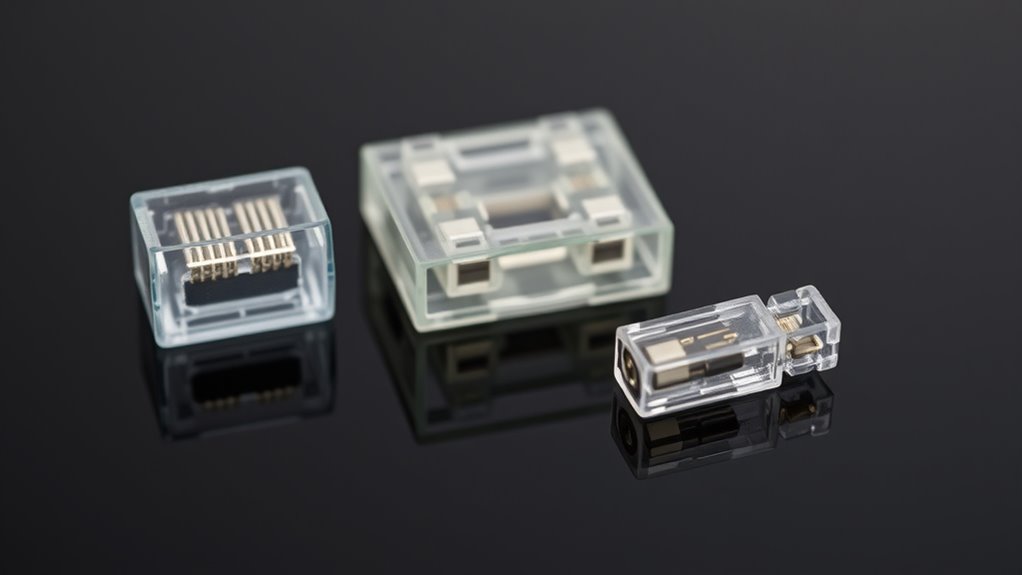
Micro2 fuses are small but essential components designed to protect circuits in tight spaces, making size a key consideration. With a maximum width of 9.1 mm and a length of 15.3 mm including spade terminals, they fit neatly into confined areas. Despite their compact size, they handle electrical ratings up to 32 VDC and 30 A current, providing reliable circuit protection. Their construction features zinc alloy terminals with silver or tin plating for durability, housed in a transparent PA66 casing that allows visual inspection. These fuses operate within a temperature range of -40°C to +125°C and comply with industry standards like SAE 2741. Their color coding indicates amperage, making identification straightforward. They are rated for use in automotive electrical systems, ensuring safety and compatibility. Additionally, understanding fuse types and their specific applications can help prevent electrical failures and improve overall system reliability. Proper selection of fuse size and ratings is crucial to maintaining system safety and performance. Furthermore, selecting the appropriate fuse type ensures compatibility with specific circuit requirements and enhances overall protection. Overall, Micro2 fuses combine small form factor with dependable functionality for automotive and marine applications. Recognizing the size differences among fuse types is vital for proper installation and effective circuit safeguarding. Being aware of industry standards can also help in choosing the right fuse for your needs.

DC 24V Automotive Blade Fuses Tester and Puller Check for Circuit Breakers for Car ATR ATO/ATC ATM Reset Fuse Removal Tool Also Test for Glass Tube Fuse
- Nerites Fuse Tester: Ideal for one-time fuses
- Built-in LED Indicator: Quickly identify blown fuses
- Adjustable Fuse Puller: Non-slip handle for easy removal
As an affiliate, we earn on qualifying purchases.
As an affiliate, we earn on qualifying purchases.
Exploring Micro3 Fuses for Advanced Circuit Protection
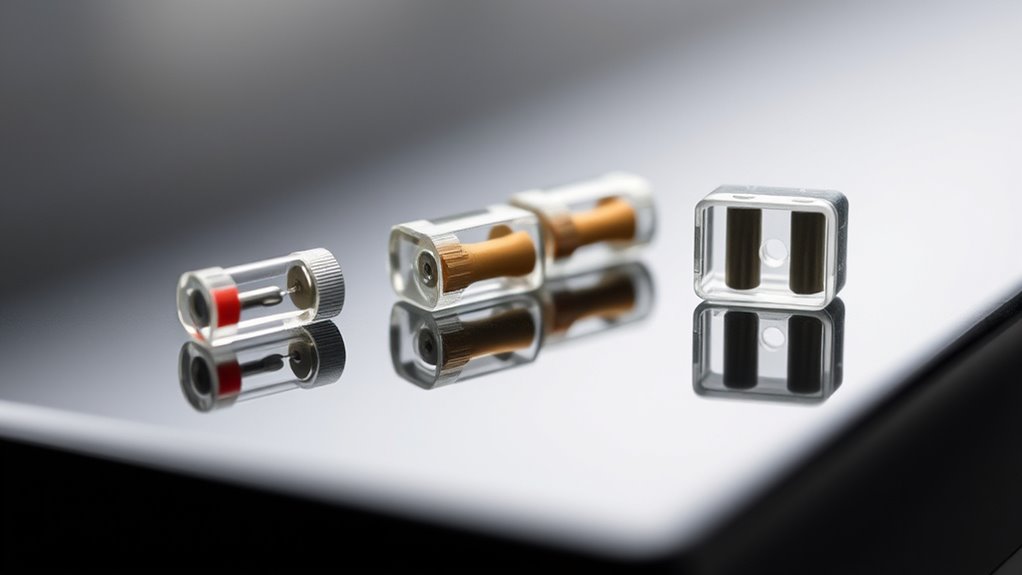
Micro3 fuses offer advanced circuit protection in compact designs, making them ideal for modern automotive and marine applications where space is limited. Their subminiature size allows for more circuit protection without sacrificing space. The see-through housing makes it easy to identify blown fuses, while high-contrast ampere ratings ensure quick recognition. Built with a UL V-2 flammability-rated PA66 housing, they are durable and meet strict safety standards. These fast-acting fuses handle voltages up to 32 V DC and feature interrupting ratings of 1 kA, making them suitable for high-current circuits. The silver-plated zinc alloy terminals withstand harsh environments, ensuring reliable performance. Whether used in cars, trucks, or boats, Micro3 fuses provide dependable, space-efficient protection with features like: Indigenous wellness essentials – highlighting the importance of incorporating traditional practices and natural ingredients for holistic health and safety, even in modern electrical components. Additionally, their space-saving design allows for more efficient use of limited installation areas, which is crucial in complex electrical systems. Incorporating reliable safety features such as these ensures that electrical systems remain protected and functional under demanding conditions. Understanding circuit protection techniques can help in selecting the most appropriate fuse types for specific applications, especially when considering the advanced designs that optimize both safety and space efficiency.
Visual Clues for Identifying Fuse Types and Ratings
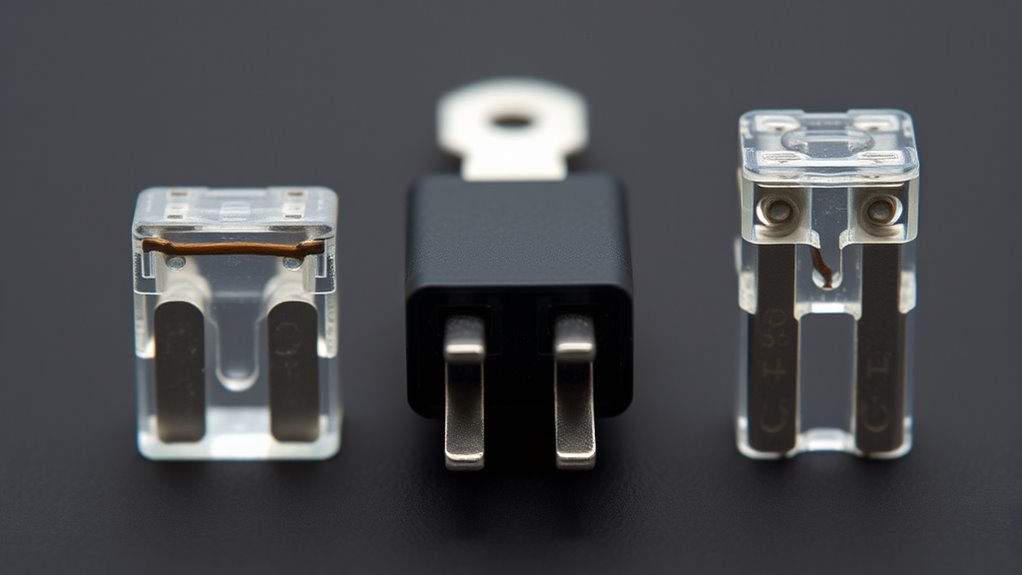
You can identify fuse types and ratings by examining their shape, size, and terminal configuration. Color coding provides an instant visual clue to the amperage, while the housing shape and pin arrangement help distinguish between models. Paying attention to these visual cues guarantees you select the correct fuse for your circuit needs. Understanding fuse standards and markings can further ensure proper identification and compatibility. Additionally, recognizing paint sprayer zone components and accessories can help prevent mismatched parts that may affect fuse performance or safety.
Shape and Size Differences
How can you tell different fuse types apart just by their shape and size? By observing their physical footprint and dimensions, you can distinguish Mini, Low-Profile Mini, and Micro2 fuses. Mini fuses are roughly 10.9 mm wide, 3.6 mm thick, and 16.3 mm tall, with tall rectangular bodies. Low-Profile Minis are shorter at about 8.7 mm high but share similar width. Micro2 fuses are smaller overall—around 14.4 × 4.2 × 18.1 mm—appearing more compact and slimmer. Visual clues include blade shape, body silhouette, and shoulder geometry. The flat, parallel blades of Mini fuses contrast with the slimmer Micro2 blades, which seat deeper. Rounded shoulders and molded ridges further differentiate Low-Profile Minis from standard Mini sizes. Their physical dimensions and overall shape are key indicators. – Body silhouette: tall rectangle vs. squat profile – Blade size: wider and thicker in Mini, slimmer in Micro2 – Shoulder shape: squared vs. rounded or tapered – Overall height and width: Micro2 is more compact
Color Coding Patterns
Identifying fuse ratings quickly becomes easier when you recognize their color coding patterns, which serve as visual clues across different fuse types. Standard blade fuses use specific colors for ratings—gray for 2A, violet for 3A, pink for 4A, tan for 5A, and brown for 7.5A. Mid-range fuses follow a similar pattern: red for 10A, blue for 15A, yellow for 20A, clear for 25A, and green for 30A. High-range fuses are distinguished by aqua blue for 35A, orange for 40A, red for 50A, blue for 60A, and amber for 70A. Maxi fuses also have color codes like gray for 25A, brown for 35A, red for 50A, blue for 60A, and transparent for 80A. Keep in mind, some colors repeat across fuse types due to similar ratings. Color coding patterns are designed to provide quick visual identification, reducing the chance of selecting an incorrect fuse rating during repairs or maintenance. Understanding fuse color codes can help you select the right fuse more efficiently and safely. Recognizing fuse color patterns can also prevent potential hazards caused by incorrect fuse replacements, especially when dealing with mini, low-profile, or micro2 fuses where size differences may add to confusion.
Terminal and Pin Configuration
Visual cues from terminal shapes, pin counts, and orientations provide essential clues for distinguishing fuse types and ratings. Blade-style terminals on Mini and Low-Profile fuses usually feature two flat, parallel blades designed to fit automotive fuse holders. Micro2 fuses have smaller, closely spaced flat blades with reduced width, making them narrower than Mini/Low-Profile variants. PCB-mount fuses show through-hole pins or SMD pads instead of blades, with through-hole pins appearing as round or square posts and SMD pads as flat metalized areas. Inline or panel fuse holders often display only two leads or threaded studs, indicating mounting style. Multi-pin fuse blocks contain several terminals, and counting these confirms the number of protected circuits.
- Blade shape, spacing, and size
- Presence of threaded studs or posts
- Number of terminals or pins
- Orientation and mounting features
Matching Fuses With Vehicle Electrical Systems
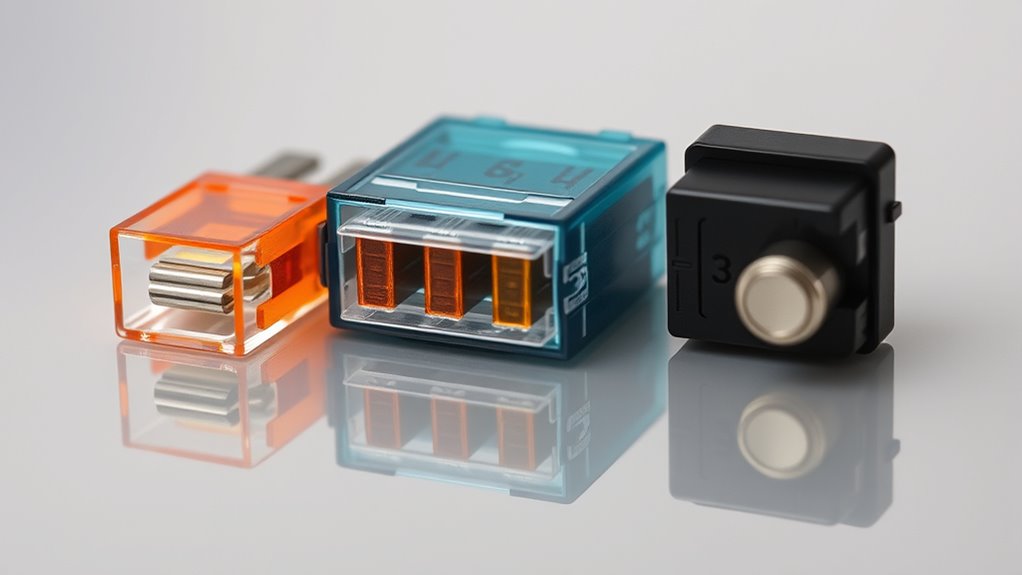
Matching fuses with your vehicle’s electrical system is essential to guarantee safety and proper function. First, check your owner’s manual or fuse diagram to identify the correct fuse type and amperage rating. Use the color coding standards—red for 10 A, blue for 15 A, yellow for 20 A, and green for 30 A—to quickly verify ratings. Confirm the fuse’s physical dimensions match the slot; for example, micro2 and mini fuses have identical pin spacing, but their sizes differ. Always select a fuse rated for the circuit’s maximum current draw to prevent overloads. Higher ratings are suitable for heavy-duty accessories, but never exceed the recommended amperage. Proper matching ensures your electrical system remains protected and functions reliably, preventing potential damage or safety hazards.
Tips for Safe Handling and Replacement of Blade Fuses

To handle and replace blade fuses safely, you must follow proper inspection and removal protocols to prevent injury and damage. Start by turning off the ignition and removing keys. Use a non-conductive tool like plastic or wood to pry out the fuse, or a fuse puller for gentle extraction. Avoid using pliers on bolt-down fuses; instead, use a socket or nut driver. Always inspect fuses for broken filaments, melted wires, or corrosion, and confirm continuity with a multimeter. When replacing, match the fuse’s size, type, and amperage precisely, ensuring it seats securely without forcing. After installation, test the circuit to confirm proper operation. If a fuse blows immediately, investigate underlying issues rather than just replacing. Proper handling minimizes the risk of electrical shock or system damage.
- Use non-conductive tools for removal
- Confirm fuse ratings before replacement
- Ensure proper seating for secure contact
- Never force or bypass fuses
Frequently Asked Questions
Can Different Fuse Types Be Used Interchangeably in Vehicles?
No, you can’t interchange different fuse types in vehicles safely. Each fuse type has a specific size, shape, and electrical rating designed for particular circuits and fuse boxes. Using the wrong type can cause poor contact, overheating, or even fire hazards. Always check your vehicle’s manual or fuse diagram, and verify the fuse type and rating before replacing to confirm proper fit and protection.
Are There Any Risks in Mixing Fuse Ratings?
Mixing fuse ratings is like mismatching puzzle pieces; it risks leaving gaps that can cause serious damage. When you use a fuse with a higher rating, it delays or prevents proper circuit protection, letting wires overheat like a glowing ember ready to ignite. Conversely, a lower rating causes unnecessary trips, masking underlying issues. Always match fuse ratings carefully to make certain your electrical system remains a sturdy, safe fortress rather than a ticking time bomb.
How Do I Identify Fuse Ratings Without Removing Them?
You can identify fuse ratings without removing them by inspecting external markings on the fuse body, such as ampere and voltage ratings, printed or stamped directly on the fuse. Use a bright light to check transparent housings for internal condition and printed codes. You can also rely on color coding, size, and shape to narrow down ratings, but always cross-reference with equipment manuals or fuse charts for confirmation before proceeding.
Do All Vehicle Models Use the Same Fuse Types?
Did you know over 80% of vehicles built after 2000 use blade fuses? Not all models use the same fuse types. Manufacturers vary based on vehicle age, design, and electrical needs, so you can’t assume all cars have identical fuses. Always check your vehicle’s manual or fuse box labels before replacing or adding fuses. Using the wrong type can lead to poor connections or electrical issues.
Are Blade Fuses Reusable or Should They Be Replaced After a Blow?
Blade fuses are not reusable after they blow. You should replace them with new ones of the same amperage rating to guarantee proper circuit protection. Reusing blown fuses risks failure to protect your wiring, which can cause damage or fires. Always diagnose the underlying issue causing the fuse to blow before installing a new one, and use fresh, correctly rated fuses from trusted sources like auto parts stores.
Conclusion
Knowing your fuse types is essential—did you know that using the wrong fuse can cause electrical failures or even fires? By understanding mini, low-profile, micro2, and micro3 fuses, you guarantee safe, reliable wiring. With over 80% of vehicle electrical issues related to fuse mishandling, paying attention to size, rating, and proper replacement is key. Stay informed, handle fuses carefully, and keep your vehicle’s electrical system running smoothly.