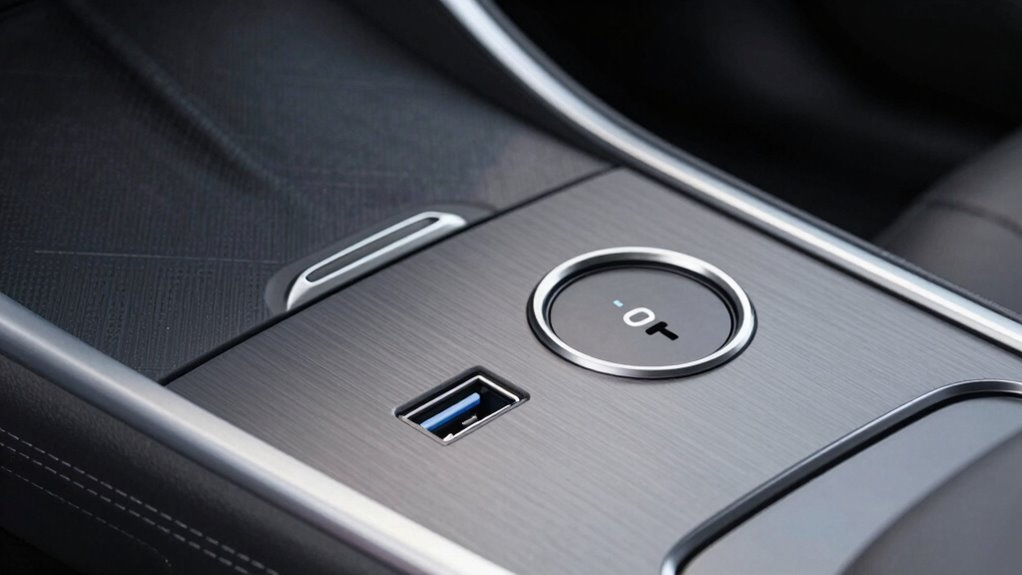
To tell apart car USB data ports from charging ports, check for icons or labels near the port—data ports often have symbols like a trident or a device icon, while charging ports may lack these. Look at the port’s color (blue or black for data, red or yellow for charging) and shape—USB-C ports typically support data and charging, while some USB-A ports may be charging-only. Understanding these signals helps you connect devices correctly; learn more for detailed tips.
Open a free Amazon Business account
Business pricing, bulk buying and tax-exempt orders.
As an affiliate, we earn on qualifying purchases.
Key Takeaways
- Look for port icons or labels: data ports often have USB symbols or “SS” logos, while charging ports may lack these indicators.
- Check port color coding: blue or teal typically signifies data-capable USB 3.x ports, whereas red or yellow often indicates charging-only ports.
- Observe port shape: USB-C ports support data transfer and charging, but some USB-A ports may be dedicated solely to charging.
- Test with a device: connect a USB device to see if it is recognized for data; charging-only ports won’t detect data devices.
- Consult vehicle documentation: manufacturer specs clarify which ports support data transfer versus charging-only functions.

Treedix USB Cable Tester 2.4" Screen for eMarker PD3.0/3.1 Resistor | USB Tester USB C Cable Tester Compatible with Lightning, Type-C, Micro-B 2.0/3.0, and Mini-B Cables, TBT 3/4/5
- USB Cable Performance Testing: Check continuity, functionality, and resistance
- Type-C eMarker Chip Reading: Read and analyze eMarker chip data
- High-Definition Color Display: 2.4-inch screen for real-time cable info
As an affiliate, we earn on qualifying purchases.
As an affiliate, we earn on qualifying purchases.
Recognizing Port Icons and Labels
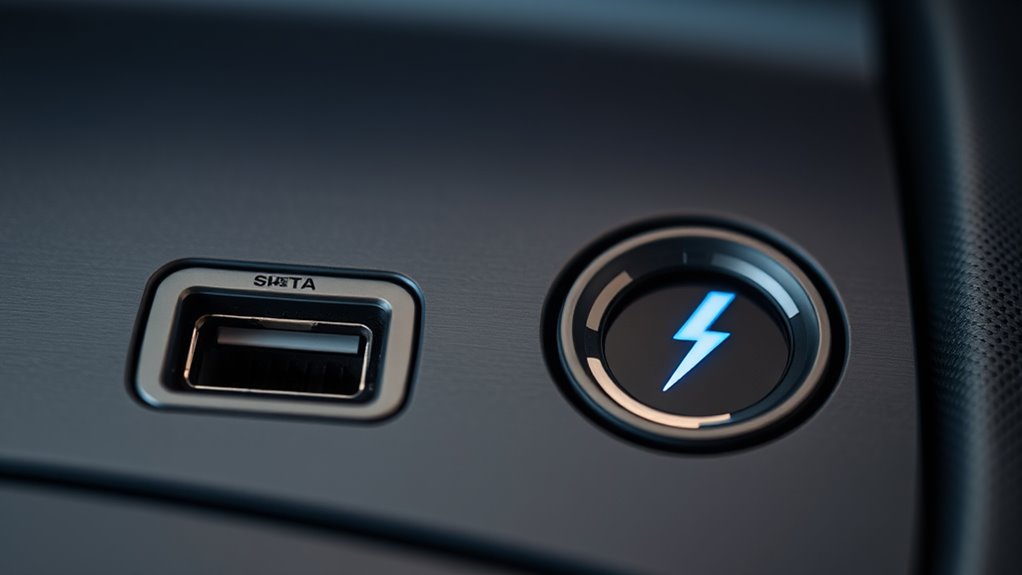
To identify whether a USB port is meant for data transfer or charging, start by examining the icons and labels nearby. The classic USB symbol, featuring a circle, smaller circle, triangle, and square, indicates standard USB ports supporting data connections, typically USB 2.0. For faster data transfer, look for the “SS” logo, which signifies SuperSpeed USB 3.2 ports. If you see “Gbps” next to it, it points to higher speeds like 10 Gbps or more. A lightning bolt symbol signals fast charging capabilities, especially when paired with a battery icon or a PD mark. Ports with a battery-like shell or yellow color often support power delivery, even when your device is off. Recognizing these icons helps you distinguish between data and charging ports quickly. Understanding port icons and labels is essential for maximizing your device’s functionality and ensuring compatibility with your accessories.

Car External Universal CD Player
- Universal Compatibility: Works with Android, PC, and TV
- Plug and Play: Easy installation without drivers or power
- Wide Media Support: Plays CD, CD-R, CD-RW discs
As an affiliate, we earn on qualifying purchases.
As an affiliate, we earn on qualifying purchases.
Differentiating USB-A and USB-C Connectors
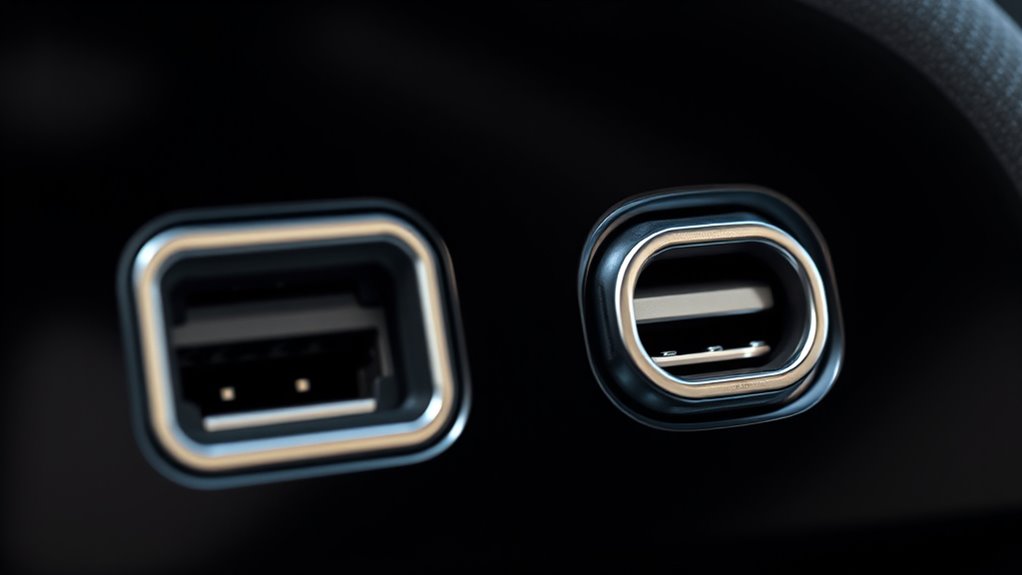
You can distinguish USB-A and USB-C connectors by their shape and size—USB-A is rectangular and larger, while USB-C is smaller and oval-shaped. Port color coding isn’t standardized, so visual inspection of the connector’s geometry is the most reliable method. Compatibility and standards vary, so checking the port specifications helps confirm their data transfer and charging capabilities. USB-C is increasingly adopted as the universal standard, ensuring broader device compatibility in the future. Additionally, understanding connector technology can help you identify the appropriate port for your needs.
Connector Shape and Size
The shape and size of USB connectors play a key role in distinguishing USB-A from USB-C. USB-A features a rectangular profile with a flat, elongated design, requiring specific alignment for insertion. It’s larger overall, with four internal contacts for power and data transfer, and its rigid, non-symmetrical shape makes it easy to identify. In contrast, USB-C has an oval-shaped, compact form ideal for slim devices like smartphones. Its symmetrical design allows reversible insertion, eliminating orientation issues. USB-C ports are smaller, matching the reduced dimensions of modern portable gadgets, and feature 24 pins supporting advanced functions. The size difference is noticeable: USB-A’s larger footprint contrasts sharply with USB-C’s slim profile, making it straightforward to tell these connectors apart just by their shape and size. Furthermore, the number of pins in USB-C enables it to handle multiple protocols and higher data transfer speeds, setting it apart from the simpler design of USB-A. Additionally, connector versatility is a significant advantage of USB-C, as it can be used for power, data, and video transfer with a single port.
Port Color Coding
Color coding helps quickly identify different USB port types and their capabilities, especially when distinguishing between USB-A and USB-C connectors. Recognizing port colors can save you time and prevent connection errors. Here are key color indicators:
- White: Old USB 1.x ports with slower speeds, often seen on Type A or B connectors.
- Black: USB 2.0 ports, common for everyday data transfer at 480 Mbps.
- Blue: USB 3.0 SuperSpeed ports, offering up to 5 Gbps, usually on Type A or C.
- Teal: USB 3.1 SuperSpeed+ ports, with speeds up to 10 Gbps, often on newer devices.
- Keep in mind, color application varies by manufacturer, so use it as a quick guide alongside other port identification methods. Understanding USB port standards can help you choose the right port for your needs.
Compatibility and Standards
Differentiating USB-A and USB-C connectors involves understanding their physical designs, supported standards, and capabilities. USB-A is larger, rectangular, and unidirectional, mainly found on host devices. USB-C is smaller, oval, reversible, and increasingly used on both hosts and peripherals. USB-C supports higher data rates, multiple protocols like DisplayPort, and can deliver up to 100W of power with proper support. USB-A ports typically provide limited charging and data speeds, while USB-C ports can handle faster data transfer and more power. Compatibility depends on the standards supported by the device and cable, which can vary. USB-C’s versatility has led to its adoption across a wide range of devices, replacing older connector types in many applications. Additionally, interoperability between different standards is crucial for seamless device operation. The development of universal standards aims to simplify connections and improve compatibility across devices. As technology advances, new standards continue to enhance connection capabilities and user convenience. Use the table below to compare key features:
| Feature | USB-A | USB-C |
|---|---|---|
| Physical Design | Rectangular, unidirectional | Oval, reversible |
| Data Standards | USB 2.0 to USB 3.2 | USB 2.0 to USB4 |
| Power Delivery | Limited, no native PD support | Up to 240W with PD support |

LMUBOY USB to USB C Adapter for iPhone Air 17 Pro Max,USB-C Female to USB Male Charger Converter for Apple MagSafe Watch 11/10/9/8/7/SE/Ultra,Car,iPhone 16 15 Mini Pro Max,Galaxy S20-26,Pixel,CarPlay
- Compatible with MagSafe Chargers: Designed for MagSafe wireless chargers
- Revives USB Chargers: Allows use of existing USB chargers for USB-C devices
- Supports Data Transfer: Transmits data at up to 480Mbps
As an affiliate, we earn on qualifying purchases.
As an affiliate, we earn on qualifying purchases.
Interpreting Physical Port Markings and Color Codes
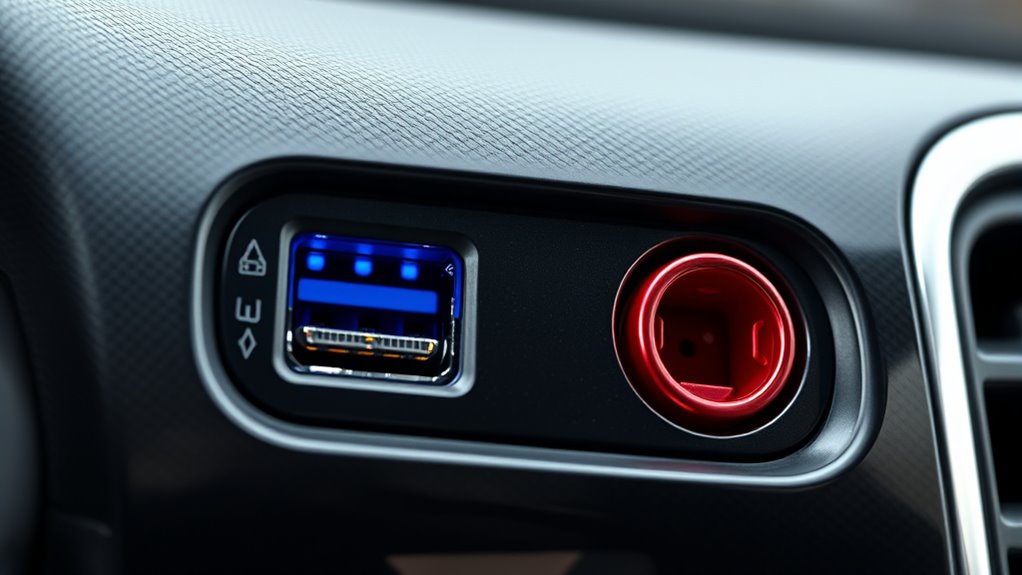
How can you tell if a USB port in your vehicle supports data transfer or just charging? Look for physical markings and color codes. For example, a port with a USB trident icon or symbols like a smartphone, headset, or infotainment logo usually indicates data support. Ports marked with “SS” or “3.0” mean USB 3.x capabilities, offering faster data transfer. Blue insides often signal USB 3.x, while black suggests USB 2.0, but icons are more reliable. Red or yellow ports might be high-current charging ports, not necessarily data-enabled. Additionally, labels like “Power Delivery” or wattage specs focus on charging, not data. Remember, connector shapes also matter; USB-C ports often support both high-speed data and fast charging, unlike Micro-B or proprietary sockets. Understanding port markings helps identify capabilities. Some ports may have dedicated data lines that facilitate information transfer even if the port appears primarily designed for charging. Recognizing port color codes and markings can prevent confusion between data and charging functionalities.

LISEN Car Charger USB C, 69W Cigarette Lighter USB Charger Adapter, Car Accessories Gifts for Men, Mini USBC Cars Fast Charging Adapter USBC Type C 12V Plug Outlet, for iPhone 17 Pro Max 16 15 14 13
- Smarter Dual Port Design: Reduces heat and clutter in your car
- Balanced Power Distribution: Prevents overheating with efficient power spread
- Fast Charging for Mainstream Devices: Supports iPhone 12-17 and Android devices
As an affiliate, we earn on qualifying purchases.
As an affiliate, we earn on qualifying purchases.
Conducting Behavioral Tests for Data Support

To verify if your car’s USB port supports data transfer, start by connecting a compatible device like a flash drive or smartphone. Observe if media files are recognized and accessible through your head unit or infotainment system. Then, test data transfer capabilities by copying files or streaming media to confirm the port handles data properly beyond just charging. Furthermore, ensuring the port meets high-speed electrical standards, such as the High Speed (HS) transfer mode of 480 Mb/s, is essential for reliable data communication. Additionally, checking for compliance with USB specifications can help verify the port’s data transfer capabilities. Proper wiring and adherence to electrical standards can also influence the port’s data functionality and performance. Confirming that the port supports data transfer standards helps ensure it functions reliably for all your device needs. Verifying the port’s compatibility with various devices can also prevent connection issues and optimize data transfer performance.
Connect a Compatible Device
Before initiating data transfer, you should connect your compatible device securely to the car’s USB port. Guarantee the connection is firm and free of looseness or poor contact. To verify proper setup, inspect the cable for damage, corrosion, or creases. Use a breakout box to isolate pins and diagnose if you have a USB-C or USB-A port. Confirm that pin connections match USB data standards with a multimeter. Additionally, understanding the net worth of individuals can provide context for their public appearances and endorsements.
- Connect your device, like a flash drive or smartphone, directly into the port.
- Use a USB loopback tester to simulate data flow.
- Force the device into loopback mode with HSETT for compliance.
- Check data transfer speed and integrity using continuity testers and data packet tests.
Observe Media Recognition
Once you’ve securely connected your device to the car’s USB port, observing the media recognition cues can quickly reveal whether the port supports data transfer. Look for icon signals: a triangle-circle-square USB icon indicates data support, while a battery lightning bolt suggests charging-only. If your infotainment system recognizes your device and prompts media playback, the port likely supports data transfer. Conversely, if there’s no media response or no icons appear, it’s probably a charging port. The presence of a smartphone icon hints at compatibility with Android Auto or Apple CarPlay. Additionally, a slow or no response when opening media apps signals the port might be limited to charging. Checking these cues helps you determine if the port can handle media syncing or simply charges your device. Understanding USB port functions can further enhance your troubleshooting accuracy.
Test Data Transfer Capabilities
Conducting behavioral tests is essential to accurately determine if your car’s USB port supports data transfer. To do this, start by testing the cable with a USB tester. Look for LED indicators that confirm data wire presence and verify voltage and current readings. Use a multimeter to check continuity between wires and ensure proper power delivery. Apply load testing, like a 100mA draw, to see if voltage remains stable, indicating good power support. Finally, attempt data transmission by connecting devices and observing if files transfer correctly or if communication fails. Keep these points in mind:
- Use a USB tester to check LED indicators and voltage.
- Perform multimeter continuity and voltage checks.
- Conduct load tests to confirm power stability.
- Attempt data transfer to verify data line activity.
- Regularly testing USB ports helps prevent connectivity issues and ensures optimal performance of your car’s multimedia system.
Understanding USB Standards and Protocols
Understanding USB standards and protocols is essential for knowing how your devices communicate and transfer data efficiently. Over time, USB versions have evolved from USB 1.0’s 12 Mbps to USB 4.0’s 40 Gbps, supporting faster speeds and more complex protocols. Different connector types, like Type-A and Type-C, offer compatibility and performance variations, with USB-C supporting USB4’s 40-80 Gbps. Power delivery protocols have also advanced, enabling higher wattage outputs, such as 240W with USB PD 3.2. Protocol enhancements now include full-duplex transfers, tunneling multiple protocols simultaneously, and improved power management. Here’s a quick comparison: USB standards have continually improved to meet the demands of modern technology, ensuring seamless data and power transfer across devices.
| Version | Max Speed | Connector Type | Power Output |
|---|---|---|---|
| USB 2.0 | 480 Mbps | Type-A | 2.5-4.5W |
| USB 3.0 | 5 Gbps | Type-A | Improved |
| USB 3.2 | 10-20 Gbps | Type-C | Up to 100W |
| USB4 | 40 Gbps | Type-C | Up to 240W |
| USB PD | Varies | All | Up to 240W |
Using Cables and Accessories to Identify Capabilities

Using cables and accessories to identify their capabilities is straightforward if you pay attention to their physical design and indicators. Look for visual cues and icons that reveal their function. For example:
- A battery icon with a lightning bolt suggests fast charging support.
- The USB icon with a triangle, circle, or square indicates data transfer for Android Auto.
- A smartphone icon signals CarPlay compatibility, confirming data support.
- No icons or labels typically mean the cable is power-only, matching a charging port.
Additionally, observe the connector shape: USB-C’s reversible design simplifies identification, while USB-A’s rectangular shape limits orientation. Thicker wires and shielding in cables also hint at their purpose—power or data—helping you choose the right accessory for your needs.
Consulting Manufacturer Documentation and Settings
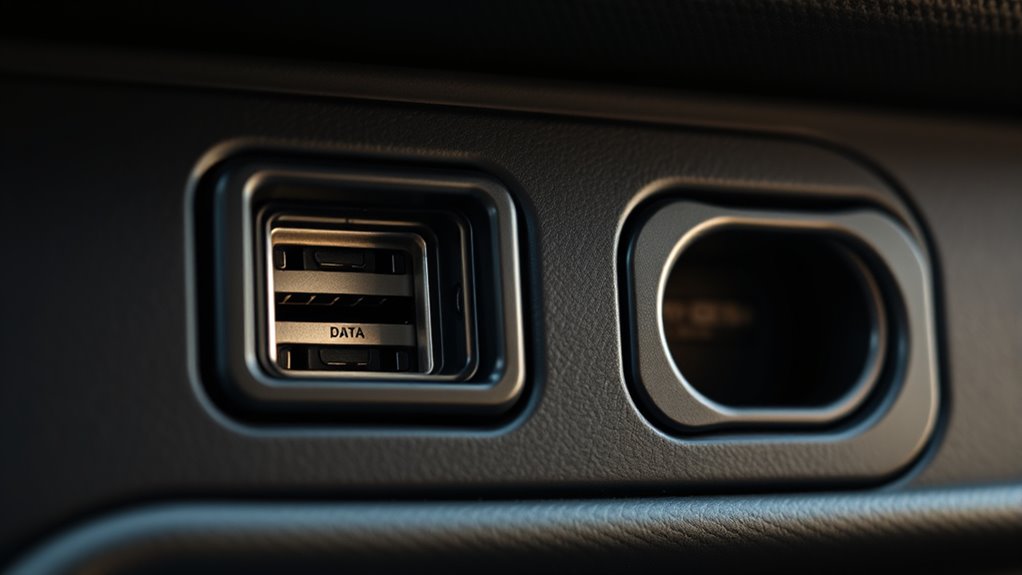
Consulting manufacturer documentation is essential to accurately identify a port’s capabilities because it provides detailed technical specifications and functional descriptions that labels or physical cues may lack. By reviewing data sheets and design notes, you can determine if a port supports high-speed data transfer or just charging. For example, USB controllers like TPS2549-Q1 and TPS251xx specify current-limiting and data line detection features. Infotainment system datasheets reveal signal integrity support and charger profiles. Power profiles, such as USB PD 3.0, are clarified through documentation, verifying voltage and current limits.
| Feature | Specification |
|---|---|
| D+/D- sensing | USB BC1.2 modes, divider/1.2V detection |
| High-speed data | 480 Mbps at USB 2.0 |
| Power profiles | 5V/1.5A, 9V/3A, 20V/5A support |
Frequently Asked Questions
Can a Port Support Both Data Transfer and High-Current Charging Simultaneously?
Yes, a port can support both data transfer and high-current charging simultaneously if it follows the USB Power Delivery (PD) standard. This allows negotiated power levels up to 240W, enabling fast charging while maintaining data connections. Make sure the cable and port support PD and are wired correctly. Your device’s firmware and hardware design also play a role, ensuring both functions operate together without conflicts or overheating.
How Can I Identify a Dedicated Charging Port Without Labels or Icons?
You can identify a dedicated charging port by testing it with a device that only charges. If it draws over 500 mA without data transfer, it’s likely a charging port. Look for physical clues like a different color (orange, teal), or absence of data pins. Using a USB load tester or software can confirm if the port supplies high amperage without supporting data transfer, indicating a dedicated charging port.
Do All USB-C Ports Support Power Delivery and Fast Data Transfer?
Not all USB-C ports support power delivery or fast data transfer, so you might feel a bit disappointed if you expect universal compatibility. Many ports, especially on older or budget devices, are limited to basic charging or data transfer. To guarantee you get the power and speed you want, look for ports labeled with PD or high-speed data standards, or check device specifications—because not every port can deliver beyond the basics.
Are All Red or Blue USB Ports Necessarily Data-Enabled or High-Power?
No, not all red or blue USB ports are necessarily data-enabled or support high power. Color alone isn’t reliable since manufacturers use colors differently. A blue port might indicate USB 3.x, but it could be charging-only. Red ports often support charging, but may also handle data. Always check for labels, symbols, or port specifications in the owner’s manual to confirm whether a port supports high-speed data transfer or high power delivery.
How Does Port Behavior Differ Between Factory-Installed and Aftermarket Vehicle Systems?
You might think all USB ports behave the same, but factory-installed ports usually prioritize data transfer and have limited power output, supporting features like Apple CarPlay or Android Auto. Aftermarket ports, however, mainly focus on charging faster with higher amps and wattage, often lacking data capabilities unless specifically designed for it. So, if you want quick data sync or fast charging, check whether the port is factory or aftermarket.
Conclusion
By paying attention to port icons, labels, and physical features, you can effortlessly distinguish between data and charging ports—like reading a map through a maze. Conduct behavioral tests, check color codes, and consult manufacturer info to uncover their true nature. Think of your car’s USB ports as gateways—some lead to data worlds, others just charge your devices. Master these clues, and you’ll navigate your car’s ports with confidence, revealing their full potential like a seasoned explorer.
Back to school Picks
back to school
As an affiliate, we earn on qualifying purchases.