
📊 Full opportunity report: How To Add Drowsy-Driver Alerts To Cars Without Built-In Safety Tech on IdeaNavigator AI — validation score, market gap, and execution plan.

Get business pricing on garage and car supplies
- Business-only prices and quantity discounts
- Tax-exempt purchasing
- Multiple users, one account, clear invoices
TL;DR
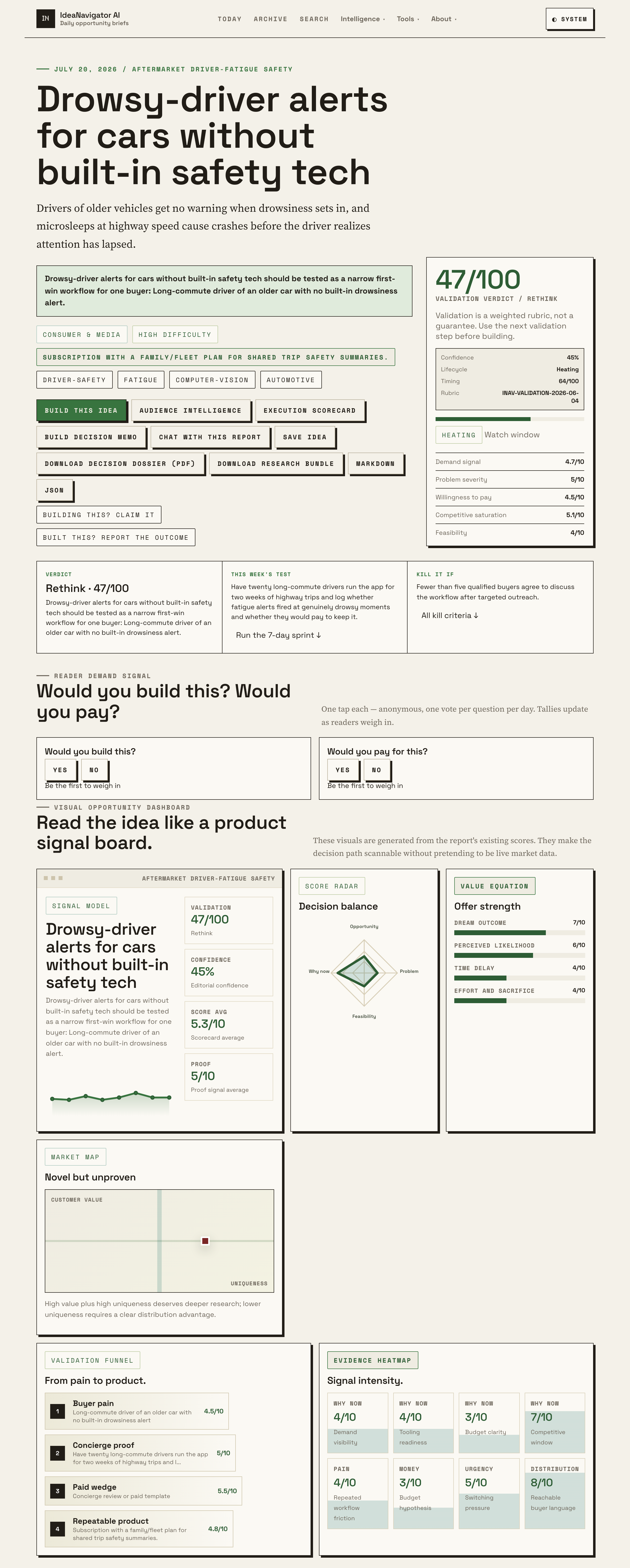
IdeaNavigator AI has proposed testing a phone-mounted app that detects possible drowsiness from eye closure and head movement, then sounds an alert and prompts a break. The concept has not been validated: a proposed two-week trial with 20 long-commute drivers would assess whether alerts match genuine fatigue and whether users would pay.
IdeaNavigator AI has proposed testing a dashboard-mounted phone app that watches for possible signs of driver drowsiness and issues escalating alerts. The concept is aimed at long-commute drivers in older cars without built-in fatigue warnings, but no trial results or evidence of the app’s accuracy have been reported.
According to IdeaNavigator AI’s proposal, the app would use a phone camera and on-device face-landmark models to look for eye-closure and head-nod patterns. If it detects signs it interprets as drowsiness, it would sound an escalating alert and prompt the driver to take a break. The concept assumes the phone is secured in a dashboard mount and positioned to view the driver.
IdeaNavigator AI frames the product as an aftermarket driver-fatigue tool for people whose vehicles lack this feature. The company proposes a two-week pilot with 20 long-commute drivers, focused on highway trips. Participants would log whether alerts occurred when they felt genuinely drowsy and whether they would pay to continue using the app.
The proposal suggests a subscription business model, with family or fleet plans that share trip safety summaries. These are proposed features and commercial assumptions; IdeaNavigator AI specifies no pricing, working product, trial enrollment, or customer demand results.
Testing Alerts in Older Cars
A phone-based warning could offer drivers of older vehicles another way to receive fatigue prompts without replacing the car. IdeaNavigator AI’s proposal targets a gap in vehicles that do not have factory-installed drowsiness monitoring, particularly for people who make regular long trips.
Its practical value depends on whether the app can recognize meaningful signs of fatigue reliably while the vehicle is moving. A false alert could distract or annoy a driver, while a missed warning could leave the driver with misplaced confidence. The proposed pilot would gather user observations, but a small trial alone would not establish that the app prevents crashes or is safe and accurate across different drivers, lighting, phone positions, and road conditions.
As an affiliate, we earn on qualifying purchases.
The Phone-Mounted Approach
The idea rests on a shift from vehicle-installed sensors to camera-based monitoring on a mounted phone. IdeaNavigator AI says low-cost phone mounts and on-device face-landmark models make it possible to estimate eye and head movements. The proposal provides no technical performance data or documented comparisons with systems in newer cars.
Unlike a built-in system, a phone app would rely on the device being mounted and aimed appropriately, and on its camera having a usable view of the driver. IdeaNavigator AI does not say what phones it would support, how it would handle occluded faces or changing light, or whether the app would operate without an internet connection. Those details would shape how the concept works in everyday driving.
As an affiliate, we earn on qualifying purchases.
Accuracy and Trial Status
No app test results are available in IdeaNavigator AI’s proposal. It is not clear whether a prototype exists, whether the suggested 20-driver pilot has been scheduled, or how participants would determine that an alert matched a genuinely drowsy moment. The proposal also gives no measured false-alert or missed-alert rates.
IdeaNavigator AI does not explain how the app would distinguish fatigue from ordinary blinking, glances away from the road, or movements caused by road conditions. The proposal does not specify how driver video or trip summaries would be stored, who could access them under family or fleet plans, or what privacy protections would apply. It provides no evidence that the app has been independently evaluated or that using it reduces crash risk.
As an affiliate, we earn on qualifying purchases.
A Small Driver Pilot
The next stated step in IdeaNavigator AI’s proposal is a two-week trial with 20 long-commute drivers on highway trips. The planned observations would cover whether alerts align with drivers’ own reports of fatigue and whether participants would pay to keep using the app. The company has not reported a start date or results.
For the proposal to move beyond an initial product test, further evaluation would need to measure alert accuracy and distraction under varied driving conditions, as well as address phone placement and data handling. Until such evidence is available, the concept should be understood as a proposed alert tool, not a demonstrated substitute for rest or a proven safety system.
eye and head movement driver alert
As an affiliate, we earn on qualifying purchases.
As an affiliate, we earn on qualifying purchases.
Key Questions
How would the proposed app detect drowsiness?
According to IdeaNavigator AI’s proposal, it would use a mounted phone camera and on-device face-landmark models to look for eye closure and head nods, then issue an alert and break prompt. The proposal does not report detection performance.
Has the app been tested with drivers?
IdeaNavigator AI provides no test results. It proposes a two-week pilot involving 20 long-commute drivers, but does not give a trial date or say whether it has begun.
Would the app prevent crashes?
That has not been established. IdeaNavigator AI describes alerts, but provides no evidence that the app reduces crashes or reliably detects fatigue.
What would the app cost?
IdeaNavigator AI specifies no price. A subscription, with possible family or fleet plans, is suggested as a business model rather than a confirmed offer.
What happens if a driver feels sleepy?
The proposed app would prompt the driver to take a break. Drivers should treat fatigue as a reason to stop somewhere safe and rest; a phone alert cannot establish that it is safe to continue driving.
Source: IdeaNavigator AI
Halloween Picks
halloween
As an affiliate, we earn on qualifying purchases.