TL;DR

Get business pricing on garage and car supplies
- Business-only prices and quantity discounts
- Tax-exempt purchasing
- Multiple users, one account, clear invoices
University of Michigan and Toyota Research Institute researchers built and tested a steering wheel with inflatable air sacs designed to communicate driver-assistance intentions and accept driver feedback. In a simulator study, participants spent less time fighting the system and reported lower effort and frustration, though researchers also found that some drivers could become too trusting.
University of Michigan researchers, working with the Toyota Research Institute, built and tested a steering wheel with inflatable air sacs that lets drivers respond to a semi-autonomous system through touch. A simulator study found that participants spent less time fighting the assistance system and reported less frustration, but the prototype has not been shown to be a production-ready feature.
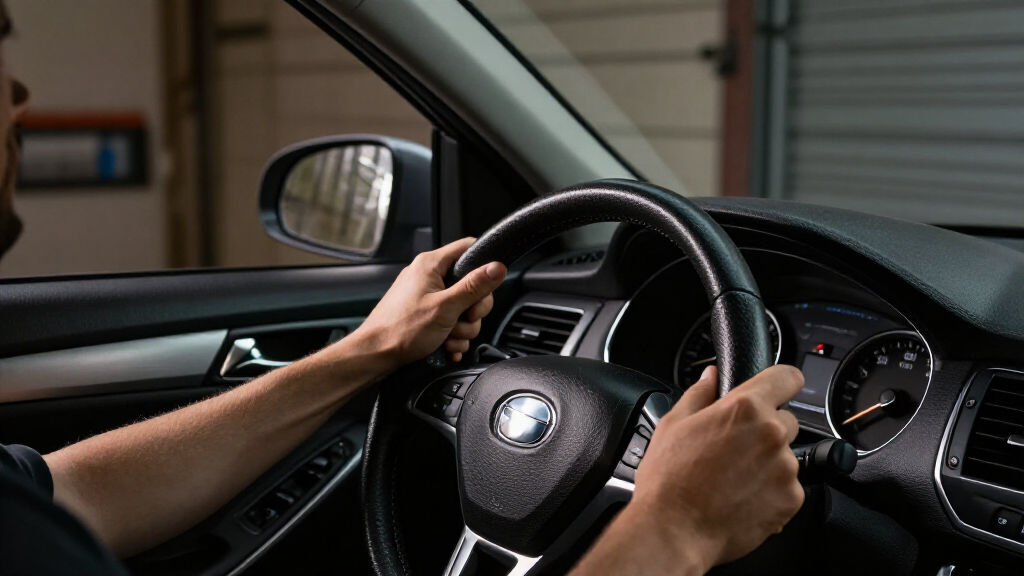
The wheel places haptic zones at the 10 o’clock and 2 o’clock positions, where drivers typically hold it. When the assistance system wants to steer left, for example, sacs on the left side inflate. A driver who disagrees can press down to deflate them; if the system continues to recommend the maneuver, it can send pulses of air that the driver feels through the wheel.
The researchers’ aim is to provide a way for a driver to respond without simply letting the system act or intervening in a way that may deactivate assistance. The research team tested the idea in a driving simulator, asking participants to navigate a turn with possible obstacles. According to the study description and a University of Michigan press release, participants spent less time struggling against the assistance system and braked less. They also reported lower effort, frustration and physical demand.
The reported results include a caution: researchers found that participants were more likely to regain trust in the system after it made a mistake, but some became too trusting. The source material does not provide the study’s participant count or numerical effect sizes, so the scale of the reported changes cannot be assessed from those details alone.
Giving Drivers a Tactile Reply
Driver-assistance systems can steer or otherwise help with driving while still requiring a person to remain attentive. When the person and the system have different intentions, the driver may have to wrestle with the wheel or make an input that switches assistance off. The researchers’ approach treats that moment as a two-way communication problem: the system signals what it wants to do, and the driver can push back through the same control.
If further testing supports the simulator findings, tactile feedback could offer another way to make shared control feel less physically demanding. But the trust finding matters too. A system that makes interaction easier could also lead some drivers to rely on it more than is warranted. The study does not establish that the wheel improves real-world safety or that drivers would use it appropriately on public roads.
smart steering wheel with haptic feedback
As an affiliate, we earn on qualifying purchases.
As an affiliate, we earn on qualifying purchases.
Fully autonomous driving remains a longer-term goal, while driver-assistance systems that require an attentive driver are already part of the driving environment described in the report. That leaves manufacturers and researchers working on how people and automated features should hand control back and forth without confusion.
The air-sac wheel was developed by University of Michigan Engineering researchers with Toyota Research Institute involvement and funding, according to the source report. It is one proposed hardware solution, not the only way to allow a driver to correct an assistance system. The Drive points to Mercedes’ MB.Drive Assist Pro as an example of a system that accepts inputs such as a steering-wheel tug or brake tap without fully disengaging. The comparison highlights an open design question: whether drivers need a dedicated tactile interface or whether existing controls can provide the same kind of response.
““lower effort, frustration, and physical demand””
— University of Michigan press release, as summarized in The Drive
As an affiliate, we earn on qualifying purchases.
Real-World Performance Still Unknown
The supplied report describes a simulator study, not testing in ordinary road conditions. It does not provide participant numbers, detailed statistical results, or evidence that the wheel reduces collisions or other safety risks. The research also does not establish whether the air sacs would be durable, practical to manufacture, or acceptable to drivers over time.
It remains unclear whether the researchers plan further testing or whether any automaker will develop the concept for vehicles. The reported increase in trust also needs careful interpretation: the source says some participants became too trusting, but does not specify how often that happened or how it was measured.
semi-autonomous vehicle steering system
As an affiliate, we earn on qualifying purchases.
As an affiliate, we earn on qualifying purchases.
Further Testing Would Be Needed
The source material does not announce a production plan or a date for additional trials. Any next step would need to establish whether the simulator findings hold up in road testing, how drivers respond after repeated use, and whether the tactile signals help without encouraging overconfidence. Until such evidence or a manufacturer announcement is available, the breathing steering wheel remains a research prototype, rather than a confirmed feature for sale.
As an affiliate, we earn on qualifying purchases.
Key Questions
How does the air-sac steering wheel work?
Inflatable sacs in zones near the driver’s hands expand to signal a system intention. The driver can press on a sac to push back, and the system can use pulses of air to repeat its signal.
Was the wheel tested on public roads?
The source report describes testing in a driving simulator. It does not report public-road trials.
What did participants report?
According to the study description and University of Michigan press release, participants spent less time fighting the assistance system and reported lower effort, frustration and physical demand. The source does not give numerical results or a participant count.
Is this steering wheel going into production?
No production plan is reported. The wheel is described as a research prototype, and the supplied material does not identify an automaker preparing to offer it.
Did the study identify any concerns?
Yes. Researchers reported that some drivers could become too trusting after regaining confidence in the system following a mistake. The report does not say how common that response was.
Source: rss
Columbus Day / Indigenous Peoples' Day Picks
long weekend sales
As an affiliate, we earn on qualifying purchases.