TL;DR

Get business pricing on garage and car supplies
- Business-only prices and quantity discounts
- Tax-exempt purchasing
- Multiple users, one account, clear invoices
Swiss startup Winduction has demonstrated a wireless charging system that transfers power from road plates through induction coils built into specially developed, steel-free bus tires. The company reports transfer efficiency above 90% and is building test infrastructure; its first pilot with transport operators is planned for 2028, but projected savings are still being assessed.
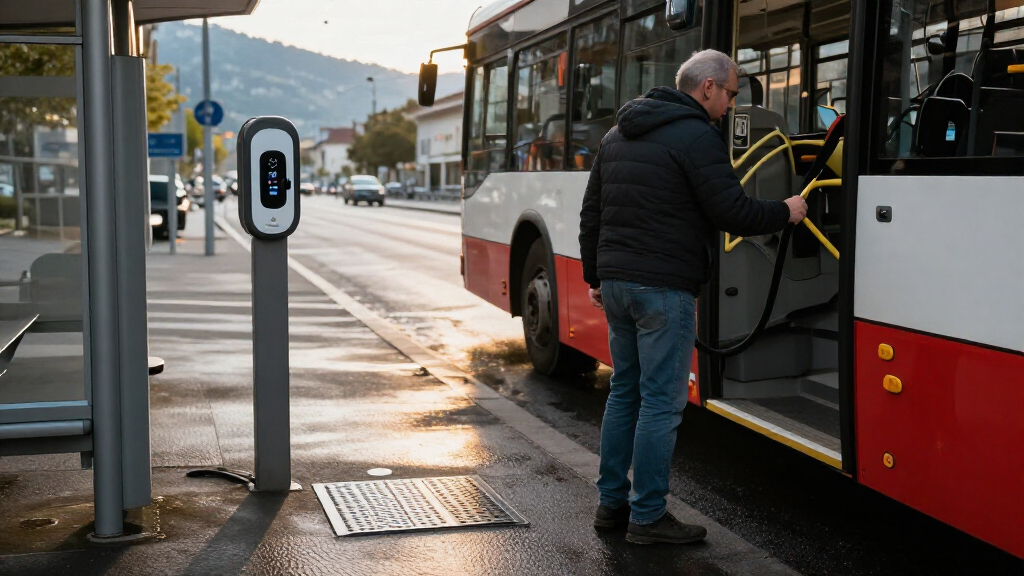
Swiss startup Winduction, a spin-off from ETH Zurich, has demonstrated a system that wirelessly charges electric buses through induction coils built into specially developed tires. The company says the approach transfers power from plates installed in the road and could let buses charge during service, although savings and commercial performance have not yet been established.
Most road-based inductive charging systems place a transmitting coil in the ground and a receiving coil under a vehicle. Winduction instead puts the vehicle-side coils inside a bus tire, aiming to reduce the gap through which electricity must pass. The company says its system achieved more than 90% transfer efficiency from the ground into the vehicle; that figure is a company claim, and the report does not give independent test results or detailed test conditions.
The design requires a different tire from a conventional bus tire, whose steel belts could interact with the magnetic field and generate heat. CEO Laurin Schwitter said Winduction is working with partners on a completely steel-free tire. The system was demonstrated on a bus route between Zurich Airport and Oerlikon, according to the report.
Winduction’s estimates for that route envisage charging plates at two of 24 stops. The buses would charge for a combined three hours over 16 hours of operation, the company says. By comparison, buses currently on the route charge together in the garage overnight for five hours. Winduction says the route’s energy needs would require less power under its approach, but the company has not published a quantified, independently verified cost comparison.
Charging During Bus Service
If the system performs reliably in routine service, charging at selected stops could change how transit agencies plan electric-bus fleets. Regular top-ups during a route may reduce the battery capacity needed for a given service pattern, potentially lowering vehicle costs and allowing buses to spend less time out of service for depot charging. Those outcomes remain potential benefits, not established results from a commercial deployment.
Roadside charging also presents a different infrastructure trade-off. Operators might need fewer charging locations than a system that charges each bus at a depot, but would have to install and maintain power equipment at selected stops and coordinate it with compatible vehicles and tires. The actual balance will depend on route length, dwell times, energy demand, installation costs and equipment performance. Winduction says a feasibility study with transport operators is assessing route-specific savings.
electric bus wireless charging system
As an affiliate, we earn on qualifying purchases.
As an affiliate, we earn on qualifying purchases.
Why Winduction Uses Tires
Inductive charging transfers energy between coils without a plug connection. In conventional vehicle systems, the space between a road-embedded coil and a vehicle’s undercarriage can vary with vehicle design and ride height. Winduction’s founders argue that placing the receiving coils in a wheel reduces that separation. CTO Sylvain Fricker said, “In any vehicle, the only thing that’s always in contact with the ground are the wheels.”
The tire is also a central engineering challenge: standard steel reinforcement could absorb energy from the magnetic field and turn it into heat. Winduction’s proposed steel-free tire is therefore part of the charging system, not simply a replacement component. The company is now building a test laboratory and test bus stop in Winterthur to bring the technology and its components closer to an industry-ready configuration.
“We believe that electric buses can be operated much more cheaply if they are charged wirelessly and regularly during operation.”
— Laurin Schwitter, Winduction CEO
As an affiliate, we earn on qualifying purchases.
Efficiency, Costs and Durability
The report does not provide independent verification of Winduction’s efficiency figure, detailed test conditions, or results from extended public-road operation. It also does not state how the steel-free tires compare with standard bus tires for durability, maintenance, safety, or cost. Those questions matter because buses operate for long periods and their tires face demanding loads.
The company’s projected savings are not yet quantified for the Zurich route. Winduction says a feasibility study with transport operators is working out how results vary by route. The report also does not specify charging power, installation costs, the number of buses involved in the demonstration, or whether the system has completed routine service testing. The scope and status of discussions with potential operator partners remain unclear.
As an affiliate, we earn on qualifying purchases.
Winterthur Tests and 2028 Pilot
Winduction is building its Winterthur test lab and test stop, where it plans to bring the charging plates, bus equipment and specially developed tires together. Schwitter said the next development stage is to prepare a system suited to industry and to build a fully converted electric bus that can operate beyond the company’s private test area.
The founders plan to conduct their first pilot in 2028, and discussions are underway with several Swiss transport operators, according to the report. No pilot route, participating operator, schedule or performance targets have been announced in the source material. Those details, along with independently measured operating costs and reliability, will help show whether the concept can move from demonstration to regular bus service.
As an affiliate, we earn on qualifying purchases.
Key Questions
How does Winduction’s bus charging system work?
Road plates contain transmitting induction coils, while receiving coils are integrated into a specially developed bus tire. The system transfers power wirelessly when a compatible bus is positioned over the charging equipment.
Has Winduction’s system entered regular passenger service?
The report describes a demonstration on a route between Zurich Airport and Oerlikon, but does not say the system is in routine passenger service. Winduction is building further test infrastructure.
Why does the system need a steel-free tire?
Winduction says steel belts in conventional bus tires could interact with the magnetic field and convert some power into heat. The company is developing a tire without steel reinforcement with partners.
When is the first pilot expected?
Winduction’s founders plan to carry out the first pilot in 2028. The report does not identify a confirmed operator or pilot route.
Are the projected savings confirmed?
No. Winduction says its estimates show savings compared with depot charging, but the size depends on the route and is being examined through a feasibility study with transport operators.
Source: rss
Halloween Picks
halloween
As an affiliate, we earn on qualifying purchases.