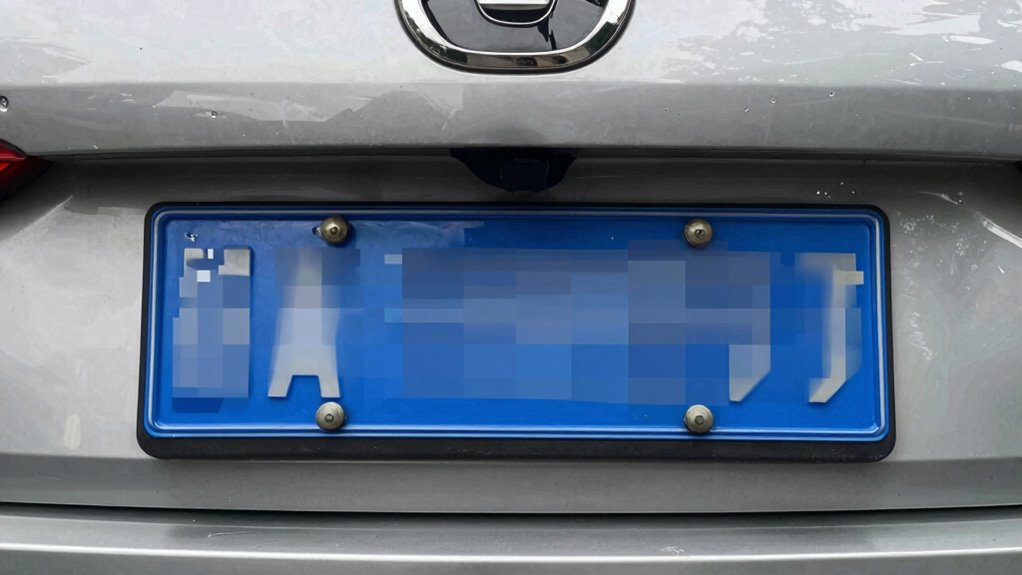

Compression artifacts, especially the blocky patterns from lossy compression, can hide essential license plate details. These patterns create abrupt edges and blurred areas that mask fine strokes and character contours, making recognition difficult. Higher compression levels worsen these effects, reducing clarity and accuracy. However, techniques like advanced filtering, super-resolution, and better encoding help reduce visible blockiness and improve legibility. Keep exploring to discover how these methods can restore clear license plate images effectively.
Key Takeaways
- Compression artifacts create blocky patterns and macroblock boundaries that obscure fine details like license plate characters.
- Lossy JPEG compression reduces high-frequency details, causing blurring and blocking effects that hide plate numbers.
- Blockiness and color bleeding at macroblock edges impair the visibility and recognition of license plate characters.
- Increasing compression levels (lower bitrates) intensify block artifacts, making plate numbers harder to detect.
- Advanced image restoration techniques can mitigate blocky artifacts, improving license plate legibility in compressed images.
Understanding Compression Artifacts and Their Visual Impact

Compression artifacts are visual distortions that appear in media files when lossy compression reduces file size by discarding some data. This process sacrifices detail to create smaller files, but it often introduces noticeable flaws. For example, JPEG images use discrete cosine transform (DCT), which divides images into blocks. Quantization of these blocks retains only low-frequency information, leading to blurry, low-resolution patches. You’ll notice block boundaries where these patches meet, causing abrupt visual jumps. Spatial artifacts like blockiness and color bleeding affect individual images, while temporal artifacts such as ghosting impact videos. These distortions obscure fine details, reduce sharpness, and create artifacts like halos or color spillovers. Overall, compression artifacts diminish image clarity and impact how you perceive the quality of digital media. Additionally, understanding how energy-efficient cloud servers process and store media can help mitigate some of these issues during digital transmission and storage. Recognizing the role of compression algorithms in managing data loss can also inform better media quality practices. Furthermore, advancements in video encoding techniques are continually working to reduce these visual flaws and improve media fidelity. Moreover, ongoing research into perceptual quality assessment aims to develop metrics that better align with human visual perception, aiding in the development of improved compression methods. A growing focus on machine learning-based compression approaches promises to further enhance media quality while maintaining efficiency.
How Blocky Patterns Obscure License Plate Details
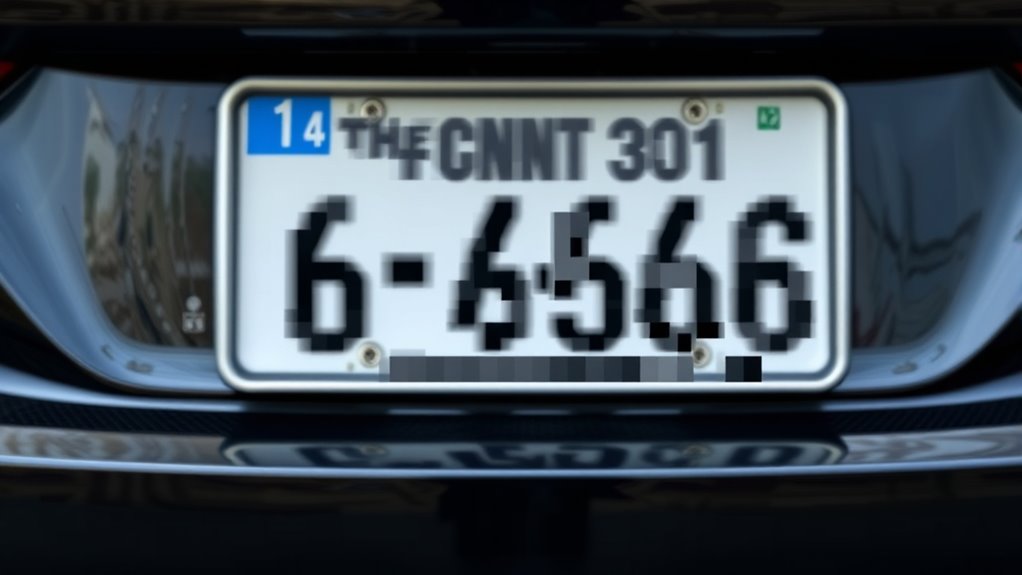
Blocky patterns from lossy compression directly impact the clarity of license plate details by creating visible edges along character boundaries. JPEG macroblock quantization produces 8×8 block boundaries that cause abrupt intensity changes over characters, masking fine strokes and serifs. These block edges can distort straight lines, making strokes appear stepped or shifted, which alters character shapes. Heavy compression also reduces high-frequency details, causing characters to lose their sharpness and become mosaicked blobs, especially after resampling or scaling. As a result, subtle features like thin strokes or small gaps vanish, making characters harder to recognize. Additionally, block boundaries tend to preserve background areas while destroying the fine contours of characters, lowering contrast and blending glyphs into the plate background, further obscuring critical license plate details. Understanding content quality and authority can help in developing better compression techniques that preserve essential details. Moreover, researchers are exploring advanced compression algorithms designed to maintain edge integrity and fine details in critical imaging applications. Recognizing how image fidelity impacts recognition accuracy is crucial for improving license plate imaging systems. Improving compression techniques to balance file size and detail preservation remains an ongoing challenge for accurate license plate recognition. Recent studies also highlight the importance of edge preservation in maintaining the readability of characters under various compression levels.
The Effect of Compression Levels on Recognition Accuracy
Higher compression levels, especially at lower bitrates, directly reduce the quality of video footage, making license plate recognition more challenging. When data rates drop to around 4 kbps, wider OCC stripes appear, decreasing detection accuracy. The baseline method struggles most under these conditions, showing the poorest results due to restoration difficulties. However, advanced techniques like image reconstruction modules maintain nearly 97% detection accuracy even at low bitrates, outperforming simpler filters. As you increase bitrates, video quality improves, leading to higher recognition accuracy. For example, the reconstruction module achieves over 85%, remaining stable despite compression. Conversely, lower bitrates cause accuracy drops, impacting confidence levels and overall system reliability. Ultimately, higher bitrates enhance recognition performance, but well-designed algorithms can mitigate some compression effects, preserving accuracy even under challenging conditions. Incorporating AI models can further improve recognition robustness by compensating for quality loss during compression, helping to maintain high Confidence Level scores. Additionally, understanding compression artifacts can guide the development of more resilient recognition systems. Recognizing the specific nature of compression artifacts allows researchers to develop targeted strategies for artifact mitigation, further boosting accuracy. Moreover, ongoing research in video compression techniques aims to optimize data rates while maintaining critical visual details necessary for accurate recognition.
Techniques to Mitigate Compression-Induced Blurring and Artifacts

To effectively improve recognition accuracy amid compression artifacts, it’s important to implement a combination of encoding practices, camera settings, and post-processing techniques. Start by choosing modern, efficient codecs like HEVC or AV1 to reduce blocking while preserving detail. Use constant quality or two-pass constrained VBR encoding to allocate bits to high-detail regions, especially license plates. Increase bitrate for specific regions of interest to ensure clarity. Capture at the highest feasible resolution with minimal compression, and select camera profiles that balance noise and aliasing. Apply deblocking filters tuned to codec block size and use edge-preserving denoisers to diminish quantization noise without blurring characters. Incorporate adaptive filtering to protect text edges and consider temporal filtering in videos to smooth noise while maintaining plate motion clarity.
Enhancing Legibility With Super-Resolution Methods
Enhancing legibility with super-resolution (SR) methods involves leveraging advanced techniques that recover fine details lost during compression or low-resolution capture. You’ll use datasets with synthetic degradations—such as JPEG artifacts, motion blur, and noise—to train models that improve OCR accuracy. You’ll evaluate performance using metrics like PSNR, SSIM, and most importantly, OCR accuracy, since small visual improvements don’t always translate to better readability. Common architectures include residual CNNs like EDSR and attention-based models, with GANs sharpening edges but risking hallucinations. Hybrid transformer models and multi-frame fusion networks further enhance high-frequency details. Data augmentation strategies, such as random compression and motion blur, improve model robustness against real-world compression artifacts. Utilizing diverse training datasets with varied degradations is critical for developing effective super-resolution models capable of handling real-world compression artifacts and improving legibility. Additionally, understanding image degradation helps in designing models that effectively restore details under different compression conditions. Incorporating robust training techniques can further enhance model resilience to unpredictable input variations. Moreover, employing multi-scale feature extraction techniques allows models to better capture details at various resolutions, boosting overall image clarity.
Frequently Asked Questions
How Do Different Camera Angles Influence Compression Artifacts?
You should know that camera angles considerably influence compression artifacts. When you shoot at a near-frontal angle, the plate pixels concentrate into fewer JPEG blocks, preserving details and reducing blockiness. Conversely, oblique angles stretch the plate across more blocks, increasing quantization variance, which causes more distortion and loss of detail. Higher angles also cause perspective distortion, making characters unevenly compressed, further impairing recognition.
Can Compression Artifacts Be Mistaken for Genuine Image Features?
You might think compression artifacts are just glitches, but they can easily be mistaken for real features if you’re not careful. These blocky, checkerboard patterns and halos around edges can resemble actual details like textures or markings, leading you astray. When compressed images are heavily processed or low quality, artifacts blend in, making it tricky to tell what’s genuine from what’s just a byproduct of lossy compression.
What Is the Impact of Lighting Conditions on Artifact Severity?
Lighting conditions directly influence artifact severity. When you shoot in high contrast scenes, you’ll notice more blocky edges and ringing because strong gradients cause concentrated DCT coefficients. Low-light areas tend to show more banding and posterization due to limited tonal ranges. Hard lighting creates sharper transitions, increasing visible artifacts, while soft lighting smooths gradients, reducing their prominence. Bright exposure helps conceal artifacts, but shadows and dim scenes often amplify them after compression.
Are Certain License Plate Fonts More Resistant to Compression Distortion?
Certain license plate fonts are like armor against compression distortion. Fonts with larger internal counterspace, high contrast, and moderate stroke weight resist blocky artifacts better, keeping characters recognizable even under heavy JPEG compression. Condensed or narrow fonts tend to merge strokes and lose clarity, making them less suitable. By choosing fonts designed with these features, you improve the chances your plate remains legible, even in low-resolution, highly compressed images.
How Does Real-Time Processing Handle Artifact Removal Efficiently?
You handle artifact removal efficiently in real-time by using lightweight algorithms like CNNs or transformers optimized for speed, often with quantization or pruning. You can also apply hybrid methods combining quick spatial filters with learned modules, focusing on regions of interest like license plates. Additionally, leveraging asynchronous pipelines and temporal filtering helps maintain low latency, while cloud offloading manages heavier processing without disrupting your display deadlines.
Conclusion
If you think compression artifacts are just minor annoyances, think again. They can turn clear license plates into unrecognizable blobs, making your security footage nearly useless. These blocky distortions don’t just compromise image quality—they could be the difference between catching a criminal or letting them slip away. By understanding and tackling these artifacts, you hold the power to restore clarity and regain control over blurry, unhelpful images. Don’t let compression hide the truth—fight back!