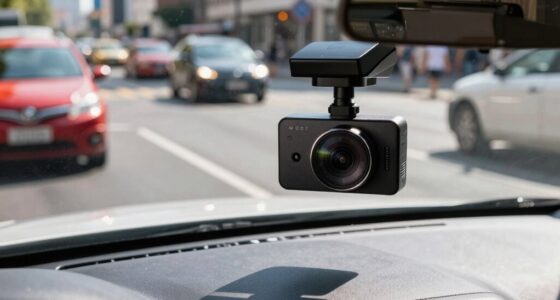
To create a clear incident timeline from your footage, start by securely collecting and preserving the original video files, verifying their integrity with hashes. Next, normalize timestamps across all sources for consistency. Segment the footage into distinct events using automated tools or visual cues, then link relevant artifacts and external data like logs or GPS. Automating parts of this process can increase accuracy. Continue exploring to learn how to assemble a thorough, reliable incident timeline effectively.

Get business pricing on garage and car supplies
- Business-only prices and quantity discounts
- Tax-exempt purchasing
- Multiple users, one account, clear invoices
Key Takeaways
- Extract and verify precise timestamps from footage using embedded metadata and external references.
- Normalize all timestamps to a standard format like ISO 8601 and synchronize device clocks with NTP.
- Use automated scene detection tools to segment footage into distinct events based on visual or audio changes.
- Link related artifacts, logs, and external data to specific footage segments for comprehensive context.
- Compile, validate, and securely store the timeline with clear labels, annotations, and version control for clarity.
Gather and Preserve Original Video Evidence
To effectively gather and preserve original video evidence, you must act promptly to secure the original storage devices and prevent any alterations. Immediately store the original files on write-protected media to prevent tampering, and create bit-for-bit forensic images at the drive or file level. Perform analysis only on copies to maintain the integrity of the originals. Use hardware write‑blockers when accessing physical storage like HDDs, SSDs, or removable flash drives to avoid accidental writes. Generate cryptographic hashes, such as SHA‑256, for both originals and copies at acquisition and after each transfer to detect any changes later. Keep the original physical media in controlled, labeled packaging and ensure proper chain of custody documentation. These steps protect the evidence’s authenticity and integrity throughout the investigation process. Power management is essential to preserve volatile data during the collection process, so ensure devices remain powered as needed. Additionally, documenting the chain of custody meticulously helps maintain the evidence’s credibility in legal proceedings. Understanding the importance of data integrity ensures that the evidence remains trustworthy and unaltered throughout the process. Regularly verifying the hashes throughout the process further safeguards the evidence against tampering or unintended modifications. Implementing verification procedures enhances the reliability of the evidence handling process. Incorporating technological solutions, such as digital forensic tools, can further streamline the validation process and improve accuracy.
Verify and Normalize Timestamps for Accuracy
Ensuring timestamp accuracy begins with verifying and normalizing all data entries across your evidence sources. Convert all timestamps to the ISO 8601 standard, like 2025-08-29T14:37:22Z, to guarantee consistent sorting and interoperability. Normalize different log formats by transforming varied date/time expressions into Unix time, then back to ISO. Use UTC for every entry to eliminate timezone ambiguities, especially when handling multi-source evidence. Handle time zones carefully by setting defaults to the source’s original zone and overriding as needed. Extract timestamps precisely from over 1,500 artifact types using regular expressions, capturing exact times down to the minute. When timestamps are missing, strategize defaults or manual adjustments to preserve event order. Accurate verification and normalization form the backbone of a reliable incident timeline. Consistent data practices ensure improved pattern recognition and incident correlation, reducing the risk of missing critical events. Incorporating verified data sources from reputable records enhances the credibility of your timeline. Additionally, maintaining standardized formats across all evidence ensures seamless integration and analysis. Furthermore, employing automated tools can streamline the normalization process and minimize manual errors. Employing robust validation techniques helps detect anomalies and prevent inaccuracies from propagating through your timeline.
Segment Footage Into Discrete Events
To effectively segment footage, you need clear change criteria that define when one event ends and another begins. Automated tools can help detect scene shifts by analyzing motion, scene changes, or audio cues, but manual review guarantees accuracy. Linking artifacts like objects or sensor data to specific events helps create a coherent, evidence-ready timeline. Video segmentation techniques can further enhance this process by precisely isolating individual moments based on visual and temporal cues.
Objective Change Criteria
Segmenting footage into discrete events relies on clearly defined objective change criteria that identify meaningful scene shifts. These criteria include measurable changes in scene semantics or object states, such as appearance, position, or integrity. Changes can be pixel-level or high-level semantic labels. You should also set a minimum duration threshold—typically between 0.5 and 2 seconds—to filter out jitter and transient noise while capturing short, intentional actions. Spatial consistency is essential; events should involve coherent regions that persist or evolve across frames. Additionally, mutual-exclusion rules prevent overlapping events unless sub-event semantics justify it. Observable change types like motion, appearance, interaction, scene composition, or semantic signals serve as triggers. Using statistical change detection, motion metrics, and temporal smoothing helps guarantee accurate, objective segmentation aligned with scene dynamics.
Detecting Scene Transitions
Detecting scene shifts involves analyzing video footage to identify points where the content changes considerably enough to mark a new event. You can use tools like PySceneDetect, which offers detectors such as the Content-aware Detector that compares adjacent frames and creates scene breaks when thresholds are exceeded. The Adaptive Content Detector improves detection of fast motion by using a rolling average of frame changes. Threshold-based detectors compare brightness or RGB values to identify fades or abrupt transitions. Histogram-based methods, like color histogram comparisons and chi-square tests, enhance accuracy, especially when combined with image subdivision. These detection techniques, supported by various algorithms and policy strategies, enable efficient segmentation, reducing processing time and ensuring you accurately capture scene changes essential for constructing a clear incident timeline. Incorporating video analysis techniques can further improve detection accuracy by leveraging advanced computational methods to interpret complex scene variations, including machine learning algorithms that adapt to diverse content types.
Linking Artifacts to Events
Building a clear incident timeline requires not only identifying scene changes but also accurately linking footage to specific events. You achieve this by leveraging artifacts like timestamps, embedded camera timecodes, and container metadata, which serve as primary anchors. Video and audio hashes help identify duplicate or altered segments across files, confirming they’re from the same source. Sensor data, such as GPS and motion telemetry, links physical movement to footage, while system logs—like Windows event logs—connect user or system activity with recorded times. Ancillary files, including thumbnails or license plate recognition outputs, offer secondary corroboration. To segment footage, you can cluster clips around key timestamps or detect audio cues, then align external logs or sensor data to define event boundaries, creating a precise, interconnected incident timeline.
Extract and Structure Relevant Evidence Artifacts

To create a clear incident timeline, you need to extract relevant evidence artifacts using effective techniques like timestamp normalization and targeted filtering. These methods help you organize data from diverse sources such as logs, registries, and memory dumps into a structured format. By applying strategic event segmentation, you ensure that your evidence is both accurate and easy to interpret. Building and extracting timeline data in Belkasoft X enables investigators to capture a comprehensive set of timestamps and metadata, further enhancing the accuracy of your timeline construction. Incorporating automated data analysis can also streamline this process and uncover critical patterns more efficiently. Additionally, understanding data correlation techniques can assist in linking related events across multiple sources for a more cohesive incident narrative. Recognizing the importance of metadata analysis can provide additional context that enriches your understanding of each event’s significance. Employing consistent data formats further ensures that your evidence remains reliable and easy to compare across sources. Furthermore, applying standardized procedures ensures consistency and accuracy throughout the evidence collection process.
Event Segmentation Strategies
Event segmentation strategies focus on systematically identifying and structuring meaningful boundaries within continuous activities or video streams. You can use scenario cues, which make up 51% of event boundaries, by creating or describing scenarios to interpret actions. When scenarios are unclear or activities are complex, visual cues like location changes help mark boundaries. Natural breaks occur at predictable pauses, while contextual cues arise from environmental or situational shifts seen in video or audio. Other triggers include miscellaneous cues that don’t fit primary categories. To evaluate segmentation consistency across groups, metrics like peakiness, agreement index, and surprise index are useful. Automated techniques, such as Hidden Markov Models and Viterbi algorithms, assist in detecting boundaries dynamically. These strategies help you structure event timelines more accurately, supporting clearer incident analysis.
Artifact Extraction Techniques
Extracting relevant evidence artifacts is essential for reconstructing a clear incident timeline. You need to identify logs, metadata, deleted files, browser histories, email communications, and application usage patterns. These artifacts reveal user activity, malicious behavior, and system events. Use forensic imaging tools with write blockers to create accurate, verifiable copies of storage media, maintaining chain of custody and verifying hashes. Leverage data extraction tools like Plaso, Magnet Axiom Cyber, and Splunk to automate artifact collection. Analyze artifacts by correlating data, examining network logs, USB history, and deleted files. Organize findings into a timeline, identifying patterns and suspicious activity. Proper documentation of your steps guarantees legal validity.
| Artifact Type | Key Data |
|---|---|
| Log Files | Event timestamps, system activities |
| Browser Artifacts | Visited sites, access times |
| Email Artifacts | Communications, timestamps |
| Application Artifacts | Usage patterns, activity indicators |
| Windows Artifacts | Registry keys, event logs, prefetch files |
Correlate Video Events With External Data Sources

Correlating video events with external data sources requires precise temporal alignment and standardized data formats. You should synchronize device clocks with Network Time Protocol (NTP) to minimize errors, aiming for sub-second accuracy. Normalize timestamps into a single reference timezone and format, then apply time-windowing to group related events within defined intervals, reducing false positives. Regularly perform drift detection and correction by comparing known reference events, adjusting offsets as needed. Record timestamp uncertainty metadata to inform downstream algorithms of confidence levels. Standardize diverse schemas—like access logs, sensor telemetry, and video metadata—into a unified event model with core fields such as timestamp, source ID, and event type. Map location data consistently, standardize categorical fields, and verify data validity. Implementing machine learning techniques can further enhance this systematic approach by identifying complex patterns and anomalies that may not be evident through manual analysis, creating a reliable foundation for accurate event correlation across sources, especially when incorporating automated anomaly detection systems. Additionally, employing data validation protocols ensures the integrity and accuracy of the integrated datasets before analysis. Incorporating data quality assessments can help maintain high standards of data integrity throughout the process, leading to more reliable insights. Furthermore, maintaining detailed audit logs of data transformations supports transparency and troubleshooting in the correlation workflow.
Utilize Tools and Automation for Efficient Timeline Creation

Leveraging automation tools streamlines the process of creating accurate incident timelines by reducing manual effort and increasing consistency. Choose ingest systems with native metadata extraction, supporting bulk uploads and automated hashing to guarantee integrity. Use media managers that auto-generate tags (faces, objects, motion) via ML for faster event filtering. Ascertain your tools support standardized timestamp formats like UTC and ISO 8601, preserving camera clock info for accurate correlation. Implement ML models for shot detection and activity segmentation, labeling events with confidence scores. Integrate telemetry data for enriched context, auto-annotating events with relevant logs and GPS info. Automate timeline assembly that orders events by timestamps, groups related incidents, and generates summaries with key frames and clips. Ensuring your metadata extraction methods are robust and accurate is essential for reliable incident reconstruction. Additionally, adopting standardized timestamp formats helps maintain consistency across different devices and sources, facilitating more precise incident analysis. Incorporating automated event detection enhances the speed and accuracy of identifying critical moments within footage, further improving incident reconstruction quality.
Present, Review, and Safeguard the Final Timeline
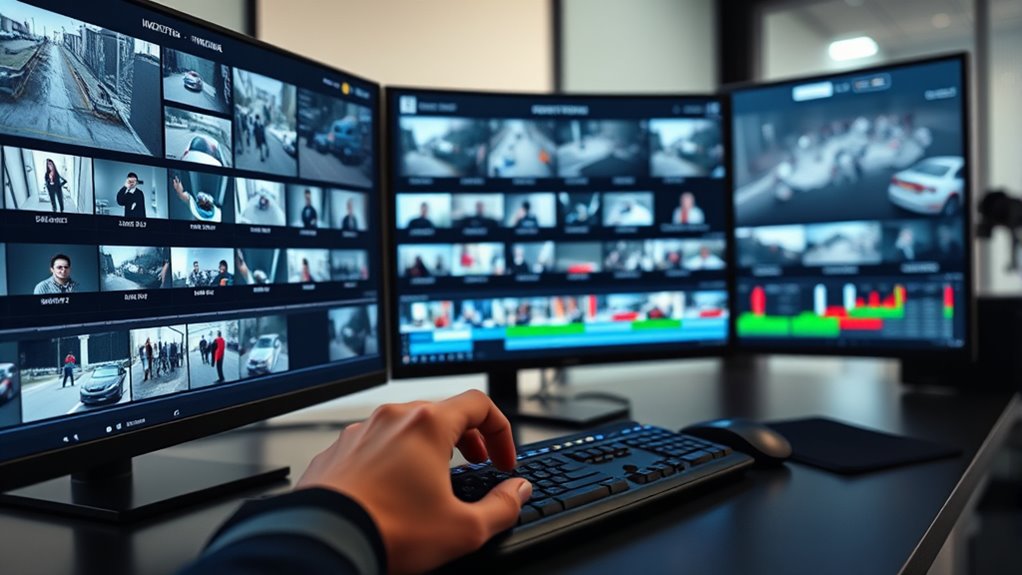
Presenting the final incident timeline requires tailoring the format to your audience’s needs and ensuring clarity. You should customize your presentation: use an executive summary for leadership, detailed technical views for operations, and a legal-focused packet for counsel. Incorporate layered visuals, starting with a high-level overview, then supporting drill-downs with expandable event details, timestamps, sources, and actor attributions to minimize ambiguity. Highlight key decision points, actions, and communications that influenced the incident’s outcome for accountability and lessons learned. Provide a secure, single-source artifact—like a PDF or dashboard—that consolidates the timeline, evidence index, and logs for post-brief review. Cross-validate events against primary sources, verify time synchronization, and conduct peer reviews to confirm accuracy. Archive versioned edits and maintain chain-of-custody to safeguard evidentiary integrity. Furthermore, ensuring consistent documentation practices helps maintain the integrity and traceability of the incident record. Incorporating time synchronization techniques can further enhance the accuracy and reliability of your incident timeline. Additionally, implementing standardized procedures for documentation can reduce discrepancies and improve overall clarity.
Frequently Asked Questions
How Can I Ensure the Integrity of Video Evidence During Transfer?
To guarantee your video evidence remains intact during transfer, always verify the hash values using algorithms like SHA-256 before and after transfer. Use secure methods such as AES-256 encryption for file sharing and store multiple encrypted copies in different locations. Employ tamper-evident packaging and restrict access to authorized personnel only. Additionally, document every transfer step with chain of custody forms to maintain a clear, unbroken record of handling.
What Are Best Practices for Resolving Timestamp Discrepancies?
You should first verify each device’s clock sync status using NTP or PTP and log drift metrics. Then, map all timestamps to a single UTC reference, applying calculated offsets. When discrepancies occur, use content-based alignment like matching visuals or audio cues. Incorporate uncertainty windows for unresolved drift, prioritize authoritative timestamps, and document every correction. Regular automated checks help detect anomalies, ensuring your timeline remains accurate and reliable.
How Do I Handle Ambiguous or Missing Event Data?
When event data is ambiguous or missing, you shouldn’t ignore the gaps. Instead, cross-reference multiple sources—logs, alerts, witness statements—and verify their consistency. Use forensic tools to authenticate evidence and employ alternative data like screenshots or system artifacts. Document uncertainties clearly, noting where information is incomplete or unreliable. This approach helps you piece together the most accurate timeline possible, reducing bias and maintaining investigative integrity.
Which Tools Are Most Effective for Automating Timeline Generation?
You should consider tools like Splunk On-Call, PagerDuty, and Incident.io. They automate timeline creation by integrating alerts, status updates, and actions, providing thorough logs. PagerDuty offers detailed incident timelines with automation, while Splunk On-Call automatically generates complete reports and shows historical incidents. Incident.io is great for real-time timelines and automated workflows. These tools streamline your process, reduce manual effort, and improve incident clarity.
How Should I Securely Store and Archive Finalized Timelines?
You need to keep your finalized timelines under lock and key, so they don’t become a loose cannon. Use encryption to safeguard data at rest, and store backups in multiple locations, including offline, to avoid a single point of failure. Implement role-based access controls and full audit logging for traceability. Regularly validate backups, and follow industry standards like NISPOM or ISO 27001 to guarantee your archives stay secure and tamper-proof.
Conclusion
Creating a clear incident timeline from footage is essential for accurate investigations. Did you know that using automated tools can reduce timeline creation time by up to 50%? By systematically gathering, verifying, and organizing your evidence, you guarantee reliability and clarity. This not only streamlines your review process but also strengthens your case. Remember, a well-structured timeline can be the difference between missing critical details and uncovering the full story.
Evergreen bestsellers Picks
bestsellers
As an affiliate, we earn on qualifying purchases.