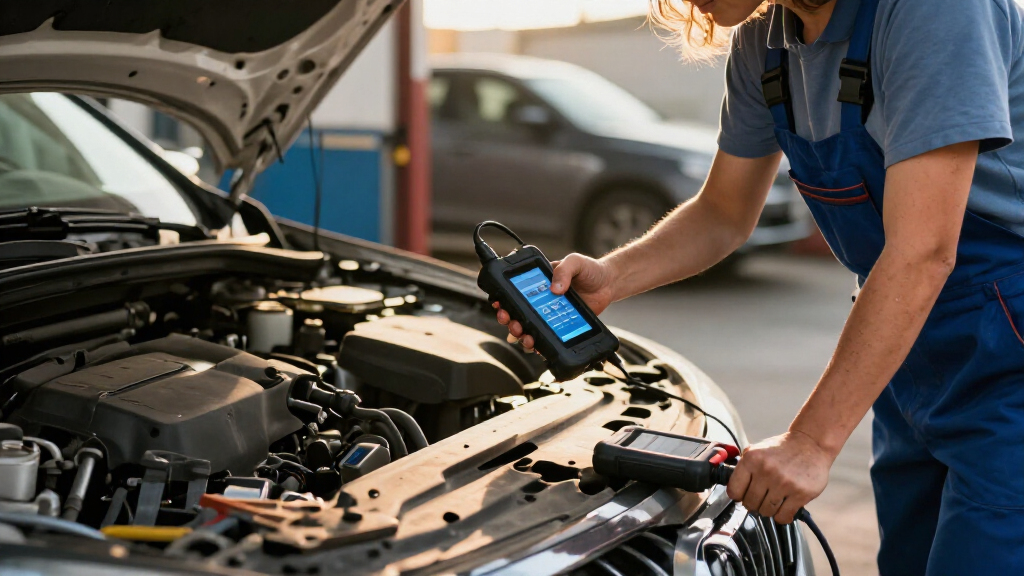

Shopping for a car diagnostic scanner usually means choosing between a low-cost way to read the check-engine light and a more capable tool for investigating faults across the vehicle. A basic OBD-II code reader suits owners who want to retrieve and clear common engine codes before deciding what to do next. A professional bidirectional scanner costs more, but can cover systems such as ABS and airbags on supported vehicles, display more live data, and send commands for certain tests or service functions.

Get business pricing on garage and car supplies
- Business-only prices and quantity discounts
- Tax-exempt purchasing
- Multiple users, one account, clear invoices

EDIAG H361 Bidirectional OBD2 Scanner with Lifetime Free Updates
- ✔ Systems: Engine, transmission, ABS, and SRS
- ✔ Special functions: Bidirectional tests; 16 maintenance functions, availability varies
- ✔ Display: 6-inch touchscreen

VDIAGTOOL VD10 OBD2 Scanner and Check Engine Code Reader
- ✔ Model: VD10-NEW
- ✔ Functions: Read and clear codes, live data, freeze frame, I/M readiness, vehicle information
- ✔ Code database: More than 3,000 definitions

ANCEL AD310 OBD II Scanner and Engine Fault Code Reader
- ✔ Model: AD310
- ✔ Functions: Read and clear emission-related engine codes, live data, freeze frame, I/M readiness
- ✔ Display: Large screen
The key tradeoff is diagnostic reach versus price and complexity. For occasional check-engine-light questions, the basic reader is the sensible purchase; a code alone does not identify the failed part, but it can help narrow the issue. The professional tool is a better fit for frequent DIY repair, a mixed vehicle fleet, or a small workshop where broader access and active tests can save time. Features vary by scanner, vehicle make, model year, and software plan, so check compatibility before buying.
At a Glance
| Criteria | Basic OBD-II code reader | Professional bidirectional diagnostic scanner | Winner |
|---|---|---|---|
| Typical vehicle coverage | Usually generic OBD-II engine and emissions systems | May include multiple modules, with coverage varying by make and model | B |
| Fault-code detail | Common standardized codes; descriptions may be brief | Can include manufacturer-specific codes and module details | B |
| Live data | Often basic engine readings, depending on model | Often broader data lists and graphing | B |
| Active tests and service functions | Usually limited to reading and clearing codes | May support bidirectional tests and selected service procedures | B |
| Ease of use | Simple menus and low setup burden | More menus, setup, and compatibility checks | A |
| Price and ongoing costs | Typically the lower-cost purchase; often no subscription | Higher purchase price; updates or subscriptions may add cost | A |
| Best use | Occasional check-engine-light checks | Frequent diagnostics and supported repair work | Depends |
EDIAG H361 Bidirectional OBD2 Scanner with Lifetime Free Updates
The H361 is the most capable scanner in this comparison for buyers who want to look beyond the check-engine light. It lists diagnostics for engine, transmission, ABS, and SRS, plus bidirectional component tests and 16 maintenance functions. Compared with the AD310 and VD10, which focus on OBD2 engine and emissions information, that wider reach can help a capable owner investigate more types of warning or service needs with one device.Its 6-inch touchscreen, AutoVIN, live-data graphs, and saved reports also make it better suited to ongoing troubleshooting than a simple code reader. A waveform view can help us follow changes in sensor readings, while a report provides a record to review or share. But the greater feature count comes with a real condition: availability varies by vehicle, so buyers should verify specific functions before purchase. FCA AutoAuth also requires a separate account and paid subscription. At a year of stated manufacturer warranty, it asks buyers to weigh its broad capabilities against compatibility and access requirements.
Pros:
- Covers engine, transmission, ABS, and SRS diagnostics, subject to vehicle compatibility.
- Bidirectional tests can activate supported components to aid troubleshooting.
- Live data graphs, AutoVIN, and diagnostic reports support more involved investigation.
- Sixteen maintenance functions and a large touchscreen broaden its use beyond code reading.
Cons:
- System coverage and maintenance functions vary by vehicle and should be confirmed in advance.
- FCA AutoAuth requires a separate account and paid subscription.
- The stated manufacturer warranty is one year.
Best for: Owners and advanced DIY users who want multi-system scans, component activation, and maintenance functions, and who will verify support for their exact vehicle.
Not ideal for: Drivers who only need to read a check-engine code, prefer a simpler low-complexity reader, or need a function that their vehicle does not support.
Bottom line: Choose the H361 when you need broader system access and supported active tests; for routine engine codes alone, the VD10 or AD310 is simpler.
“Choose the H361 when you need broader system access and supported active tests; for routine engine codes alone, the VD10 or AD310 is simpler.”
VDIAGTOOL VD10 OBD2 Scanner and Check Engine Code Reader
The VD10 is the most guided option among the two basic engine-focused readers. Along with reading and clearing trouble codes, it provides more than 3,000 code definitions, live sensor data, freeze-frame information, I/M readiness checks, and vehicle information. A built-in definition can give a new owner a starting point for understanding what a code refers to; the AD310 supplies similar core diagnostic data but does not list an onboard code database.The two-line backlit display is straightforward and offers contrast adjustment, though it shows less at once than a larger screen. Six interface languages give it an edge over the AD310 for multilingual households. It still operates within OBD2-compliant 12V vehicle coverage, so its functions do not extend to the H361’s stated ABS, SRS, and transmission diagnostics. The product information also gives conflicting warranty durations—five years in the description and three years in item details—so we would verify the applicable coverage before purchase.
Pros:
- Displays code definitions alongside code reading and clearing.
- Includes live data, freeze-frame details, readiness checks, and vehicle information.
- Backlit screen with adjustable contrast supports use in varied lighting.
- Offers six interface languages and draws power through the OBD2 port.
Cons:
- Limited to OBD2-compliant 12V vehicles and does not list the H361’s multi-system functions.
- Two-line display shows less information at once than a larger screen.
- Product materials conflict on whether the warranty lasts three or five years.
Best for: Newer OBD2 vehicle owners who want code explanations and basic live-data checks in a simple, multilingual reader.
Not ideal for: Owners seeking ABS, SRS, transmission, or bidirectional diagnostics, or buyers who need a clearly consistent warranty term.
Bottom line: The VD10 is the clearest fit for everyday engine-code checks when on-screen definitions matter, but it is not a substitute for a multi-system scanner.
“The VD10 is the clearest fit for everyday engine-code checks when on-screen definitions matter, but it is not a substitute for a multi-system scanner.”
ANCEL AD310 OBD II Scanner and Engine Fault Code Reader
The AD310 keeps the task focused: it reads and clears emissions-related engine trouble codes, shows live data and freeze-frame information, and checks I/M readiness. For a driver investigating a check-engine warning or checking readiness before an emissions inspection, those functions cover the essentials without the extra menus and system breadth of the H361. Its large screen and clearly labeled keypad also make the basic workflow easy to follow.Compared with the VD10, the AD310 is the more stripped-back choice: it supports the listed OBD2 protocols and key data views, but the VD10 adds code definitions and six language options. Compared with the H361, the difference is more fundamental—this ANCEL does not scan ABS, SRS, or transmission systems, and it does not support OBD I. Its compact, 12-ounce body and vehicle-powered operation suit occasional use, although the supplied 2.5-foot cable and vehicle compatibility still determine how convenient it is in practice. Choose it for basic engine and emissions checks, not as a tool for diagnosing every dashboard warning.
Pros:
- Reads and clears emissions-related engine codes and displays live and freeze-frame data.
- Checks I/M monitor readiness, useful when reviewing emissions status.
- Large screen and clearly labeled keypad keep routine use approachable.
- Compact and vehicle-powered, with no separate batteries or charger required.
Cons:
- Does not support OBD I, ABS, SRS, or transmission diagnostics.
- Limited to emission-related issues and compatible OBD2 vehicles.
- Does not list the VD10’s built-in code definitions or language selection.
Best for: Drivers who want a straightforward, lightweight OBD2 reader for emissions-related engine codes, readiness checks, and basic data views.
Not ideal for: Owners who need code definitions, multilingual menus, OBD I support, or diagnostics for ABS, SRS, or transmission faults.
Bottom line: Pick the AD310 for simple emissions and check-engine checks; the VD10 adds more guidance, while the H361 is the choice for broader system work.
“Pick the AD310 for simple emissions and check-engine checks; the VD10 adds more guidance, while the H361 is the choice for broader system work.”
As an Amazon Associate we earn from qualifying purchases.
Key Differences
The most meaningful difference is how far the scanner can go beyond the engine control system. A basic reader is built around standardized OBD-II data, particularly emissions-related faults that trigger the check-engine light. That makes it useful for a first look, but it may not communicate with other modules or show manufacturer-specific information. A professional scanner may reach more systems and present more detailed data, yet coverage is never universal: a function listed by the seller may apply only to certain makes, years, or trim levels.
There is also a difference between reading a problem and testing a system. Both types may clear codes, but clearing a code does not repair the underlying fault and can erase information useful to diagnosis. Bidirectional scanners can send commands to supported components, while some also offer guided service routines. These functions can help a capable user confirm a suspected issue, but they do not replace repair knowledge or guarantee a correct diagnosis.
That extra reach has a real cost in money and learning time. Owners who only check a warning light now and then will rarely use the professional scanner’s broader features enough to justify paying for them. For a DIY mechanic or shop that diagnoses several vehicles and performs supported service work, the time saved and additional information can make the higher price worthwhile.
Detailed Comparison
Vehicle and system coverage (Professional bidirectional diagnostic scanner wins — major)
The basic reader generally focuses on standardized engine and emissions diagnostics. The professional scanner can cover additional modules, such as ABS, airbag, transmission, or body systems, when the specific vehicle and scanner support them. B wins by a major margin for multi-system diagnosis. For an owner concerned only with a check-engine light, that added reach may have little practical value; for a warning light outside the engine system, it can be the difference between getting useful data and getting no result.
Code detail and interpretation (Professional bidirectional diagnostic scanner wins — moderate)
A basic reader can display standardized trouble codes, which is often enough to begin researching an engine fault. A professional scanner may show manufacturer-specific codes, module names, and additional context. B wins by a moderate margin, though neither tool should be treated as a parts-replacement instruction: codes point toward a detected condition or circuit, not necessarily the component that must be replaced. Owners who can interpret technical information benefit more from the deeper display.
Live data and recording (Professional bidirectional diagnostic scanner wins — moderate)
Some basic readers show a small set of live engine values, while more capable models can display additional parameters. Professional scanners typically provide broader data views and may graph or record readings, which helps when a fault appears only under particular conditions. B wins by a moderate margin for troubleshooting intermittent problems. For a quick code check, the simpler reader’s data may be sufficient, and the difference is less important.
Active tests and service functions (Professional bidirectional diagnostic scanner wins — major)
A basic reader usually retrieves and clears codes but cannot command a component to operate. A bidirectional scanner may activate supported components or run selected maintenance procedures, such as certain resets or relearns. B wins by a major margin for users doing repairs that require those functions. Compatibility varies, and not every professional scanner includes every procedure. A home owner who wants only to identify a warning light does not need to pay for this capability.
Ease of use (Basic OBD-II code reader wins — moderate)
The basic reader usually has fewer menus and a shorter learning curve. A professional scanner may require selecting a vehicle, choosing a module, and interpreting more technical data. A wins by a moderate margin for occasional users who want a straightforward code lookup. Technicians and experienced DIY mechanics may find the professional interface worthwhile once familiar with it, but extra features do create more room for confusion.
Purchase price and ongoing cost (Basic OBD-II code reader wins — major)
Basic readers are usually inexpensive and often work without a recurring software fee. Professional scanners require a larger initial outlay, and some brands charge for updates or advanced functions after an included period. A wins by a major margin on upfront affordability and often on ownership simplicity. B can still represent better value for a shop or frequent DIY user if its coverage and procedures replace repeated trips or separate tools; occasional use rarely offsets the premium.
Best fit for the job (moderate difference)
For a single vehicle and occasional engine warning checks, the basic reader matches the task with less expense and setup. For diagnosing faults across several systems or working on multiple supported vehicles, the professional scanner is more capable. There is no universal winner here: A wins for simple ownership checks, while B wins for active repair work. The right choice follows the jobs the buyer actually performs, not the number of features on a product page.
Basic OBD-II code reader: Pros and Cons
Pros:
- Low purchase price and usually no subscription
- Quick access to common engine and emissions codes
- Simple to learn for occasional checks
- Useful for gathering information before seeking repair
Cons:
- Often cannot scan non-engine modules
- Limited manufacturer-specific details and live data
- Usually cannot run active tests or service routines
- Clearing codes can remove useful diagnostic information without fixing the fault
Professional bidirectional diagnostic scanner: Pros and Cons
Pros:
- Broader system access on supported vehicles
- More detailed codes and live data for diagnosis
- Bidirectional tests can help confirm component behavior
- Selected service functions can support DIY and workshop repairs
Cons:
- Higher purchase price and possible software fees
- Vehicle coverage and functions vary by make, year, and model
- More complex menus and technical information
- Extra capabilities do not guarantee a correct diagnosis
Who Should Choose What
Choose Basic OBD-II code reader if:
- You mainly want to read a check-engine-light code on your own car.
- You want an inexpensive first check before researching a fault or contacting a mechanic.
- You prefer a simple tool and do not perform module-level diagnostics or service procedures.
Choose Professional bidirectional diagnostic scanner if:
- You regularly diagnose vehicles beyond basic engine and emissions faults.
- You work on multiple makes and have verified that the scanner supports their systems.
- You perform repairs where active tests, expanded data, or supported service functions are useful.
Skip both if: You need a confirmed diagnosis for a safety-critical fault, lack the skills to interpret scan data, or need a function that your vehicle and chosen scanner do not support. A qualified technician may be the better next step.
Value for Money
Pay more for the professional scanner only if its added coverage or active functions match work you expect to do. A frequent DIY mechanic or small repair business may recover the cost through faster checks and fewer trips to another diagnostic tool. Check the maker’s compatibility list and update terms before buying; an attractive feature list has little value if a key function is unsupported on your vehicle. For an owner who checks a warning light a few times a year, the basic reader is better value. It offers a practical starting point at a much lower cost, while the professional model’s unused capabilities become sunk cost.
Final Verdict
For most car owners who want to understand a check-engine light, choose the basic OBD-II code reader. It is affordable, easy to use, and suitable for retrieving common engine codes, as long as you treat those codes as clues rather than a diagnosis. Choose the professional bidirectional scanner if you routinely work on vehicles, need access to additional modules, or have a specific supported repair procedure that demands active testing.
The biggest deciding factor is whether you will use the professional scanner’s extra system access and commands. If not, paying more is hard to justify. If you do regular diagnostic work, confirm exact vehicle coverage and software costs, then buy the professional tool that supports the jobs you perform. Neither scanner can guarantee a repair; seek qualified help when the fault or repair is beyond your experience.
Frequently Asked Questions
Can a basic OBD-II reader tell me exactly what part to replace?
No. It reports a code associated with a detected fault or condition. Diagnosis may require checking wiring, readings, and other possible causes before choosing a repair.
Will a professional scanner work on every car?
No. Coverage depends on the scanner, vehicle make, model year, and sometimes trim or region. Confirm support for the exact vehicle and the functions you need before purchasing.
Is clearing a trouble code the same as fixing the problem?
No. Clearing removes the stored code, but the underlying fault may remain and the warning can return. Clearing can also erase useful diagnostic information, so record the code and relevant data first.
Is a bidirectional scanner worth it for home use?
It can be worth the cost for a capable DIY mechanic who works on several vehicles or needs active tests and supported service functions. For occasional check-engine-light checks, a basic reader is usually the better value.