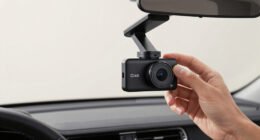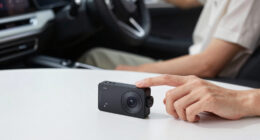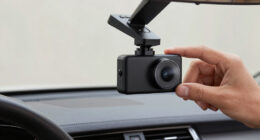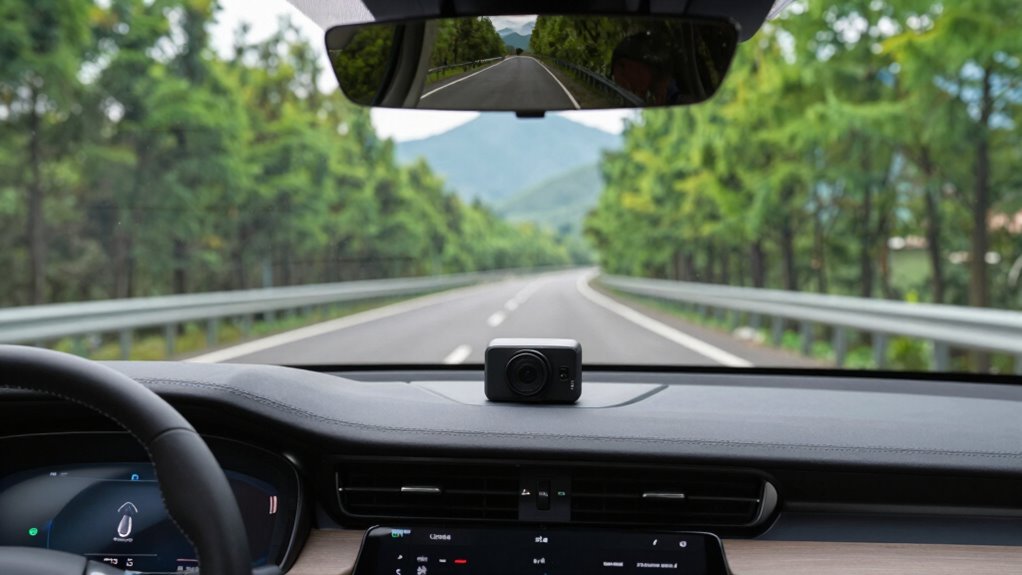
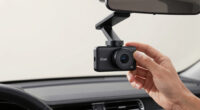
Centering your dash cam might seem like the simplest choice, but it can cause distractions, glare, and blind spots that affect safety. A centered device can divert your attention and hinder visibility with glare or reflections on the windshield. Positioning it off-center or higher can give you a clearer view, reduce glare, and minimize distraction. To learn more about how to optimize your dash cam placement for safety, keep exploring the options.
Key Takeaways
- Centered dash cams can cause glare and reflection issues, impairing visibility and footage clarity.
- Placing the camera off-center enhances the field of view and reduces blind spots.
- A centered position may distract the driver and increase visual clutter inside the vehicle.
- Variations in lighting conditions make off-center placement more adaptable for clear footage.
- Proper positioning balances safety, visibility, and minimal distraction, often favoring slight angles over central placement.
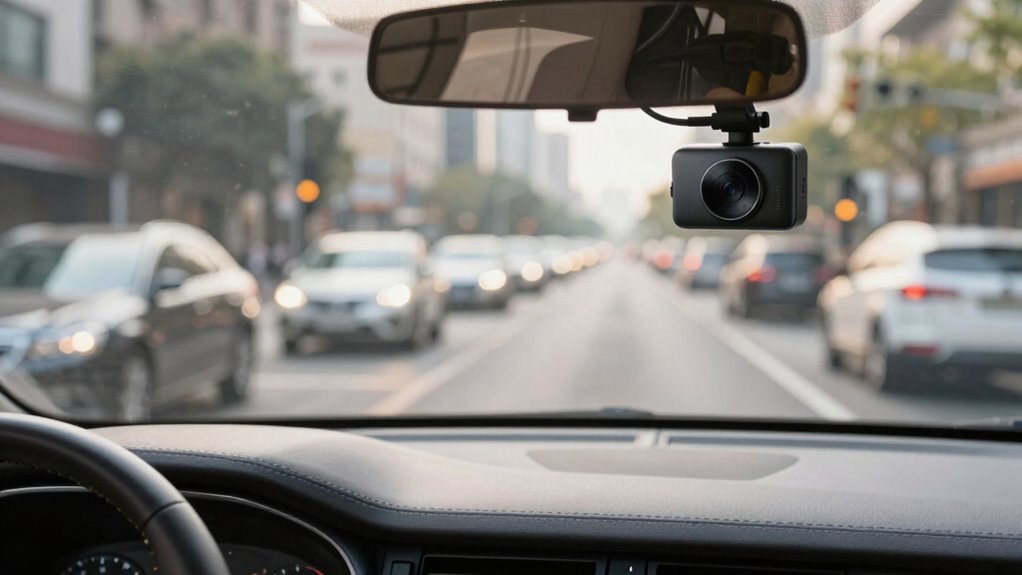
Many drivers assume that centering their dash cam is the best way to capture every detail on the road, but this isn’t always the case. While it might seem intuitive to position the camera directly in the middle of your windshield, doing so can introduce some unexpected issues. For starters, an overly centered dash cam can become a source of driver distraction. If the camera’s view is too prominent or if it creates glare on the windshield, your focus might shift from the road to the device itself. This distraction can impair your ability to react quickly to hazards, increasing the risk of accidents rather than preventing them.
Centering your dash cam can cause glare and distractions, risking your focus and safety on the road.
Camera glare is another common problem with a centered dash cam. When sunlight hits the lens directly or reflects off the windshield, glare can wash out the footage, making it difficult to see important details. This is especially true during bright, sunny days or when the sun is low on the horizon. Instead of providing clear, useful footage, a glare-prone camera can produce hazy or obscured images, defeating the purpose of having a dash cam in the first place. Proper positioning, such as angling the camera slightly downward or off-center, can help reduce glare and improve image clarity.
Furthermore, a centered position might not always give you the most effective view of the road ahead. Depending on your vehicle’s interior design or the size of your windshield, centering the camera could limit your field of vision or cause blind spots. You want a position that captures the entire lane and the surroundings without obstructing your view or becoming a visual distraction. Adjusting the camera slightly to the side or mounting it higher up can give you a broader perspective while minimizing the risk of glare and distraction. It’s also important to consider lighting conditions and how they impact visibility and footage quality throughout different times of the day. Additionally, taking into account vehicle interior design can help you find the optimal placement that balances visibility and safety.
Additionally, the impact of lighting conditions can significantly influence where you should position your dash cam for optimal footage quality. Proper placement should balance visibility, minimal glare, and safety. Take the time to experiment with different angles and positions, and check how the footage looks under various lighting conditions. This approach ensures your dash cam does its job without becoming a source of driver distraction or glare, ultimately keeping you safer on the road.

Dash Cam Mount, Rearview Mirror Bracket Installation Kit, for Rove APEMAN CHORTAU VANTRUE Crosstour Old Shark GoPro Roav YI Z-Edge KDLINKS Falcon Zero Peztio and Most Dashcam DVR GPS,16 Connectors
Dash cam mirror mount holder is equipped with 16 different connectors, suitable for 99% of driving recorders, GPS,…
As an affiliate, we earn on qualifying purchases.
As an affiliate, we earn on qualifying purchases.
Frequently Asked Questions
How Do I Properly Position My Dash Cam for Night Driving?
To position your dash cam for night driving, place it slightly below the mirror to avoid glare and guarantee a clear view. Adjust the angle so it captures the road ahead without obstructing your mirror placement. Consider windshield tinting, which can reduce glare and improve visibility. Test the setup in low light conditions, making sure the camera’s view isn’t blocked by tint or reflections, for the best nighttime recording.
Will Moving My Dash Cam Affect Its Warranty or Insurance Coverage?
Moving your dash cam can impact warranty concerns and insurance implications. If you modify or reposition it without approval, manufacturers might void your warranty. Similarly, insurance companies could question claims if they find your dash cam was improperly installed or tampered with. To avoid issues, always follow the manufacturer’s guidelines for placement and consult your insurance provider before making significant changes to your dash cam’s position.
What Are the Best Angles to Capture Road Incidents Effectively?
Imagine your dashboard aesthetics shining as your camera captures the perfect view. To record road incidents effectively, aim for a slight angle that includes the road ahead and part of your vehicle’s interior. Adjust your camera angle so it’s not too centered but offers a clear, unobstructed view of traffic and potential hazards. This way, you get a thorough perspective, ensuring essential details are always preserved.
Can Adjusting the Dash Cam Position Improve Video Quality?
Adjusting your dash cam position can greatly improve video quality by optimizing camera angles and reducing lens distortion. When you position the camera correctly, you’ll capture clearer footage with less distortion, making details more visible. Experiment with different angles to find the best view for your driving habits. Proper placement ensures the lens captures the road effectively, providing better evidence in case of incidents and enhancing overall video clarity.
How Does Camera Placement Impact Parking Mode Reliability?
Poor camera placement can compromise parking mode reliability, even if your sensor calibration is perfect. When your camera tilts or isn’t aligned properly, it may miss essential details or trigger false alarms. You need to position your dash cam thoughtfully, ensuring it stays level and focused on the right area. Proper placement enhances detection accuracy, making your parking mode more trustworthy, while misplacement can lead to missed incidents or unnecessary alerts.

BoxWave Screen Protector Compatible with Rove R2-4K Dual Dash Cam – ClearTouch Anti-Glare (2-Pack), Anti-Fingerprint Matte Film Skin
🌞 [ANTI-GLARE] BoxWave Screen Protector Compatible With Rove R2-4K Dual Dash Cam. Disperses light so the glare does…
As an affiliate, we earn on qualifying purchases.
As an affiliate, we earn on qualifying purchases.
Conclusion
In the end, perfectly centering your dash cam isn’t always the best choice. Studies show that around 60% of accidents occur slightly off-center, meaning a slightly offset camera can actually capture more critical details. By adjusting your dash cam’s position, you might better document an incident and protect yourself. Remember, sometimes a little deviation guarantees you’re more prepared for the unexpected—because it’s not just about where your camera is, but what it records.
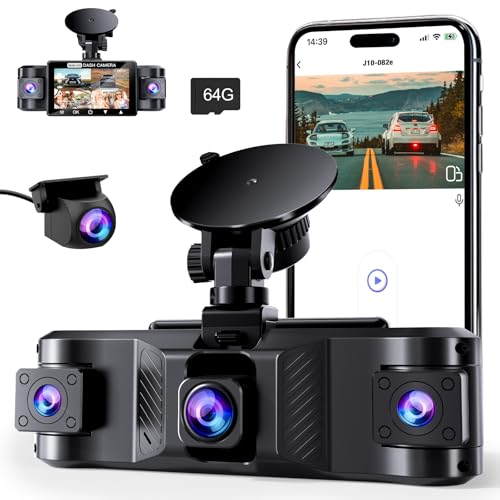
4 Channel 2.5K Dash Cam Front Rear Left Right, 170° Wide Angle Car Dash Camera with 5GHz WiFi & App Control, G-Sensor, Super Night Vision, 24H Parking Monitor, Loop Recording, 64GB SD Card Included
▶ [4-Channel Dash Cam with full Wide Angle Coverage] Featuring four cameras with 170° front wide-angle and 110°…
As an affiliate, we earn on qualifying purchases.
As an affiliate, we earn on qualifying purchases.
4 Channel 2.5K Dash Cam Front Rear Left Right, 170° Wide Angle Car Dash Camera with 5GHz WiFi & App Control, G-Sensor, Super Night Vision, 24H Parking Monitor, Loop Recording, 64GB SD Card Included
▶ [4-Channel Dash Cam with full Wide Angle Coverage] Featuring four cameras with 170° front wide-angle and 110°…
As an affiliate, we earn on qualifying purchases.
As an affiliate, we earn on qualifying purchases.