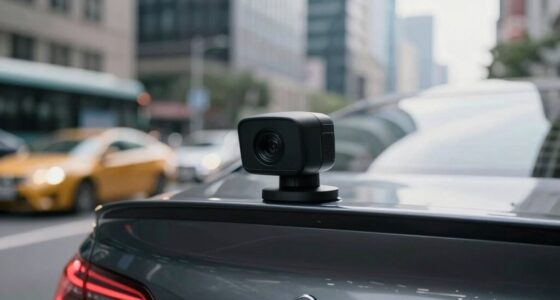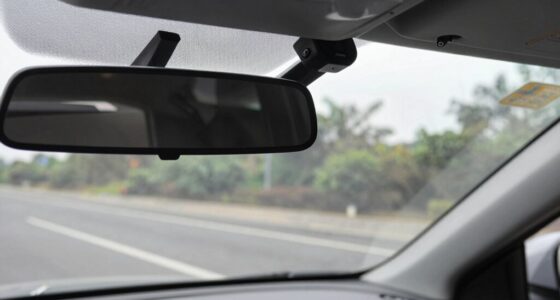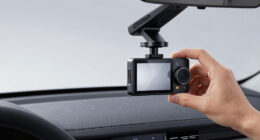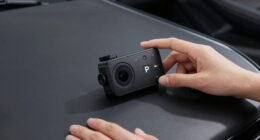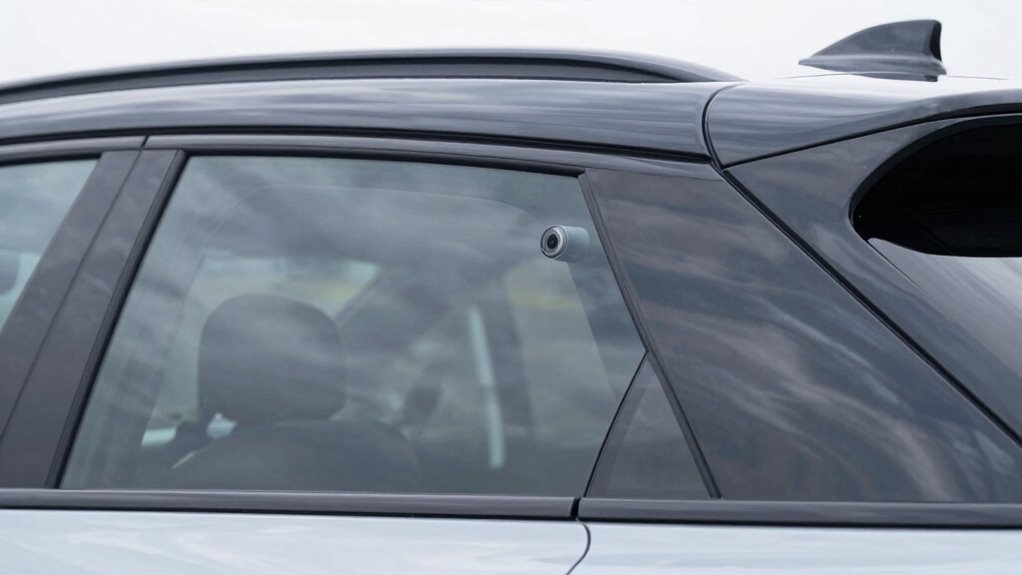

For ideal visibility, you should mount your rear camera about 1 to 2 inches below the top edge of the rear window. This height offers a balanced view of both close objects and distant surroundings, reducing blind spots and distortion. Proper placement depends on your vehicle’s size and design, so it’s worth testing different heights. Keep in mind that adjusting the angle can further improve the view—keep exploring to learn how to perfect your setup.
Key Takeaways
- Mount the rear camera about 1 to 2 inches below the top edge of the glass for optimal view.
- Ensure the camera aligns with the vehicle’s rear window or just below it.
- Avoid mounting too low to prevent limited visibility of distant objects.
- Avoid mounting too high to prevent blind spots and downward angle issues.
- Adjust the height based on vehicle size, testing different positions for best coverage.

When installing a rear camera on your vehicle’s glass, understanding the ideal height is essential for clear visibility and safety. The position you choose can profoundly impact how well you see behind you, especially when it comes to reducing blind spots. If the camera sits too low, it might not capture enough of the rear area, leaving you with limited perspective. Conversely, if it’s mounted too high, the camera angle could distort distances or miss critical objects close to your bumper. Finding the right height helps guarantee you get a balanced, accurate view that enhances your overall safety.
A key factor to consider is the camera angle, which is directly affected by the height at which you mount the camera. The goal is to position the camera so it provides an all-encompassing view of the area behind your vehicle, including blind spots that are often hard to see through mirrors alone. Mounting the camera too high can result in a downward angle that misses objects close to the rear bumper, creating a blind spot despite having a high vantage point. On the other hand, mounting it too low might cause the camera to only show the bumper or very close objects, limiting your awareness of upcoming obstacles or pedestrians.
Ideally, you want to position the camera at a height that aligns with your vehicle’s rear window or just slightly below it. This usually means mounting the camera around 1 to 2 inches below the top edge of the glass. This height allows for a camera angle that captures both the immediate area behind your bumper and the wider surroundings, minimizing blind spots. When you achieve the correct height, the camera’s field of view should include a clear view of the rear, with enough depth to see approaching vehicles, pedestrians, or objects, without overly distorting distances. It’s also important to consider installation guidelines to ensure proper placement and optimal performance. Additionally, adjusting the height to account for vehicle size and type can enhance the camera’s effectiveness in different driving situations.
It is also beneficial to consider the installation angle when mounting the camera, as this can further fine-tune the view and coverage. Additionally, consider the type of vehicle you drive. Larger vehicles, like trucks or SUVs, may require a higher mounting point to compensate for their size, while smaller cars benefit from a lower placement to maintain proper perspective. Always test different heights before completing the installation, ensuring the camera angle provides a full, unobstructed view that reduces blind spots and boosts your confidence when backing up. By carefully selecting the right height, you’ll optimize your rear camera’s effectiveness, making every reverse maneuver safer and more precise.

iSaddle Car Rear Camera Mounting Bracket Kit – Universal Adjustable Vehicle Backup Camera Mount Holder for Reverse Rearview Camera /w 13mm Screw Holes (4 Kits, Installation Bracket Only)
Hight Quality Car Reverse Camera Mount Holder, Universal Car Rear View Camera Bracket Fits Most of Cameras in…
As an affiliate, we earn on qualifying purchases.
As an affiliate, we earn on qualifying purchases.
Frequently Asked Questions
Does Camera Height Affect Parking Accuracy?
Yes, camera height affects parking accuracy. If your rear camera is too high or low, it can distort your view, making parking tricky. To keep it dependable, perform regular camera maintenance and check for dirt or damage that could impair visibility. Also, verify your camera has weather resistance, especially in harsh conditions, so it continues to provide a clear, accurate view, helping you park confidently every time.
What Is the Optimal Angle for a Rear Camera?
The ideal angle for a rear camera is typically between 120 and 160 degrees, which provides a wide view of your surroundings. To achieve this, you should adjust the camera lens based on the mounting height; a higher mounting height might require a slightly steeper angle to prevent distortion, while a lower height benefits from a more level lens. Proper adjustment guarantees clear visibility and safer parking.
Can Camera Placement Impact Image Clarity?
Yes, camera placement can considerably impact image clarity; it’s like tuning a musical instrument. If placed poorly, lens distortion may occur, making images blurry or warped. Proper positioning helps reduce this issue and allows for the ideal use of image stabilization features. When you mount the rear camera correctly, you’ll get clearer, more accurate visuals that help you see everything behind your vehicle with confidence.
How Do Different Vehicle Types Influence Camera Height?
Different vehicle types influence the ideal camera height because larger vehicles require higher mounting to guarantee proper visibility, while smaller cars need lower positioning. You should consider sensor calibration when adjusting the camera, ensuring accurate image processing. Using sturdy camera mounting brackets helps keep the camera stable at the right height. Proper placement improves image clarity, making it easier to see obstacles and enhance safety during reversing, regardless of your vehicle type.
Is There a Standard Height Regulation for Rear Cameras?
Rear camera regulations require compliance with clear contours and cautious calibrations. While no universal height rule exists, legal standards and manufacturer guidelines often recommend mounting the camera just above the license plate, typically around 20-24 inches from the ground. You should adhere to these specific standards to guarantee safety and avoid violations. Following these firm guidelines helps facilitate flawless functioning and fosters favorable, foolproof framing for your rearview visuals.
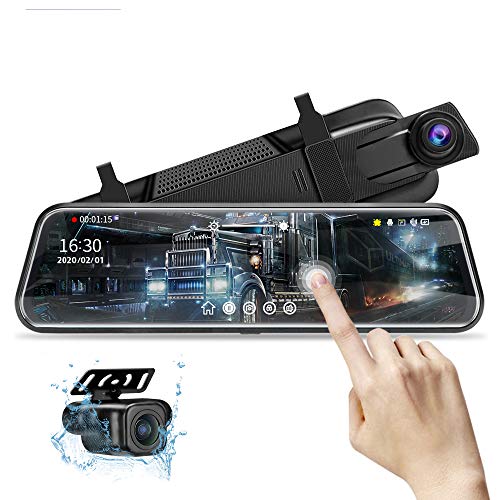
10'' Mirror Dash Cam Night Vision 1080P FHD Full Touch Screen Front and Rear View Backup Camera for Cars Loop Recording Streaming Media 170°Wide Angle Parking Assistance with 10 Meters Cable
Dual 1080P Front and Rear Camera & 33ft Long Camera Cable: 1080P front camera and 1080P IP68 waterproof…
As an affiliate, we earn on qualifying purchases.
As an affiliate, we earn on qualifying purchases.
Conclusion
Ultimately, finding the right height for your rear camera is like tuning a fine instrument — too high, and you’ll miss the subtle notes; too low, and the melody becomes muddled. Aim for a position where the lens gazes just beyond the bumper, capturing a clear horizon without distortion. When perfectly aligned, your camera becomes a vigilant eye, seamlessly blending into the symphony of your driving experience, ensuring every reverse is as smooth as a well-orchestrated performance.
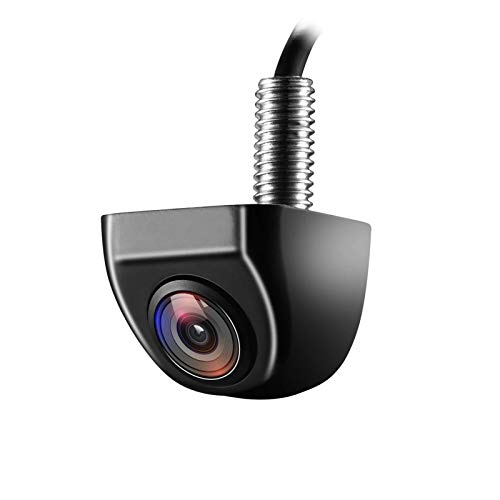
NATIKA Backup/Front View Camera,IP69K Waterproof Great Night Vision HD and Super Wide Angle Metal OEM Style Reverse Rear View Backup Camera for Cars Pickup Trucks SUVs RVs Vans (Black)
Backup camera with strong waterproof function. It designed with fully sealed glue filling craft, you no need to…
As an affiliate, we earn on qualifying purchases.
As an affiliate, we earn on qualifying purchases.

Dash Cam Installation Kit – Trim Removal Tool, 20 Strong Adhesive Cable Clips, Reusable Cable Ties, Split Sleeve & Foam Pads – Clean Car Wire Organizer
Hide Dash Cam Wires Like a Pro: Keep your dash cam installation clean and factory-looking. This complete kit…
As an affiliate, we earn on qualifying purchases.
As an affiliate, we earn on qualifying purchases.