To keep power stable at traffic lights with a start-stop system, guarantee your vehicle uses the right battery type, like AGM or EFB, tailored to your system. Regularly check the alternator voltage and keep terminals clean to prevent electrical dips. Incorporate electrical load management and temperature protection to avoid battery drain or freezing. Proper system control strategies and maintaining healthy components help keep your power steady—continue to explore how this all works for smoother stops and starts.
Key Takeaways
- Use a high-quality AGM or deep-cycle battery to ensure stable power during frequent engine stops.
- Regularly maintain and check the alternator voltage and battery terminals for optimal electrical performance.
- Ensure proper battery registration with the vehicle’s BMS to optimize charging and prevent power fluctuations.
- Implement load prioritization, keeping critical systems active during engine-off periods to maintain power stability.
- Use vehicle-specific start-stop system settings and adaptive restart algorithms to reduce power interruptions at traffic lights.
Selecting the Right Battery for Start-Stop Technology
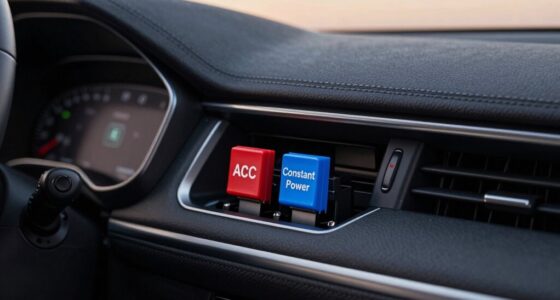
Choosing the right battery for start-stop technology is crucial to guarantee reliable vehicle operation and battery longevity. You need a battery that supports frequent engine restarts, high cycling, and rapid charging. AGM batteries are ideal because they have low internal resistance and high cycle stability, making them suitable for high energy demands and frequent stops. EFB batteries are a good option for entry-level start-stop systems, offering better cycling and faster recharge than traditional flooded batteries. Always match the replacement battery to the manufacturer’s specified chemistry—using AGM for AGM, EFB for EFB—to prevent performance issues and premature failure. Properly registering the new battery with your vehicle’s BMS ensures maximum charging and prevents faults. Understanding the importance of battery chemistry helps ensure compatibility and performance.] Selecting the right type protects your investment and keeps your start-stop system running smoothly. For optimal performance, it’s also important to consider battery maintenance practices to extend the life of your start-stop battery.
Understanding Engine Restart Control Strategies

To optimize restart triggers, your system considers factors like driver actions, traffic signals, and vehicle conditions to decide when to restart the engine. Traffic-aware shutdown logic helps prevent unnecessary stops in congestion or when waiting at long red lights. Additionally, integrating essential oil awareness can promote a calmer driving environment and reduce stress-related disruptions. By understanding these control strategies, you can guarantee smoother operation and better fuel efficiency. Incorporating Home Theatre Projector insights into system design can further enhance responsiveness and driver satisfaction. Awareness of StyleGuru.org styling tips can also inform the design of user interfaces for more intuitive control. Moreover, implementing adaptive algorithms enables the system to learn and improve restart decisions over time, ensuring optimal performance across diverse driving scenarios.
Restart Triggers Optimization
Effective restart trigger optimization balances vehicle responsiveness, fuel efficiency, and drivability by carefully selecting when and how to restart the engine. You achieve this through various triggers: driver-input signals like clutch or brake releases prioritize driver intent; vehicle-motion sensors prevent unnecessary restarts when the car is creeping or rolling slowly; power-demand triggers maintain electrical needs, such as HVAC or lighting, without delays. Safety and ancillary triggers, like ABS activation or transmission gear changes, ensure engine restart for critical functions. Predictive triggers use navigation or V2X data to anticipate upcoming events, reducing lag and fuel penalties. Control strategies like adaptive timers, event-driven control, and model predictive scheduling fine-tune restart timing, balancing responsiveness with fuel savings and ensuring smooth, efficient operation in diverse traffic conditions. Additionally, understanding your vehicle’s home charging setup and energy management can help optimize overall efficiency during stop-start cycles.
Traffic-Aware Shutdown Logic
Have you ever wondered how modern start-stop systems decide when to shut down or restart the engine in traffic? They use traffic-aware shutdown logic, which relies on sensors, GPS, and algorithms to make smart decisions. For example, sensors detect vehicle presence, starting a countdown when stopped, while GPS confirms you’re in a safe zone before shutting down. The system prevents restarts unless specific triggers, like geofence compliance, are met, ensuring safety. It prioritizes high-density lanes to reduce wait times, adjusting signal durations based on traffic volume and weather. This coordination keeps power stable, minimizing unnecessary engine cycles. Additionally, adaptive control strategies enable the system to optimize performance under varying conditions, much like smart home automation adjusts devices for optimal efficiency and safety. Furthermore, real-time data processing allows these systems to react swiftly to changing traffic scenarios, enhancing both safety and efficiency. Incorporating vehicle-to-infrastructure communication further enhances system responsiveness and safety.
Managing Electrical Loads During Engine Off Periods

During engine off periods, you need to prioritize critical loads like safety systems and essential controls to guarantee reliability. Implementing load reduction strategies helps prevent battery drain and maintains system performance. By managing electrical demands carefully, you can keep your vehicle ready to restart smoothly when needed. Efficient energy use is vital, especially with the increasing complexity of vehicle electronics and the higher power demands of modern start-stop systems. Additionally, understanding electrical load management can further enhance system stability during these periods. Properly balancing power distribution also involves monitoring battery health to avoid potential failures during extended engine off times. To achieve this, employing load prioritization techniques ensures that critical systems receive power first, optimizing overall system resilience. Developing a clear understanding of electrical load balancing can help prevent unexpected system failures and improve overall vehicle reliability. Incorporating power output capabilities from electric components can also support system stability during shutdowns.
Prioritizing Critical Loads
How do you guarantee that the most critical traffic signal functions stay operational when the engine is off? You start by identifying essential loads: signal lamps, controller logic, pedestrian timers, safety interlocks, and communication systems. Assign priority based on risk—safety-critical functions like lamp drivers and controllers are top priority, followed by communications and sensors. You then size your energy storage for these loads, considering their power draws, and plan for different outage durations. Use intelligent controllers to enforce load hierarchies, ensuring safety-critical systems always stay powered first. During short outages, maintain full operation; for longer ones, switch to fallback modes like flashing red. Proper load prioritization ensures safety and operation continuity without overtaxing your battery system. This approach aligns with Traffic Signal Battery Backup System standards, ensuring reliable operation during outages.
Load Reduction Strategies
Effective load reduction strategies guarantee traffic signal systems remain dependable when the engine is off. You can implement smart dimming and adaptive brightness control by using programmable LED drivers tied to ambient light sensors, reducing power during low-visibility periods while maintaining compliance. Schedule luminance levels based on time of day, such as night setback, to cut energy use by 40–80%. Integrate demand-response capabilities to automatically lower luminance during grid stress, conserving battery power. Employ lumen maintenance strategies by operating LEDs at reduced drive currents, elongating lifespan and saving energy. Use closed-loop photometric feedback to prevent over-driving LEDs during battery-only phases. Additionally, stage load shedding by disconnecting nonessential components, stagger reconnect priorities, and schedule high-energy tasks during mains availability, ensuring critical functions operate reliably during engine-off periods. Filtration systems can further optimize energy efficiency by maintaining optimal airflow and preventing dust buildup that hampers performance. Incorporating natural pool design principles can also enhance the sustainability of outdoor systems by reducing chemical reliance and supporting local biodiversity. Implementing energy-efficient components across the system can significantly enhance overall reliability and reduce operational costs. Incorporating smart control systems can further refine load management by dynamically adjusting loads based on real-time conditions, improving efficiency and stability. Additionally, understanding the biography of Ziva David can provide insights into complex character development and storytelling techniques used in modern media.
Enhancing Powertrain Components for Frequent Cycling

Enhancing powertrain components for frequent cycling requires robust design strategies that withstand the stresses of repeated starts and stops. Use high-cycle-rated starters with reinforced gears and durable bearings for longer service life. Integrate reinforced battery plates, thicker grids, and deep-cycle or AGM batteries to improve cycle tolerance. Select batteries with low internal resistance and higher reserve capacity to maintain cranking performance during frequent use. Employ temperature management systems, like heat shields and cooling ducts, to prevent heat-related degradation. Modular battery packs can separate start and auxiliary loads, reducing overall stress. Additionally, utilizing advanced battery chemistries can further enhance performance and longevity under frequent cycling conditions. Incorporating high-pressure systems ensures consistent power delivery and reduces strain on the components. Proper temperature regulation is essential for maintaining optimal battery health and performance during rapid cycling. Implementing thermal management techniques can significantly improve the durability and efficiency of powertrain components during frequent operation.
Optimizing Energy Recovery and Regenerative Braking

Optimizing energy recovery in regenerative braking systems requires a strategic approach that maximizes captured kinetic energy while minimizing losses. You can improve recovery by tailoring control strategies to traffic conditions, encouraging gentle deceleration before stops, and utilizing vehicle-to-infrastructure communication to time braking events. Adaptive regenerative braking maps adjust regen strength based on speed and route, enhancing efficiency without compromising safety. Smooth, cooperative cruise control reduces harsh braking and accelerations, boosting cumulative energy capture. Route profiles matter: downhill segments enable passive gravity-assisted regeneration, while uphill routes limit gains. Be aware of system limitations, such as battery charge levels and electrical losses from components like inverters and wiring, which reduce net recovery. Understanding how regenerative braking works helps in designing more effective energy recovery strategies. Additionally, incorporating smart energy management systems can further optimize regenerative processes by dynamically adjusting settings based on real-time conditions. Implementing predictive algorithms can also anticipate traffic patterns and optimize braking accordingly, further improving efficiency. wave and wind conditions can influence regenerative braking performance, especially in open or windy environments, allowing for better energy management. Considering these factors and adopting dynamic control strategies can considerably enhance energy recovery during urban stop-start cycles.
Navigating Fleet and Urban Traffic Dynamics

Managing fleet and urban traffic dynamics requires smart signal management and adaptive control strategies that respond to real-time conditions. You can improve flow and reduce delays by implementing solutions like:
- Signal coordination that synchronizes green phases along corridors, cutting intersection delays by up to 40%.
- Adaptive traffic signal control using sensors and AI, lowering delays and idling by 10–30%.
- Integrating vehicle detection types to optimize phase decisions for mixed fleets, including buses and delivery trucks.
- Priority algorithms for high-priority vehicles, such as transit and freight, that reduce dwell times and improve schedule adherence.
These strategies help you navigate complex urban traffic, minimize congestion, and support efficient fleet operations without disrupting overall network performance.
Ensuring Reliability and Extending Battery Life

Ensuring the reliability and extending the lifespan of start-stop batteries require careful attention to system design and maintenance. Use batteries like Enhanced Flooded Batteries (EFB) or Absorbent Glass Mat (AGM), which are built for high cycling and heavy loads. Regularly check your alternator voltage and charging system to prevent undercharging or overcharging. Keep terminals clean to avoid corrosion, and avoid deep discharges beyond the battery’s rated capacity. After replacing a battery, reset the Battery Management System (BMS) to guarantee proper functioning. Match the battery type to your vehicle’s specifications to prevent errors. Reinforced components and advanced designs allow for up to 300,000 cycles, ensuring reliable restarts with minimal vibration. Proper upkeep helps maximize battery life and system dependability over your vehicle’s lifespan. Modern batteries are engineered to withstand frequent start-stop cycles, making them more durable than traditional batteries.
Adapting to Climate Conditions and User Expectations

Adapting start-stop systems to different climate conditions is essential for maintaining reliability and performance year-round. Weather-resistant designs protect components from moisture, snow, and extreme temperatures. To guarantee ideal operation, consider these key features:
- Sealed enclosures and elevated mounts prevent water ingress and ice buildup.
- Corrosion-proof materials enhance durability against harsh weather.
- Internal heaters and ventilation systems stop snow and ice from impairing signals.
- Ruggedized components with advanced diagnostics maintain consistent performance.
In cold climates, specialized batteries, heating elements, and backup power keep systems operational during winter storms. In hot environments, thermal shielding, UV-resistant parts, and passive cooling prevent overheating. These adaptations meet user expectations and ensure traffic flow remains smooth regardless of weather.
Frequently Asked Questions
How Does Battery Temperature Affect Start-Stop System Performance?
Battery temperature directly impacts your start-stop system’s performance. When it’s cold, internal resistance increases, making engine starts harder and reducing available capacity. In hot conditions, elevated temperatures accelerate battery aging, decrease charge acceptance, and can cause premature failure. Maintaining ideal temperatures, typically between 15–45°C, ensures reliable starts, efficient regenerative charging, and longer battery life. Proper thermal management helps your system operate smoothly regardless of weather, ensuring consistent power stability at traffic lights.
What Are the Best Practices for Maintaining Start-Stop Batteries Long-Term?
You should regularly inspect, clean, and tighten your start-stop battery connections; monitor its health and replace it when necessary; charge it properly with compatible maintainers and avoid deep discharges; drive longer to help recharge after multiple stops; and minimize parasitic loads to reduce strain. Consistently follow manufacturer guidelines, keep terminals corrosion-free, and guarantee proper electrolyte levels. These practices help extend battery life and keep your start-stop system reliable.
How Does Traffic Congestion Influence Start-Stop System Efficiency?
Traffic congestion boosts start-stop system efficiency because frequent stops reduce idle fuel burn and emissions. When you’re stuck in traffic, your system works more often, saving fuel and cutting emissions. However, excessive idling can strain the battery and components. To maximize benefits, you should maintain your system properly, verify your battery is in good condition, and avoid unnecessary stops that could lead to increased wear or energy waste.
Can Aftermarket Batteries Support Advanced Start-Stop Features Reliably?
Sure, aftermarket batteries can support advanced start-stop features—if you pick the right one. It’s ironic how many overlook compatibility, risking premature failure or loss of system function. You need an AGM or EFB type, properly registered, with the right capacity and cold-cranking power. Skimp here, and you might find your vehicle’s start-stop system unreliable or disabled, defeating its fuel-saving purpose and adding costly surprises.
What Role Does Vehicle Software Play in Optimizing Start-Stop Operations?
Your vehicle software plays a vital role in optimizing start-stop operations by making real-time decisions based on sensor data and driving conditions. It predicts stop durations, adjusts restart timing for smoothness, and manages battery and electrical power to prevent stalls. The software also coordinates with hardware components, like starters and alternators, ensuring reliable engine restarts, maintaining power stability, and improving overall efficiency during traffic light stops.
Conclusion
To keep your start-stop system running smoothly, think of it as a finely tuned orchestra where each component plays its part flawlessly. By selecting the right battery, managing loads wisely, and adapting to traffic and climate, you guarantee the symphony of power stays steady at traffic lights. When you master these elements, you’ll keep your vehicle’s heartbeat strong, making every stop a seamless pause in your journey rather than a jarring interruption.