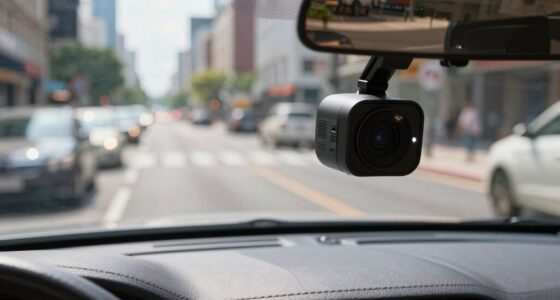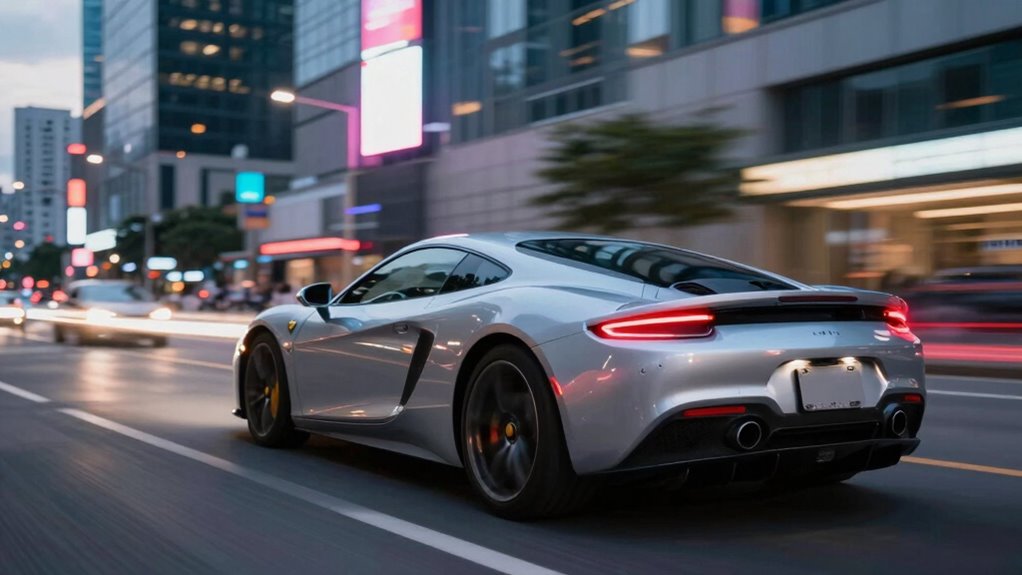

Shutter speed is essential because it directly affects how sharp a moving license plate appears in your images. Faster shutter speeds (less than 2 milliseconds) freeze motion and prevent blurring, which is often more important than just increasing resolution. Even high-resolution cameras can’t overcome motion blur if the exposure time isn’t quick enough. To effectively capture clear plates at speed, mastering shutter timing is key—you’ll discover ways to optimize your setup as you continue exploring.
Key Takeaways
- Shorter shutter speeds reduce motion blur, preserving the clarity of fast-moving license plates better than increasing resolution.
- Motion blur spreads stroke energy, decreasing effective resolution and hindering OCR accuracy more than pixel count.
- Faster shutter speeds minimize streaking, ensuring plate details remain sharp despite high vehicle speeds.
- Higher resolution offers limited benefits if motion blur dominates image quality; shutter speed directly controls blur severity.
- Proper shutter timing combined with illumination balances exposure and sharpness, crucial for accurate license plate recognition.
The Impact of Exposure Time on Plate Clarity
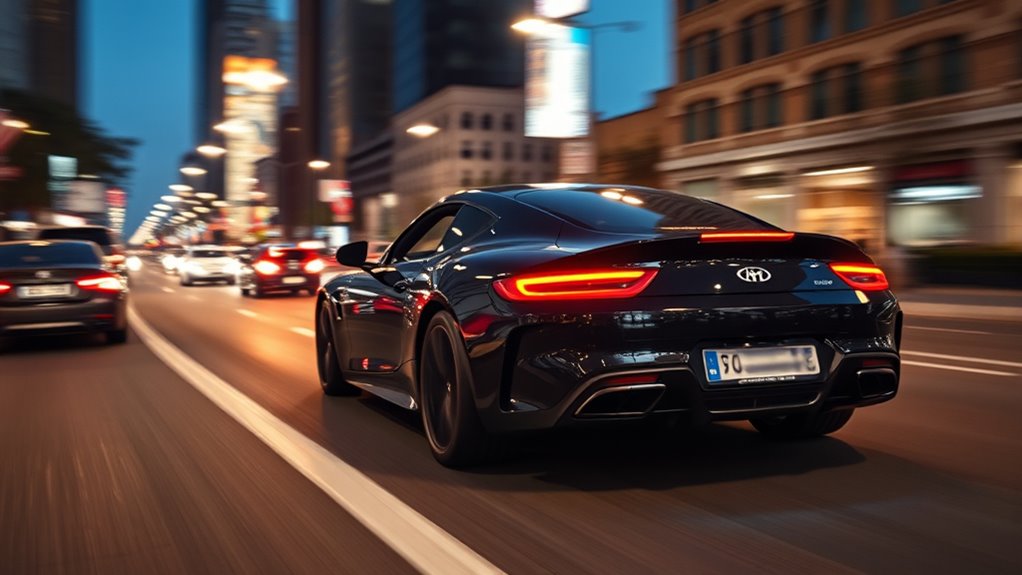
Exposure time plays a critical role in determining how clear a license plate appears in images. Shorter shutter speeds reduce motion blur by limiting how much the vehicle moves during capture. For typical road speeds, camera vendors recommend shutter times in the sub-millisecond to single-millisecond range. When the camera angle is transverse, effective motion across the sensor increases, requiring even shorter shutter times to keep blur below the width of the characters. Field guidance suggests shutter times of 1–2 ms for high-speed roads and 3–4 ms for parking scenarios. However, shorter exposures collect less light, which can reduce image contrast and signal-to-noise ratio. Balancing shutter speed with illumination and gain is essential to maintain both clarity and sufficient exposure for accurate OCR. Utilizing precise sensor timing and understanding the thermal behavior of camera components can further optimize image quality under various outdoor conditions. Additionally, controlling ambient lighting and camera heat management helps ensure consistent image sharpness across different environments. Proper exposure settings, tailored to specific conditions, can significantly enhance license plate recognition performance. Moreover, understanding the impact of sensor noise at very short exposure times can help in selecting the optimal balance for reliable imaging. Implementing advanced image processing algorithms can also compensate for some limitations caused by shorter exposure durations.
Resolution Limits When Motion Blur Is Present

When motion blur occurs, it effectively reduces the spatial resolution of license plate images, making character recognition more challenging. Blur spreads stroke energy across multiple pixels, decreasing the number of pixels that encode each character stroke. Even if the nominal resolution meets the 100–150 pixel width target, motion blur can lower the effective resolution below the 2-pixel minimum needed for reliable OCR. As blur width approaches or exceeds stroke width, recognition accuracy drops sharply. High-frequency details are attenuated, meaning that increasing sensor megapixels offers little benefit if motion dominates image quality. Optical improvements, like faster shutters, only partially compensate. Ultimately, short exposures and higher frame rates preserve stroke integrity better than simply increasing resolution when motion blur is present. Connected equipment and optimized shutter speeds work together to mitigate motion-related resolution loss. Additionally, understanding yarn weight and stitch type can help optimize camera settings in textile-related imaging applications, ensuring clarity despite movement. Employing motion compensation techniques can further enhance image sharpness in dynamic scenes. Furthermore, shutter speed plays a critical role in controlling motion blur and maintaining image detail during rapid motion.
The Role of Frame Rate and Timing in Capturing Sharp Plates

Maintaining an appropriate frame rate is essential for capturing sharp license plates, especially at higher vehicle speeds. You should aim for a minimum of 20 FPS for fast-moving vehicles and 25-30 FPS for reliable recognition. Higher frame rates ensure you capture enough clear images during a vehicle’s pass, aligning with speed-to-FPS guidelines—such as 15-25 FPS for 30 mph or 30-40 FPS for 60 mph. The camera’s frame rate directly limits maximum vehicle speed for accurate ANPR. Fast mode typically processes at 10 FPS, but increasing it to 20 FPS or more improves detection sensitivity. Timing is critical: vehicles need to stay in frame long enough to generate multiple detection frames, with license plates requiring at least 10-15 frames for precise recognition. Additionally, higher frame rates can help reduce motion blur, which is crucial for maintaining license plate clarity during fast passes. Proper camera calibration also plays a significant role in optimizing recognition accuracy under varying conditions, and understanding the relationship between frame rate and vehicle speed can help set more effective monitoring parameters. Moreover, selecting the right shutter speed is vital for balancing exposure and motion clarity, especially when capturing rapid vehicle movements.
Balancing Lighting, Aperture, and Shutter Speed at Night
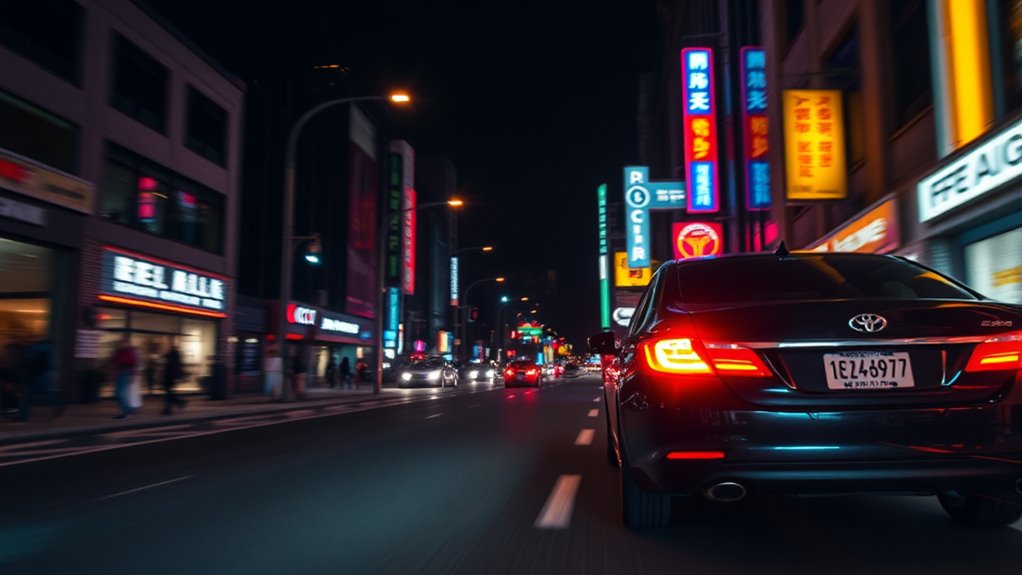
Balancing lighting, aperture, and shutter speed at night is essential for capturing clear license plate images, especially on high-speed roads. Low light conditions require you to use faster shutter speeds—under 2 milliseconds for high speeds—to minimize motion blur. To compensate, you need wider apertures like f/1.6 or f/1.8, which gather more light and allow shorter shutter times. However, wider apertures can reduce depth of field, so finding the right equilibrium is critical. Increasing ISO can also help but risks noise. Ambient lighting variations and backlit scenes further challenge exposure consistency. Using a combination of ideal shutter speed, appropriate aperture settings, and possibly higher ISO, you can improve clarity while preventing excessive blur and underexposure. Adjustments depend on vehicle speed and lighting conditions for the best results. Proper sensor sensitivity is crucial to achieve optimal image quality in low-light conditions without introducing excessive noise.
System Design Strategies to Minimize Blur and Maximize Readability
Effective system design is key to minimizing blur and maximizing license plate readability during high-speed captures. Proper camera placement, optics, and exposure control are essential. Mount cameras at optimized heights and angles to keep the plate near perpendicular, reducing distortion and motion smear. Use lenses with low field curvature and minimal aberrations for sharper edges. Select focal lengths that make the plate occupy at least 10–20% of the image height for reliable segmentation. Employ vibration-isolated mounts to prevent mechanical blur. Additionally, sensor sensitivity plays a crucial role in capturing clearer images under rapid shutter conditions. Incorporating knowledge about biography of camera technology can further enhance system performance in dynamic environments. Understanding camera sensor advancements helps in selecting components that improve clarity in fast-motion scenarios.
Frequently Asked Questions
How Does Vehicle Speed Influence Optimal Shutter Speed Settings?
Your vehicle’s speed directly impacts your ideal shutter speed. Faster speeds cause more motion blur, so you need a quicker shutter—usually faster than 1/500 second for 100 km/h—to freeze details like license plates. Slower speeds, under 50 km/h, allow you to use longer exposures like 1/250 or 1/500 second. Adjust your shutter based on speed, distance, and focal length to guarantee clear, legible plates.
Can Software Deblurring Fully Recover Details From Blurred License Plates?
A picture is worth a thousand words, but a blurred license plate can only tell part of the story. You can’t fully recover all details from severe blurring, especially when the information is lost or distorted. Software deblurring helps with minor issues, but it often falls short on strong blurs. You might get partial character recognition, but complete clarity remains elusive without high-quality original images.
What Are the Best Lighting Strategies for Nighttime License Plate Capture?
You should combine infrared and supplemental visible lighting for ideal nighttime license plate capture. Use 850 nm IR light to enhance contrast, especially on red plates, and white LEDs for even illumination, reducing reflections. Position your camera with proper angle and lighting sources, ensuring IR and visible lights work together. Employ adaptive systems to adjust brightness automatically, and use high shutter speeds to minimize motion blur, ensuring clear, readable images in low-light conditions.
How Does Camera Mounting Angle Affect Motion Blur and Plate Readability?
Like a dance partner stepping out of sync, an improper mounting angle throws off your camera’s performance. When you mount the camera at steep or oblique angles, motion blur increases, making plates harder to read. This happens because the plate appears to move faster across the sensor, and the distortion reduces character clarity. To keep plates sharp and readable, maintain angles within recommended limits and avoid extreme tilt or offset.
Is Higher Resolution Always Beneficial for License Plate Recognition Systems?
Higher resolution isn’t always beneficial for license plate recognition systems. While it can improve detail when images are sharp and well-exposed, it also amplifies motion blur, making recognition harder if shutter speed isn’t adjusted accordingly. Without sufficient shutter speed, increased resolution may lead to more blurry images, reducing OCR accuracy. Focus on suitable shutter speed and lighting to guarantee images are sharp, then higher resolution provides real benefits.
Conclusion
Remember, shutter speed plays a vital role in capturing clear license plates, especially at night. Even with high resolution, slow shutter speeds can cause motion blur that hinders readability. Studies show that increasing shutter speed by just 1/100th of a second can improve plate clarity by over 30%. So, prioritize quick exposure times and proper system design to guarantee sharp images. Your success depends on balancing these factors to catch those elusive plates every time.