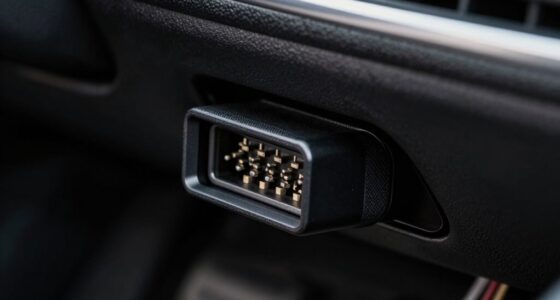
When your car feels “off,” start by checking live data PIDs like engine speed (RPM) and load to see if idle is stable and within normal range. Watch for irregular signals from air intake sensors (MAF, MAP, IAT) and look at fuel trim percentages to identify lean or rich mixes. Also, monitor ignition timing and oxygen sensor feedback to spot combustion issues. Continuing will help you understand how these indicators fit together to diagnose your vehicle’s behavior.
Key Takeaways
- Monitor RPM PID to identify unexpected dips or surges indicating idle or drivability issues.
- Check airflow sensor PIDs (MAF, MAP, IAT) for abnormal signals suggesting intake problems.
- Observe fuel trim PIDs (LTFT, STFT) to detect leaks, vacuum issues, or fuel delivery irregularities.
- Review ignition timing and cylinder spark PIDs for misfires or timing inconsistencies affecting smoothness.
- Use freeze frame data alongside live PIDs to correlate symptoms with specific operating conditions.
Monitoring Engine Speed and Load for Idle Stability
Monitoring engine speed and load is essential for maintaining idle stability, especially when your vehicle faces varying accessory demands like air conditioning or steering. You should keep an eye on PID 010C for engine RPM, which typically stays between 600-900 RPM at idle. The target is usually around 700-750 RPM, but it can rise during cold starts or when accessories engage. Watch for RPM dips under load—if RPM drops more than 100-200, it could signal a problem. The ECU compares actual RPM to the target using closed-loop feedback, adjusting via PID gains to settle within about 9 seconds. Proper monitoring helps prevent stalls and improves fuel economy. Additionally, understanding how energy-efficient cloud servers operate can inform maintenance of modern vehicle systems, which increasingly rely on advanced computing.
Diagnosing Air Intake and Flow Sensor Signals
Diagnosing air intake and flow sensor signals involves understanding the primary outputs of key sensors like the MAF, MAP, IAT, and boost sensors, and recognizing how their signals reflect the engine’s airflow and pressure conditions. The MAF provides voltage or frequency signals indicating the mass of intake air; abnormal patterns like steady or noisy signals suggest contamination or wiring issues. The MAP sensor outputs voltage proportional to manifold pressure, which should decrease under vacuum and rise with boost. The IAT shows resistance or voltage that correlates with air temperature; sudden jumps may indicate leaks or sensor faults. Boost sensors measure pressure differences for forced induction; incorrect readings can distort airflow calculations. The signals from these sensors can often be checked with diagnostic tools to verify their accuracy and responsiveness. Consistent, plausible signals across these sensors are critical for accurate diagnosis of intake-related problems.
Analyzing Fuel Trim and Oxygen Sensor Feedback
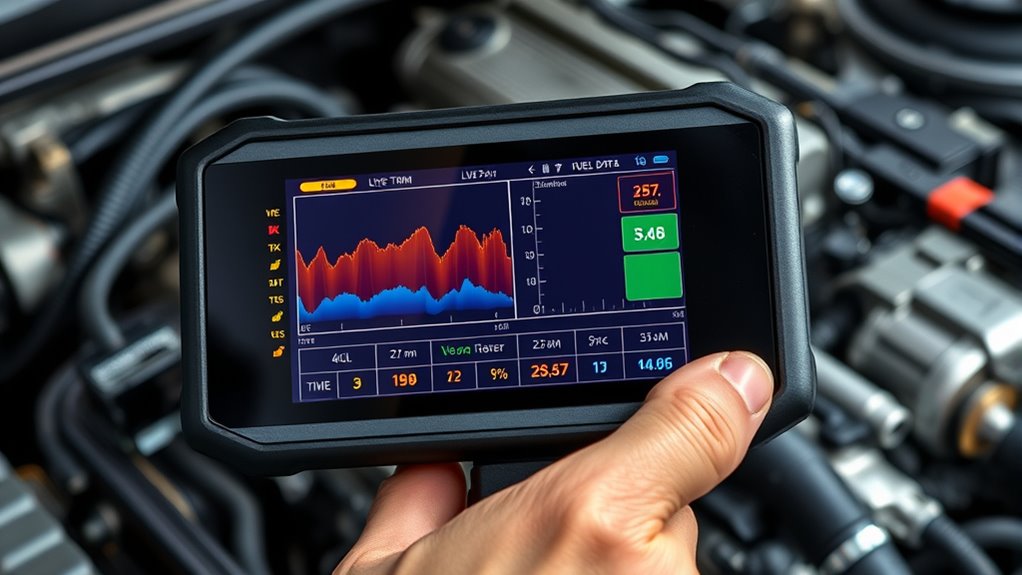
Understanding how fuel trims and oxygen sensor feedback interact is key to diagnosing engine performance issues. The ECM adjusts fuel delivery based on real-time oxygen sensor signals to maintain the ideal 14.7:1 air-fuel ratio. If sensors detect a lean mixture, positive fuel trims increase fuel to compensate; if rich, negative trims reduce fuel. Short-term trims respond quickly to immediate changes like load or temperature, while long-term trims reflect persistent deviations, indicating issues like leaks or faulty sensors. Upstream oxygen sensors provide feedback for these adjustments, and anomalies can cause misaligned trims. Monitoring both trims and sensor readings with a scan tool helps pinpoint problems. For example, consistently positive LTFT suggests a lean condition, often caused by vacuum leaks or low fuel pressure, guiding targeted repairs. Youngster Choice Additionally, integrating adaptive diagnostics tools can enhance real-time analysis and fault detection.
Evaluating Ignition Timing and Combustion Indicators
Evaluating ignition timing and combustion indicators involves analyzing key live-data PIDs that reveal how well the engine’s spark events align with ideal timing for efficient combustion. Start by checking the crankshaft angle reference (CKP) PID to ensure pulses are consistent; missing or irregular signals suggest timing faults or sensor issues. Use the camshaft position (CMP) PID to confirm the phase relationship with the CKP, helping identify drift or slipped timing. Compare commanded ignition advance (degrees BTDC) with the actual timing; discrepancies indicate control or mechanical problems. Examine ignition coil dwell/current and primary waveforms to assess spark energy and coil charging. Finally, review cylinder-specific spark or ionization PIDs to verify sparks occur at the correct crank angle, guaranteeing normal combustion initiation. Additionally, understanding the contrast ratio can help interpret differences in combustion efficiency and exhaust gases during diagnostics.
Using Diagnostic Modes and Live Data to Pinpoint Issues
Using diagnostic modes effectively allows you to pinpoint specific issues by providing targeted data and fault information. Mode 01 helps you monitor real-time PIDs like fuel trims, MAF, and temperature sensors, revealing immediate symptoms. Mode 02 captures freeze frame data, showing exactly what conditions triggered a fault. Mode 03 and 07 display stored and pending DTCs, helping identify intermittent issues that haven’t fully set off the check engine light. Mode 06 offers insight into component test results, verifying sensor accuracy or detecting marginal performance. To deepen your understanding: 1. Use live data to compare current readings with freeze frame snapshots for context. 2. Cross-reference persistent and pending DTCs to confirm faulty components. 3. Run drive cycles to activate non-continuous monitors and reproduce intermittent faults efficiently. Understanding how these modes work together is essential for comprehensive diagnostics and effective troubleshooting. Additionally, familiarizing yourself with digital asset management strategies can improve your overall approach to vehicle diagnostics and data security. Incorporating proper data management practices can help you organize diagnostic information more effectively and protect sensitive vehicle data. Incorporating knowledge of herbal teas and their benefits can also support overall health, which is especially important when dealing with stressful diagnostic scenarios.
Frequently Asked Questions
How Can I Identify a Vacuum Leak Using Live Data?
You can identify a vacuum leak by monitoring live data for fuel trims and RPMs. If the short-term fuel trim exceeds 10-14% at idle, and long-term trims are above 20%, it indicates a lean condition from unmetered air. Elevated RPMs when pinching hoses, along with high fuel trims that drop when opening the throttle, confirm a vacuum leak. Use scan tools to observe these changes in real-time.
What Are Signs of a Failing MAF Sensor From Live Readings?
You’ll notice a failing MAF sensor if live data shows sudden zero, fixed high or low readings inconsistent with engine speed, or erratic spikes. If the MAF value doesn’t increase smoothly with throttle input, or if it hits maximum or zero unexpectedly, it’s a sign of failure. Additionally, large fuel trim adjustments and discrepancies between MAF and calculated airflow suggest the sensor isn’t providing accurate readings, indicating it’s failing.
How Do I Interpret Misfire Counters for Individual Cylinders?
You’ll find that even a small misfire count, like under five, often indicates intermittent issues, while higher counts suggest consistent problems. To interpret counters, focus on cylinders with persistent or rising values; a single high number points to ignition or fuel delivery problems specific to that cylinder. If multiple cylinders show similar increases, suspect shared systems like the fuel rail or ignition module. Always compare live data trends for accurate diagnosis.
What Live Data Indicates a Clogged or Restricted Intake System?
You’ll notice low or inconsistent MAF readings, especially under load, which suggest restricted airflow. Elevated intake air temperature and a high vacuum on the MAP sensor also point to a blockage. Watch for fuel trim patterns, like positive LTFT across both banks, indicating the PCM adds fuel due to reduced air. Additionally, sluggish RPM response, reduced boost pressure, and discrepancies between commanded and actual throttle or boost levels all signal intake restrictions.
How Can I Verify Proper Operation of the Catalytic Converter With Live Data?
To verify your catalytic converter’s operation with live data, check the upstream O2 sensor’s rapid switching between 0.1-0.9V during steady cruising. Then, observe the downstream O2 sensor; if it stays steady and mirrors the upstream sensor, the converter might be failing. Also, confirm the catalyst temperature rises appropriately under load, and review mode 6 tests for efficiency. These signs help guarantee your converter functions correctly.
Conclusion
Think of your car’s live data PIDs as the dashboard’s own heartbeat monitor. When things feel “off,” it’s like reading its essential signs to spot the trouble. By paying attention to engine speed, air, fuel, and ignition signals, you become the mechanic of your own vehicle’s health. With this knowledge, you can catch small issues before they turn into breakdowns, keeping your ride smooth—and your confidence high—just like a doctor reading vital signs to keep a patient well.