Insurance companies can request your dash cam footage during claims, but they must do so within legal limits. They often need a court order or subpoena, especially if the footage is private or inside someone’s vehicle. Laws about privacy and how footage can be used vary by state, so your rights might limit what’s shared. If you want to understand the actual boundaries and how to handle such requests, there’s more to contemplate.
Key Takeaways
- Insurance companies can request footage through legal means like subpoenas or court orders, but cannot simply demand private recordings.
- Access depends on jurisdiction, privacy laws, and whether the footage is lawfully obtained and relevant to the claim.
- Insurers typically need a subpoena to access private or public footage during claims investigations.
- Evidence must meet legal standards for relevance, authenticity, and lawful collection to be admissible in court.
- Claimants should preserve original footage and metadata, as alterations or improper handling can weaken their legal position.
The Scope of Insurance Requests for Dash Cam Footage
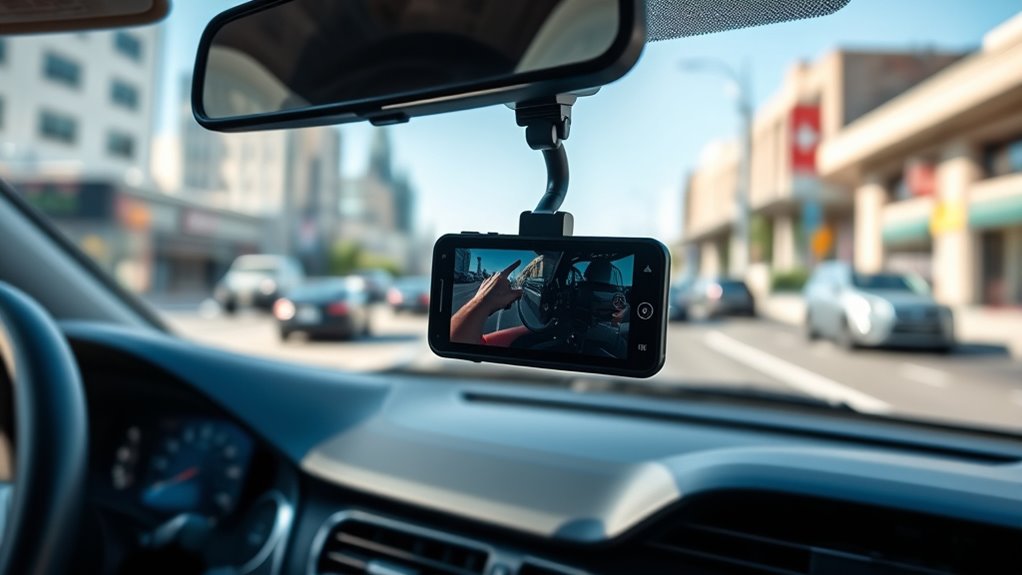
When insurers request dash cam footage, they typically focus on videos that clearly capture the accident or incident in question. About 40% of dash cam users have recorded crashes, and half of those clips are submitted to insurance or legal proceedings. Insurers mainly seek footage that provides objective, time-stamped evidence to determine fault quickly and accurately. They are particularly interested in videos that show the moments surrounding an incident, including road conditions, vehicle positions, and driver behavior. Footage that is lawfully obtained and clearly depicts the event can notably influence claim outcomes. While some insurers require or incentivize the use of dash cams, they usually focus on videos relevant to the specific accident, rather than generic driving footage. Objective evidence is key for insurers to assess claims efficiently. Additionally, understanding the legal considerations around footage collection can help ensure submissions are compliant with privacy laws and regulations. Properly managing video storage and understanding privacy rights can also impact the reliability and legality of footage submitted. Moreover, adherence to technological standards helps verify the authenticity and quality of the footage, which is crucial in legal and insurance contexts. Recognizing the importance of digital security can further protect footage from tampering or unauthorized access, ensuring its integrity in dispute resolution. Furthermore, keeping detailed records of how footage is collected and stored can help establish its chain of custody if disputes arise.
Legal Boundaries and Privacy Considerations

Insurers’ requests for dash cam footage must navigate a complex web of legal and privacy boundaries. State laws on wiretapping and consent can restrict audio recording and sharing, especially in dual-consent jurisdictions. Recording in private spaces, like inside other vehicles or private property, varies by state and might be more restricted. Data protection laws may impose obligations if footage contains identifiable personal data, requiring lawful processing. Police and public officials often have exceptions allowing recording and retention, but these depend on local statutes. Courts can issue orders or subpoenas compelling production, even if privacy concerns exist. Your footage’s discovery becomes mandatory once litigation is underway, with rules demanding preservation of original files and metadata, limiting your ability to withhold evidence. Additionally, vetted—wave and wind considerations can influence the handling and sharing of footage in certain situations. It’s important to be aware of privacy laws that may further restrict how footage can be used or disclosed. Moreover, understanding data security measures can help protect your footage from unauthorized access or breaches. Staying informed about legal compliance requirements is crucial to avoid inadvertent violations during production or sharing. Being aware of storage and retention policies is also essential to ensure proper management of footage over time.
When and How Insurers Can Access Your Footage
Insurers can access your footage when specific legal conditions are met, such as through direct requests, subpoenas, or negotiations. They review the footage to verify claims, determine liability, and support investigations, but only within the bounds of privacy laws. They may also utilize advanced nanotechnology-based tools to analyze large datasets quickly and accurately. Additionally, privacy regulations govern how and when footage can be shared or accessed, ensuring your rights are protected. They might also consider publicly available footage to gather additional evidence or context for claims processing. Footage may also be shared with your consent or as required by court orders, ensuring that their access complies with applicable regulations. Understanding how and when they can obtain your footage helps you see your rights and their procedures clearly. Being aware of home energy considerations can also influence how you manage your data and privacy in related situations. Recognizing data privacy rights ensures you are informed about your control over personal information and footage.
Legal Access Conditions
Accessing your footage legally requires following specific procedures and meeting certain conditions. Public agencies must respond to FOIA requests within five business days, with possible extensions, and release footage if it falls under statutory categories or requester rights. Police body-cam and in-car videos are retained for at least 90 days, with longer retention for flagged incidents. Private entities are not obligated to share footage voluntarily; a court-issued subpoena is usually necessary, often with associated fees. Insurance companies need subpoenas to obtain private or public footage during claims. To use footage in court, it must be authentic, relevant, and legally obtained, respecting privacy laws. Without proper legal steps, insurers cannot access or use footage against you.
Insurer Review Procedures
When an insurance claim is underway, your footage may be reviewed at key moments to evaluate the validity of the claim. Insurers access footage through various methods, such as examining security cameras, traffic videos, and social media profiles. They often deploy investigators before scheduled medical exams or during high-stakes claims to gather evidence. Adjusters and investigators analyze footage by discussing clips with owners, interviewing witnesses, or following claimants. They may cherry-pick short clips from hours of footage to challenge claim validity or liability. This process aims to identify contradictions, disprove injuries, or support fraud allegations. To prevent surprises, be aware that insurers actively review and analyze footage using multiple sources and techniques. Additionally, understanding the importance of proper evidence management can help you better prepare for such reviews.
The Role of Evidence Admissibility in Claims

When it comes to evidence in claims, you need to understand what’s legally acceptable and relevant. The admissibility of footage depends on the legality of how it was obtained, its clarity, and whether it directly relates to the case. The laws governing evidence can be complex, and understanding evidence rules is crucial to presenting a strong claim. Keep in mind that rules can vary considerably depending on your jurisdiction, affecting what evidence you can use. To ensure your evidence is credible, consider using reliable ride-tech setups that automatically capture clear footage in a non-intrusive way. Additionally, knowing evidence admissibility standards can help you determine whether your footage will hold up in court. Being familiar with evidence validation procedures can further strengthen your case by demonstrating the authenticity of your footage. Recognizing the importance of documentary evidence can also be vital in establishing a comprehensive and compelling claim.
Legality of Footage Use
The legality of footage use in insurance claims hinges on meeting strict admissibility standards that guarantee evidence is relevant, authentic, and collected lawfully. You need to verify the footage directly depicts the incident or facts in dispute to be admissible. Authenticity requires proof that the recording originates from the claimed device and time, often verified through metadata, device logs, or timestamps. The evidence must be unaltered; courts expect original, unedited recordings, as tampering can make footage inadmissible. Additionally, footage must be collected lawfully, respecting privacy statutes—illegal recordings are excluded. Proper documentation, such as chain of custody records, strengthens admissibility. Failing to meet these criteria can lead to evidence being rejected or questioned, undermining your claim. In some jurisdictions, laws may restrict or regulate the use of dashcam footage, further influencing its admissibility in court. Moreover, water safety considerations are relevant when handling footage related to incidents around pools or aquatic environments, as they often involve complex legal and safety issues. To ensure your footage is legally sound, understanding evidence collection best practices is crucial, including adherence to standardized procedures that courts recognize as reliable. Additionally, familiarity with legal standards for evidence can help you better navigate disputes over footage admissibility. Being aware of evidence integrity measures can further protect your footage from potential legal challenges.
Clarity and Relevance
Why does the clarity and relevance of footage matter so much in insurance claims? Because courts rely on recordings to prove or disprove facts, the footage must be both clear and directly related to the issue. If a recording is blurry or shows irrelevant scenes, it risks being excluded. Relevance guarantees the footage makes a fact more or less probable, avoiding marginal or pretextual evidence. Courts balance probative value against prejudice, excluding graphic material that could unfairly sway opinions. Authenticity is vital—proof of editing or manipulation may require expert analysis. Properly used footage can demonstrate bias, ownership, or control, strengthening your case. Additionally, understanding sector performance metrics can help assess the credibility of footage sources. Ensuring the footage’s admissibility standards are met can make all the difference in court outcomes. Recognizing evidence admissibility criteria is crucial for establishing the weight and credibility of the footage presented. Moreover, familiarity with evidence authentication procedures can aid in verifying the authenticity of recordings before submission.
Jurisdictional Variations
Jurisdictional rules substantially influence how insurance evidence can be used in claims, shaping both strategy and outcome. Different states and federal courts have varying standards for admitting insurance-related evidence, especially regarding negligence and liability. For example, federal rules generally exclude insurance evidence to prevent bias, but allow it for ownership, control, or witness credibility. Nevada permits insurance evidence if introduced as a rebuttal and under specific circumstances, while California’s Evidence Code generally bars insurance proof to show negligence unless relevant for other purposes. South Carolina restricts insurance evidence to non-liability issues but allows exceptions. Other jurisdictions, like West Virginia and Arkansas, permit some insurance evidence when rebutting inability-to-pay claims, affecting how you present your case and handle discovery.
Risks and Benefits of Sharing Dash Cam Videos
Sharing dash cam videos offers clear benefits, such as providing objective evidence that can speed up claims and reduce fraud. With time-stamped footage, you help clarify fault and event sequences, leading to faster settlements—industry reports cite about 60% quicker resolutions when video is available. However, there are risks too. If footage is tampered with or recorded unlawfully, it can be excluded or challenged in court. Privacy concerns also arise, especially if interior or third-party images are captured without consent. Additionally, failing to preserve or produce requested footage might suggest spoliation, raising suspicion. While dash cams can deter staged accidents and fraudulent claims, improper placement or recording laws may jeopardize admissibility. Balancing these benefits and risks ensures you protect your rights while supporting accurate claim assessments. Proper maintenance and understanding of local laws are essential to maximize the advantages of sharing dash cam footage effectively and lawfully.
Practical Tips for Handling Insurance Footage Requests
Handling insurance footage requests effectively begins with proper preservation and evidence management. First, immediately secure the original recording to prevent overwriting or corruption, increasing its authenticity. Make a bit-for-bit copy and keep detailed chain-of-custody notes—who accessed it, when, and what actions were taken. Avoid editing, cropping, or re-encoding before transfer, ensuring the file remains unaltered and credible. Record and preserve metadata like timestamps, GPS data, and camera logs to verify the footage’s context. Store backups in at least two separate locations, such as an encrypted drive and cloud storage, to prevent loss during review.
Secure original footage immediately, maintain chain-of-custody, preserve metadata, and store backups in multiple locations.
- Secure the original file immediately
- Maintain detailed chain-of-custody logs
- Preserve metadata and backup files properly
Frequently Asked Questions
Can Insurers Legally Force Me to Share Dash Cam Footage?
No, insurers can’t legally force you to share dash cam footage. You have the right to refuse unless the footage is relevant to a legal case or during litigation, where you may be required to produce it. Insurers can request it, but you’re not obligated to comply voluntarily. If a court orders the footage through legal channels, then you must share it. Always consider privacy laws specific to your state.
What Happens if I Refuse to Provide Footage to My Insurer?
Refusing to provide footage can complicate your claim considerably. Your insurer might interpret your silence as non-cooperation, leading to delays, reduced settlements, or even denial of coverage. They may escalate the matter legally, seeking court orders or subpoenas to obtain the footage. Additionally, your refusal risks losing vital evidence, which could have supported your case. To avoid these issues, cooperating and preserving relevant videos is generally in your best interest.
Are There Penalties for Tampering With Dash Cam Recordings?
Yes, there are penalties for tampering with dash cam recordings. If you intentionally delete, alter, or manipulate footage, you risk criminal charges, civil sanctions, and the loss of admissibility in court or insurance hearings. Metadata tampering or selective editing can be especially scrutinized. To avoid penalties, preserve the original footage, document any necessary edits, and be transparent about your actions, as courts often distinguish routine handling from deliberate misconduct.
How Long Do Insurers Typically Keep My Dash Cam Footage?
You might be surprised, but insurers typically keep your dash cam footage for about 30 to 90 days, sometimes longer if linked to an incident. This period aligns with industry standards, ensuring enough time to investigate claims. They usually delete footage automatically after this window unless there’s an open dispute or legal reason to retain it. So, your footage could be stored for a few months, but always check your policy for specifics.
Does Sharing Footage Affect My Insurance Premiums?
Sharing your footage can lower your insurance premiums by providing evidence that deters theft and supports claims, often leading to discounts of 10–20%. However, be aware that if your driving habits or behavior are captured and shared, it might lead to premium increases, especially if risky behaviors are evident. Overall, sharing footage can benefit you financially if it’s used to prove safety and reduce risks.
Conclusion
Ultimately, while insurers may ask for your dash cam footage, it’s often a coincidence of timing and circumstance that determines whether you’ll have to share it. Staying informed about your rights and privacy boundaries makes it easier to navigate these requests when they arise. Trust your judgment, and remember that understanding the practical reality can help you protect your privacy without losing sight of the benefits. Sometimes, the right moment makes all the difference.