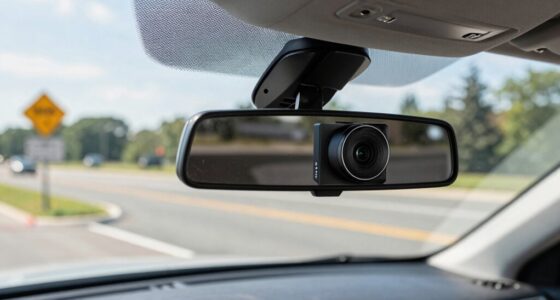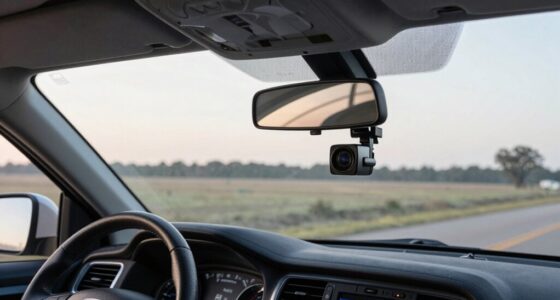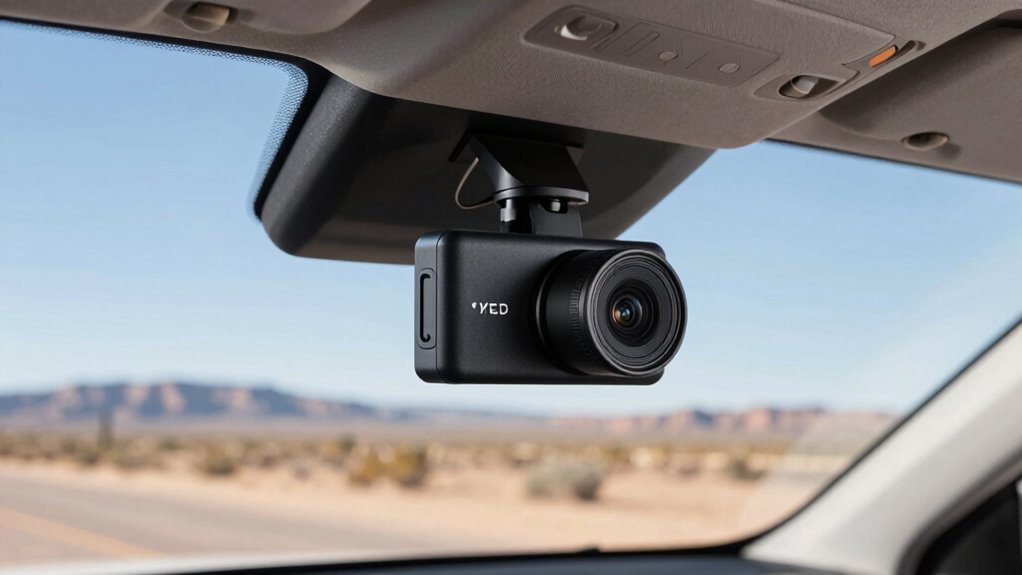

In Arizona, you can mount your dash cam within specified zones—either behind or below the rearview mirror—so it doesn’t block your view or get a ticket. You can record audio under one-party consent laws, meaning only one person needs to agree. Respect passenger privacy and be cautious about recording private conversations or private property. To understand how to stay compliant and protect your rights, continue exploring the key rules and tips.
Key Takeaways
- Dashcams must be mounted within specific zones on the windshield: within a 5-inch square driver side corner or a 7-inch square passenger side corner.
- Audio recording is legal under Arizona’s one-party consent law, requiring at least one involved person’s permission.
- Proper placement prevents obstruction of view, traffic signals, and signage, complying with state and federal regulations.
- Mounting outside designated areas or obstructing vision can result in citations, fines, and increased liability.
- Using dashcam footage in legal proceedings requires unedited recordings with accurate timestamps and metadata.
Legal Mounting Locations for Dashcams in Arizona
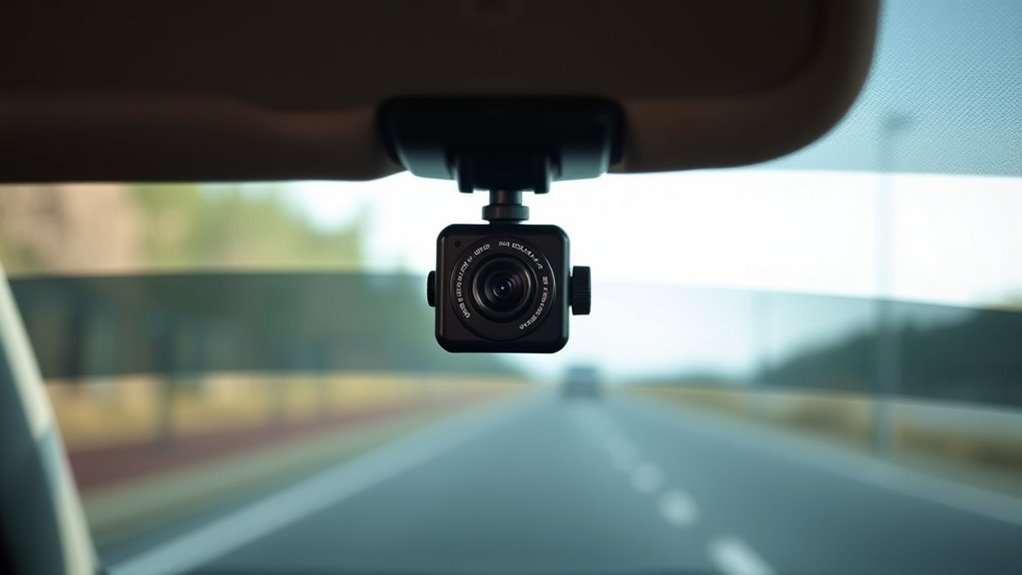
In Arizona, you must mount your dashcam within specific areas on your windshield to avoid legal issues. The law limits placement to certain lower-corner zones, as defined by Arizona Revised Statute 28-959.01. For the driver side, your dashcam can only be within a 5-inch square in the lower corner nearest you, while on the passenger side, it’s restricted to a 7-inch square in the lower corner farthest from you. Devices outside these zones or exceeding size limits risk a citation for obstructing your view. Mounting on other glass surfaces generally violates the rule against obstructing vision. To stay compliant, consider placing your dashcam behind the rearview mirror or on the dashboard, provided it doesn’t block your sight lines. Additionally, understanding dash cam laws in Arizona can help you avoid potential legal issues related to privacy and mounting restrictions. Being aware of support regulations can further ensure your dashcam setup remains within legal bounds. Properly mounting locations are essential to prevent distractions or legal complications while driving. Proper placement not only ensures safety but also helps you avoid inadvertent violations of vehicle equipment laws.
Proper Dashcam Placement to Avoid Violations
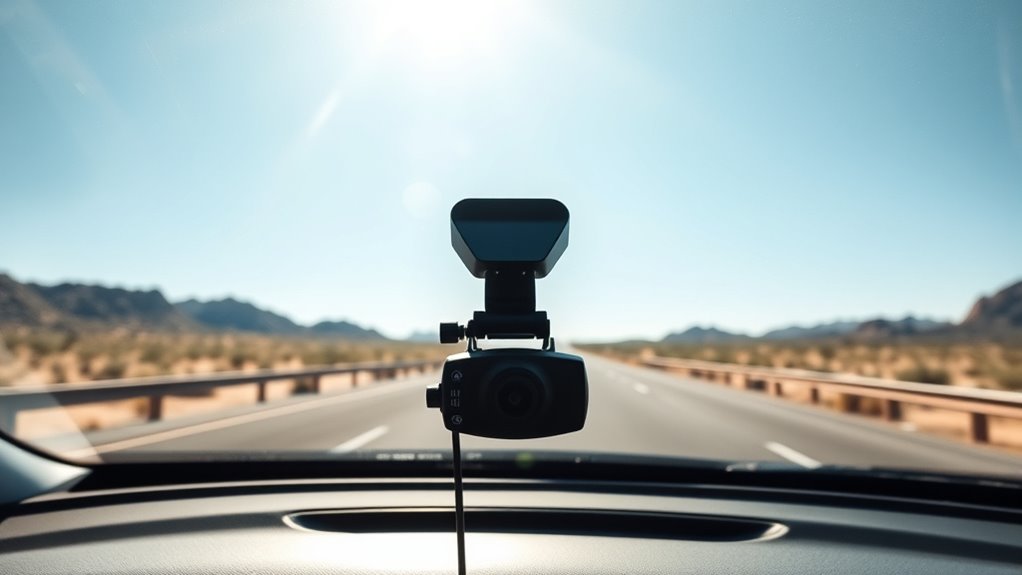
To avoid violations, you need to choose the right mounting location that keeps your dashcam within Arizona’s size limits and doesn’t block your view. Placing it behind the rearview mirror or on the dashboard helps prevent obstruction and guarantees compliance. Always double-check that your camera doesn’t interfere with traffic signals or signage from your normal driving position. Proper placement guidelines are essential to ensure your dashcam remains legal and effective while driving. Placement restrictions depend on state-specific laws; ensuring proper positioning is essential for legal compliance and safety. Additionally, considering tactical gear such as mounting brackets designed for optimal placement can enhance stability and visibility, further reducing the risk of accidental violations. Using adjustable mounts allows for precise positioning to avoid blocking critical views or signals. Moreover, utilizing European cloud server solutions can help securely store your footage, safeguarding your recordings against tampering or loss. Incorporating advanced mounting options that are adaptable to different vehicle types can further improve your setup and compliance.
Correct Mounting Locations
Proper dashcam placement is essential to avoid violations and guarantee your device complies with Arizona laws. For the driver side, position the dashcam in the lower corner closest to you, fitting within five inches square, as specified by Arizona Revised Statute 28-959.01. On the passenger side, mount the device in the lower corner farthest from you, within a seven-inch square. Alternatively, mounting behind the rearview mirror is permitted, provided it doesn’t obstruct your view and complies with size restrictions. Ascertain both placements keep the camera within the designated areas on the windshield. Proper positioning not only prevents tickets but also maintains clear visibility, reducing liability and ensuring you’re compliant with state laws. Always verify measurements and placement to avoid violations. Additionally, ensuring your dashcam does not interfere with your field of view is crucial for safe driving and legal compliance. Considering manufacturers’ guidelines can help you select the safest and most compliant mounting options. Being aware of local laws and regulations related to dashcam use can further help you avoid inadvertent violations and ensure your device remains within legal parameters. Regularly inspecting your mounting stability can prevent accidental dislodging and ensure continuous recording, which is vital for evidence in case of incidents. Consulting reliable sources for updates on legislation can also keep your setup compliant as laws evolve.
Avoid Obstructing View
Making certain your dashcam doesn’t obstruct your view is crucial to avoid violations and maintain safe driving. Arizona law prohibits objects on the windshield that block or reduce your clear line of sight, including dash cams. Only a five-inch square is allowed in the lower corner closest to the driver, and a seven-inch square in the farthest lower corner. Mounting outside these zones risks a traffic ticket. Devices behind the rearview mirror are acceptable if within size limits. Larger cameras should be mounted on the dashboard to prevent obstruction. Proper placement is essential to comply with Arizona laws and avoid penalties. Violations can lead to tickets, increased insurance liability, or even civil liability if an accident occurs. Always check your placement to ensure it doesn’t impair your view or violate size restrictions to stay compliant and safe. Additionally, dashcam placement can impact your ability to record incidents accurately and avoid legal complications. Proper dashcam mounting also ensures your device remains securely attached during driving conditions. Being aware of environmental considerations, such as avoiding glare or obstruction caused by dirt or debris, can further improve your recording quality and compliance. When considering state-specific dashcam regulations, understanding local laws helps you avoid unexpected fines or legal issues.
Use Dashboard Placement
Mounting your dashcam on the dashboard is a safe and legal alternative that keeps it out of your line of sight. This position avoids windshield restrictions and reduces the risk of a ticket. You can mount your device on the dashboard as long as it doesn’t obstruct your view. To ensure compliance, consider the placement options below:
| Mounting Area | Size Limit | Placement Details |
|---|---|---|
| Driver-side corner | 5-inch square | Keeps within lower corner near driver |
| Passenger-side corner | 7-inch square | Farthest lower corner on passenger side |
| Dashboard | No specific size limit | Out of windshield, view unobstructed |
Using dashboard placement helps you stay within legal boundaries and enhances safety. Additionally, many states specify that dash cams should not distract the driver or interfere with vehicle operation. Moreover, choosing an appropriate mounting location ensures optimal visibility and compliance with local laws. Proper dashcam placement can also prevent glare and reflections that impair your view. Proper placement also considers minimizing distractions to maintain focus on the road. Being aware of narcissistic tendencies can help you better understand the importance of unobstructed views and non-disruptive placement. Furthermore, understanding vehicle laws about dashboard camera positioning can help you avoid unintended violations.
Audio Recording Regulations and Consent Laws
In Arizona, you can record audio in your vehicle if at least one person involved consents, following the one-party consent rule. This means you generally don’t need to inform other passengers when capturing onboard conversations. However, it’s important to remember that privacy expectations and notification requirements can vary depending on the context and jurisdiction. All states permit dash cam ownership and use, but laws regarding audio recording and privacy can differ, so staying informed helps ensure compliance. Additionally, audio recording regulations may require obtaining appropriate user consent, especially in states with more restrictive laws. Being aware of privacy laws related to recording can help prevent potential legal issues and protect your rights. It’s also wise to review local regulations regularly, as laws surrounding audio recording are subject to change and can impact your dash cam usage. Moreover, understanding the recording laws specific to your state can help you avoid inadvertent violations. Familiarity with audio recording laws ensures you remain compliant and respect others’ privacy while using your dash cam.
One-Party Consent Rules
Arizona’s one-party consent rule allows you to record conversations if at least one person involved agrees. This means you can lawfully record in-vehicle audio if you’re part of the conversation or if someone else involved consents. The rule mainly covers private communications where there’s a reasonable expectation of privacy. Public conversations generally aren’t protected and may be recorded without consent. When using a dash cam, audio recording is usually legal when you’re a participant, but recording third-party calls or conversations without their involvement might violate wiretap laws. Courts look at whether the conversation was private and if someone consented. Keep in mind, recording for lawful purposes like accident documentation differs from illicit or harassing recordings, which can lead to legal trouble. Understanding wiretap laws is crucial to ensure your dash cam use remains compliant. Additionally, being aware of privacy expectations helps in avoiding unintentional violations.
Privacy and Notification
Understanding the rules around audio recording in Arizona is key to staying compliant and avoiding legal issues. Arizona law generally permits recording conversations you’re part of, but private communications are protected when there’s a reasonable expectation of privacy. Federal wiretap laws may also apply, especially for interstate or telephonic communications, creating potential overlaps and liabilities. To reduce risks, posting notices inside your vehicle about audio recording or verbally informing passengers before recording begins is recommended. Using device settings to mute or disable microphones when private conversations occur can help. In public settings, recordings of conversations visible to third parties carry less legal risk. However, recording inside a private vehicle or with passengers requires clear notice and consent to avoid violating privacy expectations.
Privacy Considerations When Recording With a Dashcam
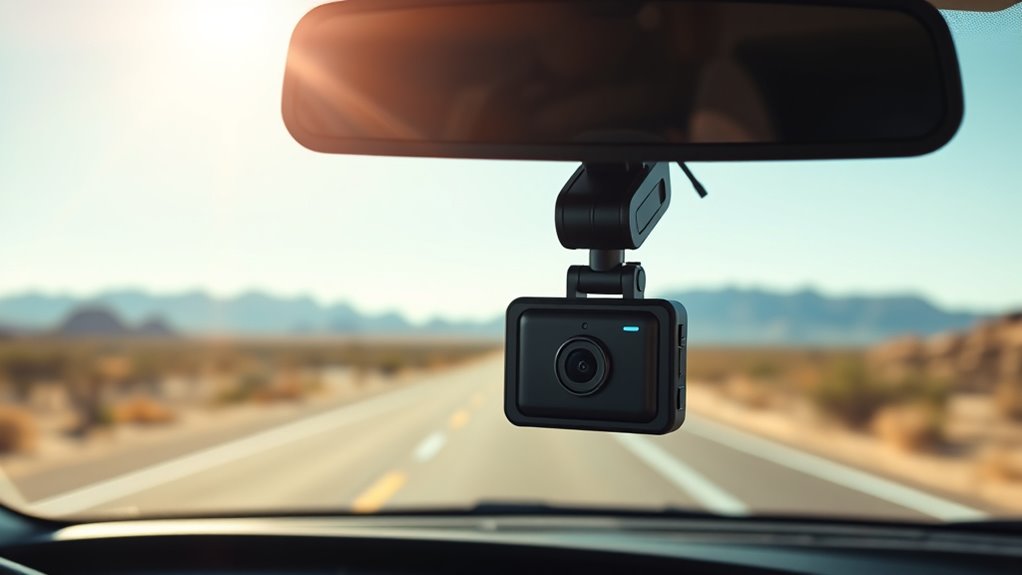
When using a dashcam, it’s vital to be aware of privacy considerations that can affect your recording practices. Arizona law requires only one-party consent for audio recording, meaning you can record audio if you’re a participant, but capturing private conversations may raise admissibility issues in court. Always notify passengers about audio recording to respect their privacy, even though Arizona doesn’t mandate it. Video recording in public spaces is generally legal and admissible, as there’s no expectation of privacy in public. However, recording on private property calls for caution; obtaining consent helps avoid legal complications, especially if footage captures private areas or inside residences. Protecting sensitive content like minors, medical emergencies, or private conversations through redaction is vital to prevent privacy violations and legal troubles. Compliance with recording laws is essential to avoid potential legal issues and ensure your recordings are admissible in court.
Ensuring Court-Ready Footage and Evidence Standards
To guarantee your dashcam footage is court-ready, you must meet specific admissibility standards that prove its relevance and authenticity. Confirm the footage clearly relates to the incident without edits or alterations. It should capture key details like fault, road conditions, or reckless behavior. Properly preserved footage is essential; secure it immediately and avoid editing to maintain its integrity. Using original, unaltered recordings strengthens its credibility. Also, verify metadata and timestamps stay intact to support chain of custody. Courts in Arizona accept footage that meets these standards, especially if it shows reckless actions like red-light running. Proper documentation and storage increase your chances of having compelling, admissible evidence.
| Criterion | Requirement |
|---|---|
| Relevance | Directly related to incident or fault |
| Authenticity | No tampering; unaltered footage |
| Preservation | Secure, timestamped, and unedited footage |
Penalties for Improper Dashcam Mounting and Recording
Improper dashcam mounting can lead to serious legal and financial penalties in Arizona. If you mount your device outside the designated areas—such as beyond the 5-inch square in the driver’s lower corner or the 7-inch square on the passenger side—you risk a citation under Arizona Revised Statute 28-959.01. Mounting on the windshield center or outside the specified zones can obstruct your view, resulting in fines and possible points on your license. These violations may also make you liable in accidents caused by obstructed vision. Additionally, if your dashcam exceeds size limits or blocks visibility, it could be considered a windshield obstruction. Fines, license points, or court penalties can follow, emphasizing the importance of proper placement to avoid legal trouble.
State Regulations on Dashcam Use and Federal Guidelines
Understanding how Arizona’s dashcam laws align with federal guidelines helps you stay compliant when recording on the road. You need to be aware of state-specific rules about mounting and audio recording, especially when crossing state lines. By knowing the differences, you can prevent legal issues and make sure your dashcam use stays within legal boundaries. Additionally, being familiar with both state and federal regulations ensures your footage remains admissible and protected in case of an accident or legal dispute.
Arizona Dashcam Laws
Arizona’s dashcam laws specify where and how you can mount your device, guaranteeing your footage is legally admissible and doesn’t interfere with safe driving. You must place your dashcam within a five-inch square in the lower corner closest to the driver or within a seven-inch square in the farthest lower corner, according to Arizona Revised Statute 28-959.01. Mounting outside these areas can result in tickets for obstructing your view and increase liability if involved in an accident. To stay compliant, consider these points:
- Avoid placing the dashcam outside designated zones.
- Keep the device unobstructed for clear footage.
- Use dashboard mounts for safer placement if windshield rules are tight.
Following these rules helps protect you legally and ensures your recordings remain valid.
Federal Regulations Overview
Federal regulations set clear limits on where and how you can mount dashcams, especially for commercial vehicles. The FMCSA and DOT specify that windshield-mounted devices can’t obstruct the driver’s view, with strict size and placement rules to ensure safety. Devices should be mounted behind the rearview mirror or within small corner zones measured from the windshield’s edge, avoiding airbag zones and sightlines. Improper mounting can lead to violations or inspection failures. Federal guidance emphasizes that device size, angle, and position relative to airbags are safety-critical. Fleets must verify placements to prevent obstructions. Additionally, federal policies support using safety tech like dashcams when they don’t impair vehicle operation or driver visibility, encouraging integration into broader safety programs and regular inspection during compliance checks.
State vs. Federal Rules
While federal guidelines provide a broad framework for dashcam placement and use, state regulations in Arizona add specific requirements that vehicle owners and operators must follow. These include strict mounting rules, audio consent, and privacy considerations. For example, you must:
- Mount dashcams within the designated 5- or 7-inch squares on the windshield to avoid citations.
- Obtain one-party consent for audio recordings, and handle footage carefully to ensure admissibility.
- Respect privacy by understanding that recordings in public spaces generally have fewer restrictions, but interior recordings require clear notices and consent.
Arizona emphasizes proper placement to prevent obstruction, and legal use of audio and footage depends on adhering to state-specific rules. These regulations supplement federal guidelines, creating an exhaustive legal framework.
Practical Tips for Installing and Using Dashcams Legally

To guarantee your dashcam remains compliant with Arizona laws, start by choosing the right mounting location and size. Place your device within the lower corner squares: 5 inches on the driver’s side and 7 inches on the passenger’s side, avoiding obstructing your clear view under Arizona Revised Statute 28-959.01. When unsure, dashboard mounting can prevent windshield obstruction. Ensure the device’s size and position don’t block your vision, as violations can lead to tickets or liability issues if they contribute to an accident. Regularly check that your dashcam remains properly mounted and unobstructed. Keep the device clean, and avoid loose wiring that could distract or interfere with your driving. Proper installation and routine checks help guarantee legal compliance and peak performance. Be aware that dash cam placement laws may vary slightly across different counties, so consulting local regulations can provide additional guidance.
Costs and Features of Affordable Dashcam Options
Affordable dashcams come in a range of prices and features that can fit different budgets without sacrificing essential performance. For under $100, you can find basic front-only HD/1080p models that record clear footage and include parking or impact detection modes. Mid-range options between $100–$250 often add rear cameras, better sensors, and 2K/4K resolution, improving night vision and overall clarity. Budget “best value” picks around $150–$350 combine multiple features like Wi-Fi, GPS, and ADAS for enhanced safety and convenience. Accessories such as hardwire kits or larger microSD cards can add $15–$80. Keep in mind ongoing costs like cloud subscriptions or replacing microSD cards, which typically range from $10–$70 annually. Choosing the right balance depends on your priorities and budget.
Maintaining Compliance to Protect Your Rights and Evidence

Maintaining compliance with Arizona dashcam laws is essential to safeguard your rights and guarantee your footage can be used as valid evidence. Make certain your dashcam is mounted within the five-inch square limit on the driver’s lower corner or the seven-inch square on the passenger side farthest from the driver, avoiding obstructing your view. Position your camera behind the rearview mirror or on the dashboard to prevent legal issues. For audio recordings, remember Arizona is a one-party consent state—your consent suffices, but informing passengers is recommended to address privacy concerns. Always keep footage relevant, authentic, and unaltered, especially for court use. Disclose data practices to passengers and avoid illegal surveillance. Proper mounting, clear notification, and adherence to these regulations protect your rights and strengthen your evidence in any incident.
Frequently Asked Questions
Can I Legally Record Audio in My Vehicle Without Informing Passengers?
Yes, you can legally record audio in your vehicle without informing passengers in Arizona since it’s a one-party consent state. As the driver, your consent suffices for the recording to be lawful. However, consider notifying passengers to avoid privacy concerns or disputes later. Disabling audio or posting a notice about audio recording can help maintain transparency. Always guarantee your recordings are unaltered if you plan to use them as evidence.
Are There Specific Brands or Models Recommended for Legal Dashcam Use in Arizona?
You should consider brands like Garmin, Nextbase, Thinkware, Viofo, and Vantrue for legal dashcam use in Arizona. Look for models with built-in GPS, high resolution (2K/4K), and timestamping features to guarantee footage is court-admissible. Prioritize discreet mounting options and models with toggleable audio to protect privacy. Choose units with reliable file handling and local storage options to maintain evidence integrity and comply with state regulations.
How Can I Ensure My Dashcam Footage Is Accepted as Evidence in Court?
To guarantee your dashcam footage is accepted in court, keep the video relevant, clear, and unedited. Always preserve the original files and document the chain of custody. Use proper mounting to avoid tampering questions, and include accurate date and time-stamps. Avoid editing or altering footage, and ensure any audio recordings comply with Arizona’s one-party consent law. Presenting reliable, authentic footage supports your case and increases its admissibility.
Is It Legal to Record Video Outside My Vehicle, Like at a Traffic Stop?
Yes, recording outside your vehicle at a traffic stop is legal since public roads have no privacy expectation. Picture your camera capturing the flashing lights, officers, and surroundings clearly in public view. As long as your dashcam doesn’t obstruct your view or violate mounting rules, your footage is admissible in court. Just make certain your device stays within legal mounting limits and doesn’t interfere with driving safety.
What Are the Consequences of Mounting a Dashcam Outside the Permitted Areas?
Mounting your dashcam outside the permitted areas can lead to fines, citations, and points on your license. If your device obstructs your view or violates size limitations, authorities may view it as a safety hazard. Improper mounting can also make your footage inadmissible in court and complicate insurance claims. To avoid penalties, guarantee your dashcam is positioned correctly in the lower corners or on the dashboard, respecting all size and placement rules.
Conclusion
By following Arizona’s dash cam laws, you’re like a guardian of your own road story, ensuring your footage stands strong in court like a knight’s shield. Stay mindful of mounting spots, audio rules, and privacy rights—think of it as steering through a legal maze with a trusty map. With proper installation and respect for regulations, you’ll protect your rights and capture clear evidence, turning your dashcam into a reliable sidekick, much like a trusted companion on every journey.