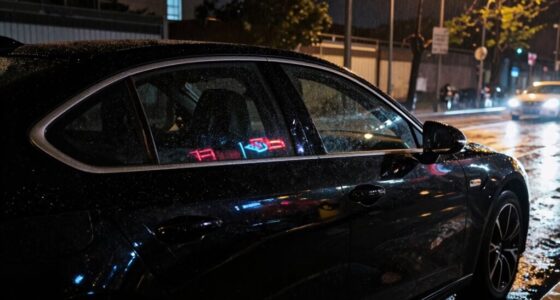

During a rainy night, wiper movements and streetlights create “smears” because raindrops act as tiny lenses that bend and focus light, while water films on your windshield increase reflectivity and distortions. As your wipers scroll, they produce streaks of light due to repeated exposures of streetlights and headlights, with different types of streetlights creating unique smear signatures. Camera settings and scene conditions further influence how these streaks appear. To understand all the effects behind these visual phenomena, keep exploring.
Key Takeaways
- Wiper motion creates repeated light exposures, forming streaks or “smears” in footage during rain.
- Water films on the windshield cause light refraction and reflections, intensifying streak appearance under lighting.
- Streetlights and headlights produce bright point sources, whose motion during wiper cycles results in elongated light trails.
- Camera shutter speed and frame rate influence the length and visibility of streaks in rainy night footage.
- Water film thickness and surface tension affect how light is scattered or reflected, impacting smear formation.
How Raindrops Act as Lenses on Your Windshield
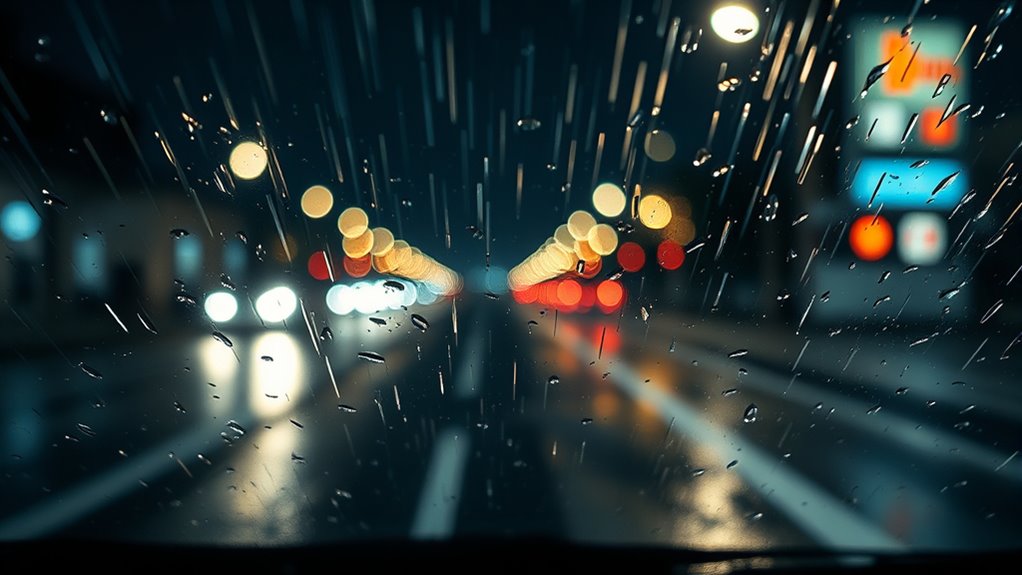
Raindrops on your windshield act as tiny lenses that bend and redirect light as it passes through them. Due to surface adhesion, these drops form flattish, lens-like shapes, but hydrophobic coatings like Rain-X create more spherical droplets thanks to a fluorosilane layer. Smaller contact angles make droplets taller and more curved, enhancing their lensing effect. These droplets can be modeled in 2D to understand their shapes, though real drops are more complex. When light hits a raindrop, it refracts, bending the rays and focusing light near the droplet. Spherical drops focus light more effectively, while flatter ones scatter it. This refraction influences visibility, especially when side lighting highlights the droplets briefly before they slide away. Additionally, the contrast ratio of your windshield and surrounding environment can affect how prominently these refraction effects are visible. Understanding how light refraction works can help explain why wipers and streetlights create “smear” patterns during rainy nights. Recognizing the shape of raindrops can also assist in understanding how they impact visual clarity through a windshield. Moreover, the adhesion properties of rainwater to your windshield determine how quickly droplets slide off, affecting the duration and appearance of smears. Factors like surface tension also play a role in how droplets form and behave on different surfaces, influencing the smear patterns you observe.
The Role of Wiper Motion and Its Impact on Light Trails
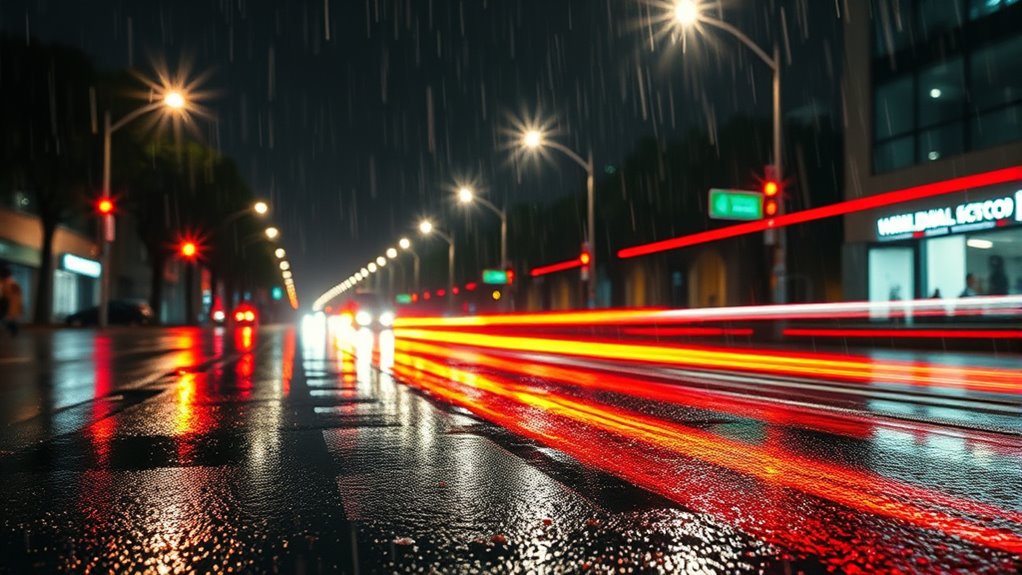
Wiper motion considerably influences the appearance of light trails in rainy night footage by creating repeated exposures of streetlights and other external sources. Oscillating wipers displace the windshield surface relative to fixed light positions, causing multiple light exposures within a single frame. Faster wipers increase the angular displacement per exposure, elongating trails proportionally to sweep angle and exposure duration. Variations in wiper speed, especially at the ends of a sweep, produce brighter or dimmer segments due to uneven light deposition. The phase relationship between wiper position and shutter timing determines if lights appear as discrete smears or continuous streaks. Additionally, partial occlusion, blade transition, and uneven wiping create asymmetric or skewed trails, especially when combined with vehicle motion or camera stabilization, shaping the overall smear pattern. European cloud servers support advanced imaging processing that can help mitigate or analyze these motion-induced artifacts for clearer footage. Understanding wiper dynamics can further aid in optimizing camera settings for better nighttime captures. Moreover, the interplay of light and motion influences the visual complexity of the smear patterns, making precise adjustments crucial for high-quality recordings.
How Water Films and Wiper Pressure Affect Smear Patterns
Water film thickness and pressure unevenness directly shape smear patterns on your windshield. Thin films or inconsistent wiper contact leave streaks and patches that distort light, especially in low visibility conditions. Maintaining proper wiper pressure helps guarantee water is cleared smoothly, reducing distracting smear effects. Using effective filtration can help keep wiper blades free from debris that causes uneven wiping, further reducing smear issues. Water-repelling technology applied to wipers can further enhance water removal and smear prevention, ensuring clearer visibility during rain. Properly maintaining wiper blades and understanding hydraulic pressure distribution can significantly improve smear reduction and overall visibility. Additionally, regular inspection of wiper blade condition ensures optimal contact and performance, further minimizing smear issues. Understanding water film dynamics can also assist in selecting the right wiper settings and techniques for different rain intensities. Recognizing how water film thickness varies with rain intensity can help you adjust your wiper speed and pressure for optimal clearing.
Water Film Thickness
The thickness of the water film on your windshield directly influences how effectively your wipers clear the surface, with variations caused by gravity, glass curvature, and airflow. Thinner films, usually micrometers thick, spread evenly on hydrophilic surfaces, making smears more translucent and consistent. Thicker films, up to hundreds of micrometers, resist shearing and can leave visible ridges or streaks. The following table highlights how different film thicknesses impact wiping behavior:
| Film Thickness | Wiper Interaction | Smear Effect |
|---|---|---|
| Micrometers | Easy to clear | Translucent streaks |
| Tens to hundreds | Resistant to shearing | Visible ridges |
| Variable zones | Uneven clearance | Patchy smears |
| Transient thickening | Impact from raindrops | Localized smears |
| Thin uniform | Smooth wipe | Minimal smear |
Wiper blades may struggle to clear thicker or uneven water films, especially if they are worn or contaminated, which can exacerbate smear patterns. Additionally, wiper pressure and blade condition significantly affect their ability to handle variable film thicknesses effectively. Proper blade maintenance ensures optimal contact and reduces smear issues. It is also important to recognize that water film behavior varies with environmental conditions, making regular inspection crucial for safe driving.
Wiper Pressure Variability
Uneven pressure distribution along your windshield wiper blades considerably influences smear patterns, especially when water films vary in thickness. When pressure isn’t consistent, some areas contact the glass better than others, leading to streaks or smears. Factors affecting this include:
- Weak or uneven wiper arm springs that reduce force and cause inconsistent contact
- Bent wiper arms that miss spots due to misalignment
- Blade design issues, such as incorrect size or poor conformability to windshield curves
- Variations in contact pressure measured by systems like Tekscan, revealing pressure gaps
- Proper maintenance and correct blade selection help guarantee uniform pressure, reducing smear patterns. Additionally, attention to detail in the installation process ensures that wipers operate smoothly and evenly across the windshield surface. Regular inspections to identify pressure inconsistencies can prevent worsening smear issues over time. Incorporating pressure distribution analysis techniques can further optimize wiper performance and minimize streaking. Understanding the material properties of the wiper blades, such as flexibility and conformability, is also essential to achieving consistent pressure across the entire blade surface.
Reflection Changes on Wet Roads and Their Visual Effects
On wet roads, optical properties undergo significant changes that dramatically alter their visual appearance. The thin water films increase surface specularity by creating an air–water interface, boosting Fresnel reflections at grazing angles. This results in stronger directional reflections of streetlights and headlights compared to dry surfaces. Wetting also decreases diffuse reflectance, making the surface appear darker while emphasizing bright, mirror-like highlights. Micro-scale pooling and uneven film thickness produce a patchwork of specular and diffuse reflections, creating complex visual patterns. These effects are heightened at shallow viewing angles, where reflections stretch into long streaks. Additionally, polarized light reflections become more prominent, especially near Brewster-like angles. Overall, these changes cause dynamic, high-contrast visual effects that contribute to the characteristic smear seen in rainy night footage. The presence of water films significantly enhances the surface’s reflective qualities, leading to a distinctive visual effect in nighttime driving scenes. Furthermore, the increased surface specularity can sometimes cause dazzling glare, impairing visibility for drivers and pedestrians alike. Recognizing the optical effects of water films can help drivers anticipate and adapt to these visual challenges on wet roads. For example, glare management techniques are essential for maintaining safety in such conditions. Understanding these light reflection patterns can also aid in developing better lighting and safety measures for rainy conditions. Recognizing the visual distortions caused by wet surfaces can improve driver awareness and reaction times during adverse weather.
Streetlight Types and Their Unique Smear Signatures

Different streetlight types produce distinctive smear signatures that influence your perception during rainy nights. High-pressure sodium (HPS) lamps generate orange-yellow streaks, thanks to narrow sodium lines, creating high-contrast smears. Low-pressure sodium (LPS) lamps produce monochromatic orange smears with poor color differentiation. LED streetlights emit broad-spectrum white light, resulting in white-to-bluish smears that enhance edge sharpness but can scatter more in rain. Metal halide and mercury vapor lamps produce whiter or cooler smears, offering more accurate object colors. – Sodium lamps give narrow, orange streaks with minimal chromatic dispersion. – LED smears appear bluish and increase perceived sharpness. – Metal halide and mercury vapor produce whiter, more detailed streaks. – Beam patterns influence smear shape: elongated, diffuse, or multi-directional depending on fixture design. Proper waterproofing of streetlights ensures these different types perform reliably during rainy conditions, maintaining safety and visibility. Additionally, light dispersion characteristics impact how smears form and influence visibility in wet weather. Recognizing how fixture design affects beam patterns can help in understanding the variations in smear shapes and their impact on night-time visibility. Furthermore, quality of materials used in fixtures can alter light scattering and smear formation, affecting overall night-time visibility in rainy conditions. Proper consideration of fixture placement can optimize visibility by reducing undesirable glare and scatter during adverse weather.
Nighttime Visibility Challenges in Rainy Conditions

Nighttime visibility becomes considerably more challenging during rainy conditions, as rain reduces the effectiveness of both natural and artificial lighting. When rain falls, it scatters and absorbs light from headlights, streetlights, and signs, decreasing perception distance. Reduced visibility leads to longer braking distances, higher collision risks, and makes it harder to see road markings and obstacles. Rain also causes glare and reflections that impair your ability to judge distances accurately. As a result, drivers tend to lower speeds, but variability in driving behavior can increase crash likelihood. Additionally, rain can cause a smear effect on camera lenses and headlights, further impairing vision. These combined factors dramatically elevate the dangers of nighttime driving in rain, making vigilance and proper lighting essential for safety. Rain scatters light, which further diminishes visibility during stormy nights.
Factors Influencing Rain Streaks in Video Footage
Your ability to interpret rain streaks in video footage depends heavily on rainfall intensity, as heavier rain creates denser, more occluded streaks. Wiper speed and movement can also alter streak visibility, making some drops appear clearer or more blurred. Additionally, lighting conditions, like scene brightness and artificial light sources, directly affect how prominently rain is captured on camera.
Rainfall Intensity Effects
Rainfall intensity markedly influences the visibility and appearance of rain streaks in video footage, with higher rates producing denser and more prominent streaks. As intensity increases, rain streaks become more numerous and vivid, often resulting in heavy veiling that obscures details. You’ll notice that low-intensity rain creates sparse, faint streaks, while heavy rainfall causes a thick, almost foggy overlay. Factors affecting this include:
- Scene depth amplifies exponential transmission loss as rain intensifies
- Small droplets (1–10 µm) contribute to cohesive pixel effects, intensifying streaks
- Higher rainfall rates cause electromagnetic attenuation, degrading background clarity
- Variations in rainfall intensity directly impact streak density and visibility
- Rainfall intensity also influences the scattering properties of water particles, further affecting the appearance of rain streaks in footage.
Understanding these effects helps explain how different rainfall intensities alter the visual quality and interpretability of rainy night footage.
Wiper Speed Dynamics
Wiper speed considerably shapes how rain streaks appear in video footage by influencing the motion and persistence of water on the windshield. Faster sweep frequencies shorten streaks per frame, reducing smear length, while higher angular velocities increase residual droplet streaks. Acceleration and deceleration during strokes create variable streak thickness and brightness. The blade’s path geometry affects smear uniformity across the frame, with near and far edges showing different streaks. The duty cycle determines how long pixels stay clear versus exposed to falling droplets, impacting streak density.
| Wiper Parameter | Effect on Rain Streaks | Resulting Visual Effect |
|---|---|---|
| Sweep frequency | Shorter streaks at higher rates | Less smear per frame |
| Blade angular velocity | Longer residual streaks | Increased residual smear |
| Acceleration/deceleration | Variable streak brightness | Nonuniform streak appearance |
| Path geometry | Streak variation across frame | Different smear lengths from edges |
| Duty cycle | Streak density and persistence | More or fewer visible streaks |
Lighting Conditions Impact
Lighting conditions play a crucial role in shaping how rain streaks appear in video footage, as they influence the brightness, contrast, and internal features of the droplets. Bright streetlights and headlights create high contrast, making streaks more visible due to larger luminance gradients. Point sources produce localized highlights, elongating streaks with motion blur. Multiple light sources overlap brightness patterns, increasing streak density and texture. Spectral differences, like warm sodium vapor versus cool LED, change streak color and visibility based on white balance. Scene illumination changes, such as passing headlights or flashing signs, cause temporal intensity variations, resulting in segmented or speckled smears. The presence of LED lighting can also influence the sharpness and clarity of rain streaks, especially when combined with other light sources. – High contrast enhances streak visibility – Light source position affects streak length and brightness – Spectral differences alter streak color perception – Scene illumination shifts produce smearing variations
How Camera Settings Capture and Amplify Smears
Camera settings play a essential role in how smears appear and are intensified in rainy night footage. Slow shutter speeds, like 1/30 or 1/60s, integrate movement, creating longer streaks. Lower frame rates cause aliasing, making smears jumpy. Rolling shutters skew smears during fast wiper motion. High ISO amplifies reflections, making smears brighter and more noticeable, while limited dynamic range causes highlights to clip, enlarging streaks. Lens choices also matter: wide apertures produce larger blobs that streak under motion, and defocused lenses turn reflections into broader smears. Adjusting these settings can either diminish or exaggerate smear effects, shaping your footage’s clarity and realism.
| Setting | Effect on Smear |
|---|---|
| Slow shutter speed | Longer, more pronounced streaks |
| High ISO | Brighter, more visible smears |
| Wide aperture | Larger, blurrier light source streaks |
| Low frame rate | Jumpy, aliasing streaks |
Frequently Asked Questions
How Do Raindrop Shapes Influence Light Refraction and Smear Length?
Raindrop shapes directly affect how light refracts and the resulting smear length. Spherical drops produce clear, well-defined rainbows, while flattened or oscillating drops scatter light, elongating the smear. Larger or irregularly shaped drops bend light at varied angles, increasing dispersion and blurring colors. Smaller, consistent drops maintain sharper refraction, resulting in shorter, more precise smears. Your viewing experience depends on these shape-induced variations in light behavior during rain.
Why Does Wiper Blade Speed Vary the Appearance of Streaks?
You notice the streaks change with wiper speed because faster blades struggle to fully clear water, creating thinner, uneven films that appear as smeared lines. As speed increases, the water film’s shear and entrainment cause bright or dark bands, and motion blur enhances streak length. Variable speeds cause inconsistent contact, leading to alternating clear and smeared segments, making the scene appear more chaotic and unpredictable, heightening the sense of tension in your footage.
How Does Water Film Thickness Affect Light Scattering on Windshields?
Water film thickness directly impacts light scattering on your windshield. Thicker films cause more diffusion, scattering light like prisms, which creates smears and reduces visibility. Thin films, especially under 0.1 mm, limit scattering, minimizing glare and halos around streetlights. When the film is uneven or dirty, scattering worsens, causing streaks and starbursts. Using hydrophobic coatings helps maintain ideal thinness, keeping your view clearer and safer during rainy nights.
What Role Do Different Streetlight Colors Play in Smear Visibility?
Different streetlight colors considerably affect smear visibility. Warm yellowish lights, like halogen, reduce smear prominence because they emit less blue, allowing rain and water streaks to blend less with the background. Cooler white and blue-rich LEDs scatter more in rain, making smears more noticeable and hazy. High Kelvin lights intensify blue reflection, increasing smear visibility, while lower Kelvin lights soften edges, helping you see clearer through wet conditions.
How Do Camera Frame Rates Impact the Depiction of Rain and Smear Effects?
You’ll notice that shooting at 24 fps produces longer raindrop streaks than higher frame rates, making smear more prominent. Increasing your camera’s frame rate to 120 fps with short exposures freezes drops into bright points, reducing smear. Faster frame rates also lessen aliasing effects from wipers, giving clearer rain details. So, higher frame rates sharpen rain images and minimize smear, which is perfect for capturing crisp, detailed rainy night footage.
Conclusion
Ultimately, understanding how raindrops, wipers, and streetlights intertwine reveals that each element paints a fleeting, ghostly masterpiece on your windshield. Like whispers of a hidden world, these smears remind us that clarity in the rain is a fragile illusion—an ephemeral dance of light and water. So, next time you see those streaks, remember they’re not just flaws but a poetic symphony of nature’s transient artistry, forever blurring the line between chaos and clarity.